The best AI CRM tools in 2026 are not the ones that tack a chatbot onto your pipeline and call it innovation. The useful ones reduce manual follow-up, make customer context easier to trust, surface the next action faster, and help your team keep the CRM clean enough that it is still worth using.
This category is moving for a real reason. HubSpot Breeze is pushing assistants and prospecting agents across the customer platform. Salesforce Agentforce is selling a full enterprise agent platform built around governed action-taking. Attio is leaning hard into the AI-native CRM idea with research, enrichment, and custom workflows for startup teams. Zoho CRM is expanding Zia into agents, predictions, module creation, and workflow assistance. Pipedrive is staying focused on easier deal management with built-in AI guidance. That tells you what buyers actually want now: less CRM admin, more usable context, and AI that helps move deals instead of just talking about them.
If you are choosing a broader revenue stack, pair this with our guides to the best AI tools for sales teams, best AI tools for customer success, and best AI workflow automation tools. If your real problem is conversation intelligence rather than CRM itself, the sales-teams guide is usually the better starting point.
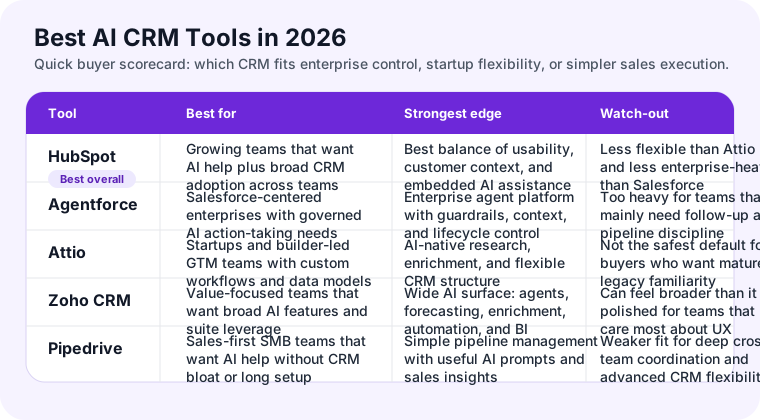
Quick answer: which AI CRM tool should you use?
- Use HubSpot if you want the best overall balance of usability, CRM context, AI assistance, and cross-team adoption.
- Use Salesforce Agentforce if you are an enterprise buyer who needs AI to act inside a governed, Salesforce-centered operating environment.
- Use Attio if you want the most interesting AI-native CRM for startup GTM teams, flexible data models, and custom AI workflows.
- Use Zoho CRM if you want broad AI features, strong value, and a full business-software ecosystem without enterprise-level spend.
- Use Pipedrive if you want a practical sales CRM that keeps pipeline management simple and adds AI where it actually helps.
For most growing teams, HubSpot is the best default AI CRM in 2026 because it stays usable while adding genuinely helpful AI across sales, service, and customer context. If you are operating at enterprise scale inside Salesforce already, Agentforce is the stronger choice. If you want a more modern, flexible, startup-shaped system, Attio is the most interesting alternative.
Why AI CRM is a real buying category now
CRM used to be mostly a storage and process-enforcement layer. That is still part of the job, but the expectation changed. Teams now want the CRM to do more of the mechanical thinking: summarize accounts, enrich records, flag risks, suggest next steps, draft outreach, route work, and keep the system from rotting under messy human habits.
That is why the category is splitting into clearer lanes:
- Enterprise AI CRM platforms focus on governed action-taking, cross-system orchestration, and security controls.
- AI-native modern CRMs focus on flexible data models, embedded research, and faster builder-style workflows.
- Practical SMB CRMs focus on adoption, speed, ease of setup, and enough AI to reduce admin without forcing a replatforming project.
- Suite-led CRMs win when sales, support, marketing, and post-sale teams all need the same customer context.
You can see the same pattern in adjacent categories too. Our AI tools for customer support and customer feedback analysis tools guides both point to the same truth: AI gets more valuable when it can operate on trustworthy customer data instead of a disconnected prompt window.
| Tool | Best for | What it does best | Link |
|---|---|---|---|
| HubSpot | Best overall | Balances CRM usability with AI assistants, prospecting help, and shared customer context across teams | → Visit HubSpot CRM |
| Salesforce Agentforce | Enterprise CRM AI | Brings governed AI agents, unified context, and action-taking into Salesforce-heavy workflows | → Visit Agentforce |
| Attio | AI-native startup teams | Combines flexible CRM data, research, enrichment, and custom AI workflows in a modern system | → Visit Attio |
| Zoho CRM | Value and breadth | Offers wide-ranging AI features, forecasting, automation, and strong ecosystem leverage at sensible pricing | → Visit Zoho CRM |
| Pipedrive | Simple sales execution | Keeps pipeline management approachable while using AI prompts and insights to speed up rep work | → Visit Pipedrive |
HubSpot — Best overall AI CRM for growing teams that want adoption, context, and useful AI in one platform
Website: hubspot.com/products/crm
HubSpot gets the top spot because it solves the most common AI CRM buying problem: teams want help from AI, but they also want a CRM that normal humans will still open every day. HubSpot keeps winning on that balance. The CRM is easy to stand up, the customer platform angle is strong, and Breeze adds assistant-style help, prospecting agents, company research, and AI features that can actually use CRM context instead of operating blind.
That matters more than it sounds. Many teams do not fail with CRM because the software lacks features. They fail because adoption dies, records get stale, and the AI layer ends up floating above bad data. HubSpot's advantage is that it stays relatively understandable while still giving sales, marketing, and service teams a shared system of record.
HubSpot is best for:
- Growing SMB and mid-market teams that want one customer platform rather than a fragile pile of tools
- Teams that want AI help with prospecting, prep, outreach, research, and customer conversations
- Organizations where sales, marketing, and service context need to stay connected
- Buyers who care about adoption almost as much as feature depth
Where HubSpot falls short: it is not the most flexible data model here, and it is not the sharpest enterprise answer if your world already revolves around Salesforce governance. If you want the most builder-friendly modern CRM, Attio is more exciting. If you need more governed enterprise automation, Salesforce is stronger.
Bottom line: HubSpot is the best AI CRM tool in 2026 for most teams because it makes AI useful without making the CRM harder to live in.
Salesforce Agentforce — Best for enterprise teams that need AI agents inside governed CRM workflows
Website: salesforce.com/agentforce
Salesforce Agentforce is the enterprise-shaped answer in this category. Salesforce is not just talking about summaries or copilots anymore. It is explicitly positioning Agentforce as a platform to build, test, deploy, manage, and orchestrate AI agents at scale, with intelligent context, guardrails, and lifecycle supervision. That is a very different buying proposition from "our CRM now has AI too."
The reason it belongs here is simple: many large revenue teams do not need a nicer little CRM. They need AI that can operate inside approvals, customer records, service flows, knowledge systems, and cross-functional process rules without turning governance into an afterthought. Agentforce is strongest when that governed action-taking is the actual requirement.
Salesforce Agentforce is best for:
- Enterprise revenue teams already standardized on Salesforce
- Organizations that need AI agents with guardrails, supervision, and controlled action-taking
- Complex account, service, partner, or multi-system workflows
- Buyers who care more about platform depth than lightweight ease
Where Salesforce Agentforce falls short: it is too much platform for smaller teams that just need pipeline clarity, cleaner follow-up, and better rep leverage. The cost, complexity, and operational gravity are real. If your team does not already benefit from Salesforce depth, this can be an expensive way to buy ambition.
Bottom line: Salesforce Agentforce is the best AI CRM tool here when enterprise control, data gravity, and governed AI action matter more than simplicity.
Attio — Best AI-native CRM for startup GTM teams and flexible builders
Website: attio.com
Attio is the most modern-feeling product in this roundup, and that matters. Its pitch is not "old CRM, now with a smarter textbox." It is an AI-native CRM with embedded research, data classification, summaries, enrichment, relationship intelligence, and builder-friendly workflows. The product is clearly built for teams that want the CRM to feel programmable without turning it into a DevOps project.
This makes Attio especially strong for startups, founder-led GTM teams, venture-backed sales orgs, and operators who hate rigid CRM schemas. The flexible data model is a genuine advantage, and the AI layer is much more interesting when the system can adapt to the way your business actually works instead of forcing everything into legacy objects.
Attio is best for:
- Startups and modern GTM teams that want an AI-native CRM from the start
- Teams that need flexible objects, custom workflows, and rich data enrichment
- Operators who want AI research and relationship intelligence directly in the CRM
- Builders who want to shape the system rather than accept a rigid default
Where Attio falls short: it is not the safest default for every conservative buyer. Some teams still want the maturity, ecosystem breadth, and familiarity of HubSpot or Salesforce. And if you just want a simple sales pipeline tool, Pipedrive may feel easier.
Bottom line: Attio is the best AI CRM tool in 2026 for startup teams that want a CRM designed around modern data and AI workflows instead of retrofitted legacy behavior.
Zoho CRM — Best for broad AI features and value without enterprise-level spend
Website: zoho.com/crm
Zoho CRM earns its spot because the AI story is broader than many buyers realize. Zia now covers agents for sales, generative setup help, module creation, forecasting, anomaly detection, recommendations, data enrichment, email assistance, call transcription, and business intelligence. That is a big surface area, and Zoho pairs it with a long-standing value story and a large surrounding software ecosystem.
The key appeal is practical breadth. Not every buyer wants to pay Salesforce prices or stitch together multiple point solutions to get decent automation, reporting, and AI support. Zoho is attractive when you want a lot of capability in one stack and you care about cost discipline, privacy posture, and being able to grow without a major vendor shock later.
Zoho CRM is best for:
- Budget-conscious teams that still want substantial AI capability
- Businesses that want forecasting, automation, enrichment, and sales-assist features in one place
- Organizations already leaning toward the broader Zoho ecosystem
- Teams that want more power than a simple CRM but less platform burden than Salesforce
Where Zoho CRM falls short: the product can feel broader than it is elegant. Buyers who care most about polish or the cleanest modern UX may prefer HubSpot, Attio, or Pipedrive. And truly large enterprise teams may still prefer Salesforce-level governance depth.
Bottom line: Zoho CRM is the best AI CRM tool here for buyers who want a lot of AI and business-software leverage without paying for a heavyweight enterprise stack.
Pipedrive — Best for straightforward sales teams that want AI help without CRM bloat
Website: pipedrive.com
Pipedrive keeps showing up because a lot of teams are not trying to buy a digital-labor platform. They are trying to close deals. Pipedrive stays focused on pipeline visibility, follow-up discipline, automation, and built-in AI prompts and insights that help reps move faster without making the whole product feel heavier than the sales process itself.
That restraint is valuable. Many AI CRM buying decisions get distorted by roadmap theater. Pipedrive is much less ambitious in tone than Salesforce or Zoho, but for many SMB teams that is exactly why it works. If your real problem is that opportunities slip, follow-ups get missed, and the pipeline becomes messy, simpler is often better.
Pipedrive is best for:
- Small and midsize sales teams that want a clean, sales-first CRM
- Organizations that value simple pipeline visibility and follow-up structure
- Teams that want AI suggestions and automation without a heavy implementation project
- Buyers who care about usability and speed more than giant-platform ambition
Where Pipedrive falls short: it is not the strongest fit if you need deeper cross-functional customer-platform coordination, more advanced AI orchestration, or highly flexible custom data models. HubSpot, Salesforce, or Attio will be stronger when those needs dominate.
Bottom line: Pipedrive is the best AI CRM tool in 2026 for teams that want practical help closing deals, not a bigger software identity crisis.
How to pick the right AI CRM
- You want the best overall balance of usability, AI help, and customer-platform context: HubSpot
- You need enterprise AI agents with governance, supervision, and Salesforce gravity: Salesforce Agentforce
- You want an AI-native modern CRM for startup GTM work: Attio
- You want broad functionality and strong value: Zoho CRM
- You want a simple sales CRM with just enough AI to reduce rep admin: Pipedrive
If your stack question is wider than CRM, read our sales-teams guide and workflow automation guide. Many teams need one CRM, one conversation-intelligence layer, and one automation layer — not one tool pretending to be all three.
What not to do with AI CRM tools
- Do not buy an "AI CRM" just because the demo talks a lot. Ask what data the AI can actually use and what actions it can reliably take.
- Do not assume embedded AI fixes poor CRM hygiene. Bad records still poison good suggestions.
- Do not buy enterprise platform complexity when your real need is simple pipeline discipline and better follow-up.
- Do not ignore privacy, permissions, and governed action-taking if customer data is sensitive or regulated.
- Do not confuse sales-assistant features with a full CRM decision. Prospecting, call intelligence, and CRM are adjacent layers, not identical ones.
Verdict
HubSpot is the best AI CRM tool in 2026 for most businesses because it keeps the CRM usable while adding AI that can actually help with prospecting, preparation, customer context, and follow-through.
Salesforce Agentforce is the strongest enterprise answer. Attio is the best AI-native CRM for startup and builder teams. Zoho CRM is the best value-heavy broad-feature option. Pipedrive is the best practical sales-first choice for teams that do not want platform bloat.
The smartest question is not "which AI CRM has the most AI?" It is whether you need governed enterprise action-taking, startup-grade flexibility, suite-level customer context, or just a CRM that helps reps sell without turning admin into a second job. Buy for that bottleneck and this category becomes much easier.