The best AI customer feedback analysis tools in 2026 do more than count keywords in surveys. The useful ones unify support tickets, app reviews, call notes, NPS comments, CRM notes, and product feedback into one layer you can actually act on. That is the real buyer problem now: not getting more feedback, but finding the patterns fast enough to change retention, roadmap, and support decisions before the damage spreads.
This category is moving fast right now. Direct product-source checks today show Chattermill leaning hard into AI-powered VoC and metric-linked feedback analysis, Enterpret positioning itself as customer intelligence for the AI era, Unwrap pushing automatic trend surfacing without manual tagging, Thematic focusing on scalable text feedback analytics for enterprise teams, and SentiSum leaning into AI-native retention and churn-warning workflows. That is a real freshness signal: voice-of-customer software is shifting from dashboard reporting toward AI customer intelligence that teams can actually use every week.
If your main job is deciding what product teams should build next, start with our AI tools for product managers guide. If your pain sits closer to ticket volume and recurring support failures, our AI tools for customer support roundup is the better adjacent read. And if your team lives or dies on retention, the AI tools for customer success guide gives the wider stack around post-sale execution.
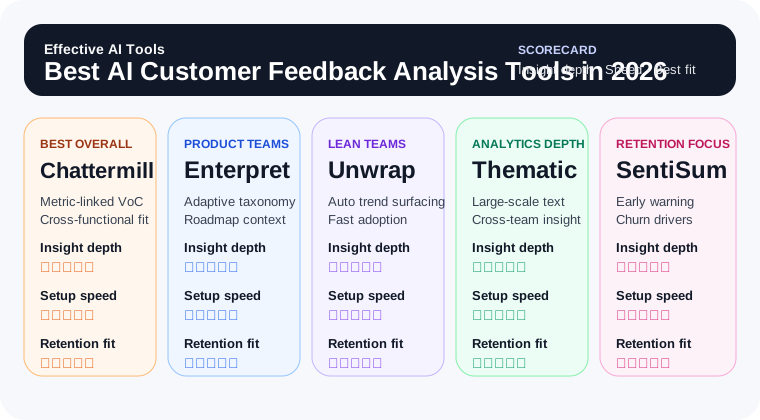
Quick answer: which AI customer feedback analysis tool should you use?
- Use Chattermill if you want the best overall AI customer feedback analysis platform for mature CX, support, and product organizations.
- Use Enterpret if product teams need feedback tied to themes, features, and business impact instead of another reporting layer.
- Use Unwrap if you want fast setup, strong automatic trend detection, and an AI-native tool that lean teams will actually use.
- Use Thematic if you need deeper multi-channel text analytics and cross-functional reporting across large organizations.
- Use SentiSum if support and retention are the core job, especially when you need early warning on churn-driving issues.
For most teams, Chattermill is the best AI customer feedback analysis tool in 2026. For product-led companies, Enterpret is the most compelling product-and-CX bridge. For support-heavy organizations trying to catch issues earlier, SentiSum stands out.
Why AI customer feedback analysis tools matter right now
Most companies already have plenty of customer feedback. They just do not have a clean way to turn it into action. The data is scattered across surveys, Intercom threads, Zendesk tickets, Gong calls, app store reviews, Slack escalations, and account notes. Teams end up trapped between two bad options: manual tagging that nobody maintains, or static dashboards that show there is a problem without explaining why.
That is why this buyer category is getting more interesting. The best AI customer feedback analysis tools now try to solve four separate problems at once:
- Unification: pull customer signals from many sources into one place.
- Classification: cluster messy language into themes people can trust.
- Prioritization: connect those themes to business impact, churn, roadmap, or support load.
- Accessibility: make the insights visible to product, support, CX, and leadership without needing a dedicated analyst every time.
The same broader pattern shows up in our AI tools for operations teams guide too: teams are buying AI that compresses coordination work, not just software that produces prettier charts.
| Tool | Best for | What it does best | Link |
|---|---|---|---|
| Chattermill | Mature CX and VoC programs | Unifies fragmented feedback, links themes to metrics, and helps teams prioritize what changes customer outcomes | → Visit Chattermill |
| Enterpret | Product-led feedback intelligence | Builds adaptive taxonomies and ties customer signals to features, reasons, and product decisions | → Visit Enterpret |
| Unwrap | Lean teams that need fast value | Surfaces trends automatically, reduces manual tagging, and makes feedback insight easy to share across the company | → Visit Unwrap |
| Thematic | Large-scale text analytics | Handles unstructured feedback across channels and helps enterprises distribute decision-ready customer intelligence | → Visit Thematic |
| SentiSum | Support and retention teams | Flags churn-driving issues early and pushes AI-native VoC insights into operational workflows | → Visit SentiSum |
Chattermill — Best overall for mature customer feedback analysis
Website: chattermill.com
Chattermill gets the top spot because it feels closest to what most serious buyers actually want from AI customer feedback analysis tools now: one place to centralize fragmented feedback, ask clear questions, connect themes to metrics like NPS or CSAT, and prioritize the issues that matter most. Its current positioning is unusually direct about that. The product emphasizes unifying all feedback sources, clustering unstructured feedback with AI, generating summaries grounded in customer evidence, and surfacing anomalies before teams miss them.
That makes Chattermill a strong fit for organizations that are already beyond “should we collect feedback?” and into “how do we operationalize it across the business?” If you have separate CX, support, and product stakeholders all touching the same signals, Chattermill’s structure is compelling.
Chattermill is best for:
- CX and VoC teams that need a single source of customer truth
- Organizations that care about linking themes to loyalty or satisfaction metrics
- Businesses that want prioritization, not just passive reporting
- Cross-functional teams spanning product, support, and operations
Where Chattermill falls short: it is not the obvious lightweight choice for a very small team that just wants quick weekly review analysis. Its strengths make the most sense when you already have enough customer volume and enough organizational complexity to justify a more serious feedback intelligence layer.
Bottom line: Chattermill is the best AI customer feedback analysis tool in 2026 for teams that want mature VoC infrastructure instead of a thin sentiment dashboard.
Enterpret — Best for product teams that need customer intelligence tied to real decisions
Website: enterpret.com
Enterpret stands out because it is not selling generic “insights” language. Its product story is much more about turning customer feedback into structured, evolving intelligence around features, reasons, business context, and measurable outcomes. The platform’s adaptive taxonomy positioning is important here. A lot of feedback software breaks once the categories stop matching how your business actually thinks. Enterpret is trying to solve that with AI that learns and refines the structure over time.
That makes it especially interesting for product-led organizations. If your PMs, product ops, and CX teams need one place to connect tickets, reviews, and call notes to roadmap tradeoffs, Enterpret looks stronger than the average VoC dashboard. It also pairs naturally with the workflows in our product manager AI tools guide, where the hard part is usually prioritization, not idea generation.
Enterpret is best for:
- Product teams prioritizing features from messy customer signals
- Product ops teams that need structure without endless manual tagging
- Companies that want product and CX teams working from the same evidence
- Organizations that care about tying feedback to business impact
Where Enterpret falls short: if your main use case is frontline support triage or churn warning rather than product intelligence, a more support-native platform may fit better. It also looks more compelling when the company already acts on product feedback systematically.
Bottom line: Enterpret is one of the best AI customer feedback analysis tools in 2026 when the real goal is better roadmap and product decisions, not just nicer reports.
Unwrap — Best for lean teams that want fast setup and automatic trend detection
Website: unwrap.ai
Unwrap earns a place here because it leans hard into a problem buyers actually feel: no one wants to babysit tagging rules forever. The product pitch is blunt in the right way — proactive insights, zero manual work, automatic surfacing of trends, and alerts that catch issues before teams would have noticed them. That is a strong value proposition for companies that want customer intelligence without building a whole internal analysis process around it.
Unwrap also feels more accessible than many enterprise-style customer intelligence platforms. The positioning around transparency, automatic issue detection, and wide cross-org use suggests a tool that wants decision-makers to read the output directly instead of routing everything through a specialized insights function first. That is useful for fast-moving companies where support, product, and leadership all need the same signal quickly.
Unwrap is best for:
- Lean teams that need customer feedback analytics fast
- Companies that want automatic issue detection and digest-style reporting
- Organizations trying to eliminate manual tagging work
- Product and support leaders who need easy adoption across teams
Where Unwrap falls short: it may not be the ideal choice for buyers who want a heavier enterprise governance layer or extremely customized taxonomy control from day one. It is strongest when speed and usable insight matter more than maximum platform complexity.
Bottom line: Unwrap is the best AI customer feedback analysis tool here for teams that want real signal quickly and do not want to hire a process around the software.
Thematic — Best for large-scale multi-channel text feedback analytics
Website: getthematic.com
Thematic is the most obviously analysis-heavy option in this list. Its messaging centers on AI-powered text feedback analytics, one trusted source of customer truth, and decision-ready insights for multiple teams across the organization. The use-case coverage is broad in a good way: CX, support, product feedback, insights and research, marketing, even compliance and risk. That suggests a platform designed for companies that need one analysis layer serving many functions.
Thematic also makes a strong case when the real bottleneck is scale. If you are trying to convert hundreds of thousands of comments, tickets, or survey responses into usable patterns, a platform built around unstructured text analytics can be more credible than a lighter “AI assistant for feedback” product.
Thematic is best for:
- Enterprises handling large volumes of open-text feedback
- Insights teams that need customer intelligence shared across departments
- Support, product, and research teams working from the same feedback pool
- Organizations that want stronger text analytics depth
Where Thematic falls short: it is probably more platform than a small company needs. If you just want lean weekly detection of customer pain points, it may feel heavier than faster AI-native tools built for smaller operating teams.
Bottom line: Thematic is one of the best AI customer feedback analysis tools in 2026 if your main challenge is scale, complexity, and cross-functional distribution of insight.
SentiSum — Best for support-led teams focused on churn and retention risk
Website: sentisum.com
SentiSum is the most retention-and-support-native product in the group. Its positioning is explicit: unify every customer signal, know why customers churn, fix issues fast. The current product story goes further than standard VoC language too. SentiSum talks about AI agents that warn early, explain why churn is rising, and distribute insights into Slack, Teams, and Copilot instead of trapping them in dashboards. That is important because many support organizations do not need one more place to read reports. They need earlier operational visibility.
If your main pain is recurring support issues that quietly drive churn, SentiSum makes a lot of sense. It looks especially relevant for teams where support, customer care, and retention are tightly connected. It also complements the workflows in our customer success AI tools guide, because churn prevention is rarely solved by a dashboard alone.
SentiSum is best for:
- Support leaders trying to catch churn drivers earlier
- Customer care teams that need one source of truth across tickets, calls, surveys, and reviews
- Retention-focused organizations that want operational alerts, not just analysis
- Teams that want insights delivered in existing workflows instead of buried in a BI tool
Where SentiSum falls short: if your real priority is product roadmap intelligence or broad enterprise insights distribution, another platform may be a better fit. SentiSum looks strongest when support and retention are the center of gravity.
Bottom line: SentiSum is the best AI customer feedback analysis tool here for support-led organizations trying to reduce churn, catch emerging problems early, and move faster on customer pain.
Pricing and buying reality
One thing buyers should expect here: most serious AI customer feedback analysis tools are not bought like a $29 self-serve browser extension. This is mostly demo-led software. That does not mean the category is bad. It just means your real evaluation criteria should be sharper:
- How fast can the tool ingest your actual feedback sources?
- Can the taxonomy adapt to your business, or will you spend months repairing it?
- Do product, support, and CX teams all trust the output?
- Can the platform explain why a trend matters, not just that it exists?
- Will insights show up where your team already works?
If your organization is still early, do not overbuy. Sometimes the better move is pairing one lighter customer intelligence platform with the broader workflows from our operations guide instead of jumping straight into a heavyweight enterprise rollout.
How to pick the right AI customer feedback analysis tool
- You want the best overall VoC and customer feedback analytics platform: Chattermill
- You want product feedback intelligence tied to roadmap decisions: Enterpret
- You want fast setup and automatic trend detection: Unwrap
- You need enterprise-scale text feedback analytics: Thematic
- You care most about support issues, churn, and retention: SentiSum
The right question is not “which AI customer feedback analysis tool has the fanciest AI?” It is whether your bottleneck is cross-functional visibility, product prioritization, speed, analytical depth, or churn prevention. Buy for that bottleneck and the category gets much easier.
What not to do with AI customer feedback analysis tools
- Do not buy based only on sentiment-analysis claims. That is table stakes now.
- Do not assume “unified feedback” means your teams will actually use the tool.
- Do not ignore workflow delivery. Insights trapped in a dashboard die there.
- Do not let a vendor sell you generic AI summaries if your real need is prioritization and root-cause clarity.
- Do not forget governance, security, and PII handling if customer conversations are flowing through the platform.
Verdict
Chattermill is the best AI customer feedback analysis tool in 2026 for most serious teams. It has the clearest balance of unified feedback ingestion, prioritization, and metric-linked customer intelligence.
Enterpret is the strongest product-team choice. Unwrap is the best fast-value AI-native option for lean teams. Thematic is the best fit for large-scale text analytics. SentiSum is the most compelling support-and-retention pick.
The category is worth paying attention to because it solves a real problem: turning too much customer feedback into a smaller number of better decisions. That is a much better use of AI than pretending another chatbot tab is strategy.