The best AI email assistants in 2026 do a lot more than rewrite a sentence. The useful ones now sort the inbox, summarize long threads, draft replies in your voice, find buried context, schedule follow-ups, and reduce the low-value admin that makes email feel heavier than it should.
That is why this category feels more commercially real right now. The vendor positioning has shifted from generic “AI writer” claims to fuller inbox workflow help. Superhuman is pushing auto labels, auto archive, instant replies, and AI search across inbox plus calendar. Shortwave is leaning into AI filters, cross-tool automation, and Gmail-native workflow control. Gemini in Gmail is now positioned as a proactive inbox assistant with thread summaries and natural-language inbox search. Fyxer is selling voice-matched drafts plus meeting follow-up. Missive is still more collaboration-first than AI-first, but for teams running on shared email it now has enough AI editing to stay in the conversation.
If you mostly want prompts to improve your own writing, our ChatGPT email prompts guide is the better fit. If you want broader inbox help inside an assistant-heavy workflow, pair this with our AI tools for executive assistants guide. And if your bigger question is how email fits into client work and follow-through, our AI tools for consultants roundup is worth reading too.
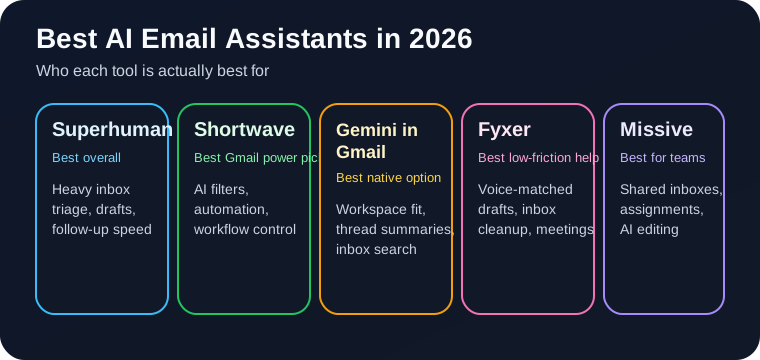
Quick answer: which AI email assistant should you use?
- Use Superhuman if you live in email all day and want the strongest premium AI-native inbox for triage, drafting, and follow-up speed.
- Use Shortwave if you want the most flexible Gmail-centered AI automation stack with strong inbox organization.
- Use Gemini in Gmail if your team already lives in Google Workspace and you want AI help without adding another email app.
- Use Fyxer if you mainly want fast drafting, automatic organization, and meeting follow-up without much setup.
- Use Missive if the real problem is shared inbox coordination and ownership, not just writing faster.
For most heavy individual inbox users, Superhuman is the best default AI email assistant in 2026. If you want more automation flexibility and deeper Gmail workflow control, Shortwave is the stronger buy. If you do not want to switch inboxes at all, Gemini in Gmail is the cleanest choice.
Why AI email assistants matter right now
Email remains one of the last big daily productivity drains because it mixes writing, search, prioritization, scheduling, and task management into one noisy place. That makes it a perfect AI category — but only if the product does more than polish prose.
The stronger tools now understand that. Buyers are asking better questions too: Can this help me clear the inbox faster? Can it find context without manual search? Can it draft useful replies instead of generic slop? Can it work for teams, not just solo users? That is a better buying lens than “which email app has AI?”
You can see the same shift in adjacent categories. Our AI meeting assistant comparison covers the meeting side of capture and follow-up, while our guide to writing better emails with ChatGPT is still useful if you want manual control without paying for a full AI-native inbox. This article is about the buyer decision when you want email itself to become more intelligent.
Superhuman — Best overall for high-volume individual inboxes
Website: superhuman.com
Superhuman takes the top spot because it has the clearest AI-native inbox story for people who already know email is one of their biggest daily bottlenecks. The value is not just that it writes. It auto-labels, auto-archives, summarizes threads, reminds you to follow up, and lets you ask for inbox answers in plain English.
That combination matters because high-volume email users are not usually suffering from a blank-page problem. They are suffering from triage overload. Superhuman is built around that reality. It feels opinionated in a good way: fast, premium, and focused on people who want an inbox that gets out of the way.
Superhuman is best for:
- Founders, executives, operators, and sales-heavy professionals buried in email
- People who value triage speed as much as drafting help
- Users who want summaries, follow-up reminders, and AI search in one product
- Buyers willing to pay for a premium email experience instead of a basic add-on
Where Superhuman falls short: if you want broader workflow automation, deeper Gmail customization, or stronger team/shared inbox handling, Shortwave or Missive may fit better.
Bottom line: Superhuman is the best AI email assistant in 2026 if your problem is personal inbox load and you want the sharpest all-around speed upgrade.
Shortwave — Best for Gmail power users who want AI automation
Website: shortwave.com
Shortwave earns its spot because it goes well beyond “AI helps you draft email.” Its current positioning is stronger than that: AI filters, AI-powered search, inbox bundles, cross-tool integrations, scheduling help, and plain-English scripts that can label, star, archive, and automate work inside the inbox.
That makes Shortwave especially good for people who want Gmail to behave more like an intelligent work surface. It is not as flashy or prestige-coded as Superhuman, but it may be the more flexible product for operators who care about workflow shape as much as personal speed.
Shortwave is best for:
- Gmail-heavy users who want more control over inbox automation
- People who want AI filters and organization rules without manual setup overhead
- Teams that want shared prompts, templates, and searchable archives
- Users who like the idea of email connecting into Slack, Notion, Asana, HubSpot, and more
Where Shortwave falls short: if you want the most polished premium solo-email experience, Superhuman feels sharper. If you want zero inbox migration, Gmail with Gemini is simpler.
Bottom line: Shortwave is the best AI email assistant for people who want Gmail plus serious AI workflow control, not just prettier replies.
Gemini in Gmail — Best if you already live in Google Workspace
Website: workspace.google.com/gmail
Gemini in Gmail is the easiest recommendation for people who do not want yet another inbox tool. Google is now framing it as a proactive inbox assistant: write and polish emails, summarize long threads with AI Overviews, and ask natural-language questions across your inbox to get answers without manually digging.
That matters because a lot of buyers do not need the best standalone email app. They need good-enough AI help in the place they already work, with the rest of Google Workspace close by. If your team already runs on Gmail, Calendar, Docs, Meet, and Drive, there is real value in keeping the workflow native.
Gemini in Gmail is best for:
- Google Workspace teams that want native AI help
- Users who care most about thread summaries and natural-language inbox search
- People who do not want to switch email clients just to get AI assistance
- Organizations that prefer staying inside a familiar admin and security model
Where Gemini in Gmail falls short: if you want a more aggressively optimized inbox workflow, Superhuman and Shortwave still feel more purpose-built. Gmail’s AI is helpful, but it is not as opinionated about clearing the inbox for you.
Bottom line: Gemini in Gmail is the smartest choice when convenience, Workspace fit, and native deployment matter more than chasing the most specialized email app.
Fyxer — Best for fast drafting and low-friction inbox cleanup
Website: fyxer.com
Fyxer stands out because its value proposition is unusually simple: organize the inbox automatically, draft replies in your voice, and plug itself into meetings so notes and follow-up emails show up fast. That is narrower than Superhuman or Shortwave, but it also makes the product easier to understand.
This is appealing for buyers who do not want to become power users of a whole new inbox system. Fyxer’s pitch is basically “connect your account and get time back.” For a lot of busy professionals, especially people doing constant meeting follow-up, that is a more realistic buying trigger than advanced scripting or deep workflow tuning.
Fyxer is best for:
- Busy professionals who mainly want drafts, organization, and follow-up help
- People who care about voice-matched email generation
- Meeting-heavy users who want notes and follow-up emails pushed back into inbox flow
- Buyers who want minimal setup and fast visible value
Where Fyxer falls short: if you want broader automation, more robust search, or better shared-team workflow handling, Superhuman, Shortwave, or Missive are stronger.
Bottom line: Fyxer is one of the best AI email assistants in 2026 if your biggest pain is not email philosophy — it is simply getting through the admin faster.
Missive — Best for teams that run on shared inboxes
Website: missiveapp.com
Missive makes the list because some buyers do not really need an “AI email assistant.” They need a system for coordinating customer conversations, assigning ownership, drafting together, and keeping internal discussion attached to the email instead of scattered across Slack.
That is where Missive is strongest. Its AI story is lighter than Superhuman or Shortwave, but it does include AI editing and sits inside a much stronger collaboration surface with assignments, internal comments, team spaces, tasks, rules, and multi-channel messaging. For many teams, that matters more than having the fanciest rewrite button.
Missive is best for:
- Teams handling shared inboxes and collaborative drafting
- Businesses that need ownership, workload visibility, and internal context on email threads
- Ops, support, and admin teams whose work still runs through email
- Buyers who want AI editing inside a broader inbox-collaboration product
Where Missive falls short: if you want the strongest individual AI triage and drafting experience, Superhuman or Shortwave are better category leaders. Missive is more about coordination than personal email acceleration.
Bottom line: Missive is the right pick when your email problem is team execution, not just faster phrasing.
What about Outlook Copilot or Spark?
Microsoft 365 Copilot absolutely matters if your organization is already all-in on Outlook, Teams, and the Microsoft Graph. I did not put it in the top five because its buying decision is usually bigger than email alone. You are often really buying into the wider Microsoft work stack, governance model, and enterprise workflow story.
Spark is also still worth a look if your main interest is inbox focus, smart organization, and lighter AI writing help. It is just not as strong on the broader AI-assistant story as the top picks above.
How to pick the right AI email assistant
- You want the best premium solo inbox upgrade: Superhuman
- You want the most flexible Gmail-centered automation: Shortwave
- You want native AI inside your existing Google inbox: Gemini in Gmail
- You want low-friction drafting and follow-up help: Fyxer
- You want team coordination on shared email: Missive
If your real goal is improving the quality of individual replies without switching tools, start with these email prompts for ChatGPT. If your inbox pain is driven by meetings, our AI meeting assistant comparison may solve more of the root problem than another email app.
What not to do with AI email assistants
- Do not judge the tool only on how polished one generated reply looks. Triage, search, follow-up, and task handoff matter more over time.
- Do not ignore privacy and deployment questions if your inbox contains sensitive work. Native ecosystem fit may matter more than clever drafting.
- Do not buy a team product when your real problem is personal inbox overload — or vice versa.
- Do not assume “AI in email” means the category is mature. Many tools still solve only one slice of the actual inbox problem.
Verdict
Superhuman is the best AI email assistant in 2026 for most heavy email users. It has the strongest overall mix of triage speed, drafting help, summaries, search, and follow-up support.
Shortwave is the more flexible Gmail automation buy. Gemini in Gmail is the smartest no-switch option for Workspace teams. Fyxer is a good low-friction assistant for drafting and follow-up. Missive wins when collaboration is the real bottleneck.
The right question is not “which AI email assistant is smartest?” It is whether your inbox problem is personal overload, Gmail workflow automation, ecosystem fit, low-friction follow-up, or team coordination. Buy for that problem and the category gets much easier.