The best AI knowledge management tools in 2026 are not just old wikis with a chatbot stapled on top. The useful ones help teams find answers across scattered systems, respect permissions, cite where information came from, and keep company knowledge from rotting the second the docs stop being pristine.
This category is getting sharper because buyers are done paying for “documentation” that still leaves employees asking the same question in Slack five times a week. Glean now positions itself as Work AI with assistants, agents, search, and 100+ connectors. Atlassian Rovo is pushing search, chat, agents, and studio on top of Jira, Confluence, and service workflows. Guru is leaning hard into an AI source of truth built on verified company knowledge with citations. Notion AI has expanded into enterprise search, connectors, meeting notes, and custom agents. Slite is going after the adoption problem directly with doc verification, AI search, and a cleaner knowledge-base experience. That is the real shift: knowledge management is moving from “where did we store the doc?” to “can the team get the right answer fast enough to use it?”
If your real problem is mostly personal notes or meeting memory, start with our guide to the best AI note-taking apps. If you care more about what happens after the team finds an answer, pair this with our best AI workflow automation tools guide. And if you are still choosing the general assistant that will sit around the knowledge layer, read ChatGPT vs Claude in 2026 first.
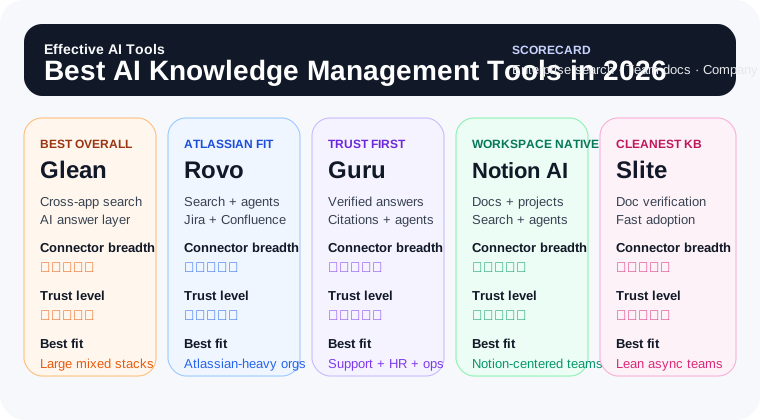
Quick answer: which AI knowledge management tool should you use?
- Use Glean if you want the best overall enterprise search and AI answer layer across a messy multi-tool company stack.
- Use Atlassian Rovo if your company already lives in Jira, Confluence, and Jira Service Management and you want knowledge search plus agents inside that ecosystem.
- Use Guru if you want verified answers, citations, and a trust-first internal knowledge system for support, sales, HR, and operations teams.
- Use Notion AI if your docs, projects, and team memory already live in Notion and you want knowledge management inside the workspace people actually use.
- Use Slite if you want the cleanest adoption-friendly AI knowledge base that helps smaller teams stay organized instead of creating another doc graveyard.
For most larger teams, Glean is the best default AI knowledge management tool in 2026 because it handles the hardest version of the problem: information spread across too many systems. If you are already standardized on Atlassian, Rovo is the sharper platform fit. If trust and answer quality matter more than the broadest connector footprint, Guru is the strongest lighter-weight pick.
Why AI knowledge management became its own buying category
Most teams do not really have a documentation problem. They have a retrieval, trust, and maintenance problem. The information technically exists somewhere, but nobody is sure whether it is current, whether it applies to their role, or whether the answer in one system conflicts with the answer in another.
That is why this category now splits into clearer lanes:
- Cross-app enterprise search platforms pull context from many business systems and answer questions across them.
- Suite-native knowledge layers work best when your company is already standardized on one ecosystem like Atlassian or Notion.
- Verified-answer platforms matter when trust, citations, and governance are more important than the biggest integration map.
- Documentation-first tools matter when the biggest pain is not search breadth but keeping the knowledge base clean enough to use.
- Agent-ready knowledge systems matter because internal search is increasingly becoming context infrastructure for AI workflows, not just human lookup.
You can see the adjacency clearly. Our AI tools for operations teams guide ends up circling the same problem from the execution side. Our AI tools for project managers guide runs into it from status visibility and handoff pain. Knowledge management matters now because AI makes bad internal memory much more obvious, not less.
| Tool | Best for | What it does best | Link |
|---|---|---|---|
| Glean | Best overall | Turns scattered company systems into a permission-aware AI search and answer layer with broad connector coverage | → Visit Glean |
| Atlassian Rovo | Atlassian-native teams | Brings search, chat, agents, and workflow context into Jira, Confluence, and service operations | → Visit Atlassian Rovo |
| Guru | Verified answers | Delivers citation-backed internal answers from verified company knowledge with a lighter operational footprint | → Visit Guru |
| Notion AI | Workspace-native knowledge | Combines docs, projects, enterprise search, meeting notes, and AI agents inside one workspace | → Visit Notion AI |
| Slite | Clean documentation and adoption | Helps teams keep documentation usable with verification workflows, AI ask, and a simpler knowledge-base experience | → Visit Slite |
Glean — Best overall AI knowledge management tool for companies with information everywhere
Website: glean.com
Glean gets the top spot because it is built for the ugliest version of the internal-knowledge problem: the truth is spread across Slack, Google Drive, Confluence, Jira, Salesforce, email, tickets, docs, and half a dozen other systems that nobody wants to migrate into one giant wiki. Glean's current pitch is direct: give every employee an AI assistant and agents that put company knowledge to work. The 100+ connector story matters because most knowledge management failures happen before the search even begins — the information is fragmented.
What makes Glean compelling is that it is no longer just search. It is trying to become the answer and action layer on top of enterprise context. That is a better fit for modern teams because they do not just want a ranked list of files. They want a fast answer, grounded in the systems they already use, without opening ten tabs and guessing which doc is current.
Glean is best for:
- Mid-market and enterprise teams with knowledge spread across many apps
- Organizations that need permission-aware enterprise search
- Companies treating internal knowledge as AI infrastructure, not just documentation
- IT, operations, support, and cross-functional teams tired of context switching
Where Glean falls short: it is usually the heavier and more enterprise-flavored buy. Smaller teams that mostly live in one workspace may not need this much connector breadth or platform overhead.
Bottom line: Glean is the best AI knowledge management tool in 2026 for organizations that need one answer layer across a messy real-world stack, not just a prettier wiki.
Atlassian Rovo — Best for teams already running on Jira, Confluence, and service workflows
Website: atlassian.com/software/rovo
Atlassian Rovo is the sharpest platform-specific buy in this category because it does not ask you to imagine a generic knowledge layer floating in space. It is built around the reality that many product, engineering, IT, and operations teams already live inside Atlassian. Atlassian's current positioning centers on Search, Chat, Agents, and Studio, with Rovo now available across eligible Standard, Premium, and Enterprise cloud plans for Jira, Confluence, and Jira Service Management customers.
That matters because knowledge management is much easier when the system of work and the system of knowledge are already tied together. Rovo is especially attractive if your team already relies on Confluence for documentation and Jira for delivery. In that environment, AI knowledge search is not a separate side project. It becomes part of how issues get resolved, how incidents get handled, and how project context gets reused.
Atlassian Rovo is best for:
- Engineering, product, IT, and service teams already standardized on Atlassian Cloud
- Organizations that want search, chat, and agents close to actual workflows
- Teams that care about security posture and admin controls inside an existing suite
- Buyers who want less tool sprawl rather than another standalone knowledge product
Where Atlassian Rovo falls short: if your company knowledge does not mostly live in Atlassian-adjacent systems, the suite fit becomes less compelling. Teams looking for the broadest independent enterprise-search layer may still prefer Glean.
Bottom line: Atlassian Rovo is the best AI knowledge management tool here when the smartest move is to deepen the stack you already run instead of adding another separate platform.
Guru — Best for verified answers and trust-first internal knowledge
Website: getguru.com
Guru earns its spot because it stays focused on the trust problem. Its current homepage says the quiet part out loud: ask, chat, and research using verified company knowledge, always cited and always secure. That is the right angle. A lot of AI knowledge tools can generate something plausible. Far fewer can make employees actually trust the answer enough to act on it.
That makes Guru especially appealing for teams where bad internal answers are expensive. Support teams need policy accuracy. HR teams need clean answers around benefits and process. Sales teams need current messaging and objection handling. Operations teams need fewer contradictions. Guru's citation-first and verification-first posture is not just a marketing detail. It is the difference between a helpful assistant and an AI system people quietly work around.
Guru is best for:
- Support, HR, sales, and operations teams that need trusted internal answers
- Organizations that value verification and citations over maximum connector sprawl
- Companies that want AI knowledge agents without committing to the heaviest enterprise-search platform
- Teams trying to reduce repeat internal questions without generating more uncertainty
Where Guru falls short: it is less obviously the answer if you want the biggest cross-app enterprise-search story or deep suite-native workflow leverage. Glean and Rovo are stronger at those extremes.
Bottom line: Guru is the best AI knowledge management tool in 2026 for teams that care most about trustworthy answers people can actually rely on.
Notion AI — Best for teams that want docs, project context, and knowledge in one workspace
Website: notion.com/product/ai
Notion AI belongs in this roundup because a lot of companies do not want a separate enterprise-search product if the work, docs, wikis, and project context already live in the same system. Notion's current AI stack now stretches beyond writing help into Enterprise Search, AI connectors, AI Meeting Notes, Notion Agent, and Custom Agents. That matters because knowledge management is better when the documentation layer sits close to the actual operating system of the team.
Notion AI is strongest when the company has already committed to using Notion as a shared workspace rather than a loose note app. In that case, AI knowledge retrieval is more valuable because the system already contains project docs, policies, operating notes, meeting capture, and task context. You are not just searching a knowledge base. You are searching the team's working memory.
Notion AI is best for:
- Teams already using Notion for docs, wikis, projects, and internal operating context
- Organizations that want enterprise search inside a broader workspace rather than as a separate layer
- Smaller and mid-sized teams trying to avoid tool sprawl
- Knowledge-heavy teams that want docs, meetings, tasks, and AI in one place
Where Notion AI falls short: if the real company memory is still fragmented across many non-Notion systems, Notion is not the cleanest answer. Glean is better for heterogeneous sprawl, and Guru is often better when answer verification is the main buying filter.
Bottom line: Notion AI is the best AI knowledge management tool here for teams whose smartest move is to make the workspace they already use more searchable, more agent-capable, and more useful.
Slite — Best for teams that want a cleaner knowledge base people will actually maintain
Website: slite.com
Slite stands out because it attacks one of the most common knowledge-management failures: even if the docs start clean, they slowly decay into clutter, outdated pages, and semi-abandoned folders nobody trusts. Slite's current positioning is unusually practical: AI-powered knowledge base, verification reminders, bulk knowledge-management operations, ownership transfer, and Ask for instant answers grounded in trusted docs. That is exactly the kind of product thinking this category needs.
Slite also looks attractive for teams that want a simpler rollout. Not every company needs a giant enterprise search platform. A lot of companies mainly need one place to document clearly, keep it current, and stop repeating the same questions during onboarding, support handoffs, and routine operations. Slite is strong because it is trying to solve that problem directly instead of pretending every team wants a giant AI platform first.
Slite is best for:
- SMBs and mid-market teams that want a cleaner internal knowledge base
- Remote and distributed teams doing lots of async documentation
- Companies where onboarding and repeated questions are the biggest pain
- Teams that want AI answers without buying a more complex enterprise-search stack
Where Slite falls short: it is not the broadest answer for sprawling enterprise app environments. If you need search across dozens of tools and more agentic enterprise behavior, Glean has the bigger platform story.
Bottom line: Slite is the best AI knowledge management tool in 2026 for teams that mainly need documentation to stay useful, searchable, and easy to adopt.
What about SharePoint, Google Drive, or plain Confluence without a dedicated AI knowledge layer?
They still matter. SharePoint, Google Drive, and plain Confluence are often where the knowledge already lives. For some teams, that is enough. But storage is not the same thing as a usable answer layer.
That is the buyer distinction that matters. If your team is disciplined, well-structured, and relatively small, a clean documentation system plus good habits may be enough. But if people are already losing time because the truth is split across tools, permissions, messages, tickets, and old docs, a dedicated AI knowledge management layer becomes easier to justify fast.
How to pick the right AI knowledge management tool
- You need the strongest cross-app enterprise search layer: Glean
- You already run on Atlassian and want AI close to that workflow: Atlassian Rovo
- You care most about answer trust, verification, and citations: Guru
- You want docs, projects, and knowledge in one workspace: Notion AI
- You want clean documentation and easier adoption without a heavy platform: Slite
If your team's bigger issue is operational follow-through, pair this with the workflow automation comparison. If your knowledge mostly lives in meetings and project updates, also read the AI note-taking guide. The right knowledge tool depends on whether your real bottleneck is sprawl, trust, workflow fit, or doc hygiene.
What not to do with AI knowledge management tools
- Do not confuse “we have a wiki” with “our team can reliably find the right answer.”
- Do not buy enterprise search when the real problem is that nobody maintains the docs at all.
- Do not buy the lightest doc tool if your knowledge is spread across dozens of operational systems.
- Do not ignore permissions and governance. Internal AI answers are only useful if the trust model is real.
- Do not evaluate these tools only on demo quality. Check whether they reduce repeated questions, onboarding time, and context-switching in actual work.
Verdict
Glean is the best AI knowledge management tool in 2026 for most larger organizations because it solves the hardest version of the problem: turning scattered company systems into a usable, permission-aware answer layer.
Atlassian Rovo is the best fit for Atlassian-heavy teams that want search and agents embedded in the suite they already run. Guru is the best trust-first option for verified internal answers. Notion AI is the best workspace-native pick for teams already using Notion as company memory. Slite is the best simpler knowledge-base option for teams that mostly need cleaner docs and better adoption.
The smart buyer question is not “which AI knowledge management tool has the fanciest demo?” It is whether your company mainly needs cross-app search, suite-native workflow context, citation-backed trust, workspace-native memory, or cleaner documentation that stays usable. Buy for that bottleneck and the category gets much easier.