The best AI procurement software in 2026 is not just a chatbot bolted onto intake. The good products are helping teams route requests, validate policy, generate sourcing events, surface contract risk, manage supplier data, and automate negotiation work without turning procurement into a black box.
That is why this category suddenly matters. Zip is pushing AI procurement orchestration across intake, sourcing, P2P, and contract work, including its April 2026 AI Contract Orchestration launch. Levelpath is leaning hard into AI agents for sourcing, contract discovery, and supplier risk after its March 2026 LevelUp conference. ORO is making the case for governed agent ecosystems inside large enterprise procurement workflows. Keelvar is narrowing in on sourcing-heavy teams with Kai and autonomous sourcing. Pactum keeps extending negotiation automation with agentic buyers and its new Requisition Alignment Agent. Buyers are finally getting a real choice between orchestration-first, sourcing-first, and negotiation-first AI procurement platforms.
If your buying problem is narrower than procurement as a whole, start with our guides to the best AI RFP software, best AI contract review software, and best AI workflow automation tools. And if you are still deciding which general-purpose assistant your team uses around writing, analysis, and approvals, read ChatGPT vs Claude in 2026 first.
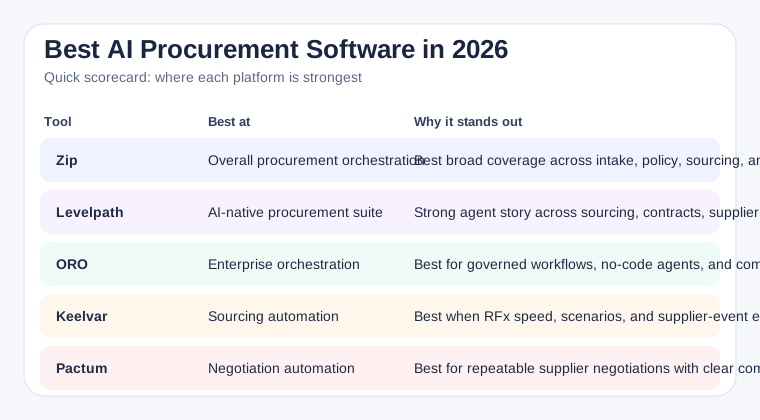
Quick answer: which AI procurement software should you use?
- Use Zip if you want the best overall AI procurement software for intake-to-pay orchestration, policy control, and cross-functional procurement operations.
- Use Levelpath if you want an AI-native procurement platform with strong sourcing, contract discovery, supplier risk, and a modern user experience.
- Use ORO if your biggest problem is large-enterprise process complexity and you need governed agentic workflows across intake, onboarding, risk, and compliance.
- Use Keelvar if sourcing events are the center of your buying motion and you want AI that actually runs events faster, not just summarizes them.
- Use Pactum if your highest-value use case is procurement negotiation automation across large supplier bases and repeatable commercial scenarios.
For most teams, Zip is the best AI procurement software in 2026 because it covers the broadest operational surface area while staying grounded in real procurement work rather than generic AI positioning. Levelpath is the sharpest AI-native challenger if you want more visible agent workflows across sourcing, contracts, and risk. Keelvar and Pactum are better specialist buys when your core need is sourcing automation or negotiation leverage rather than end-to-end procurement orchestration.
Why AI procurement software became a serious buying category
Legacy procurement suites were already overloaded before generative AI arrived. Teams were juggling intake forms, policy review, sourcing events, supplier risk checks, contract back-and-forth, approvals, and payment handoffs across too many systems. AI became useful here because procurement is full of structured but tedious decisions: route this request, check this clause, compare these suppliers, triage this risk, propose this negotiation move.
The recent product movement makes that clear:
- Zip is extending orchestration beyond intake with AI agents and AI Contract Orchestration inside the same workflow stack.
- Levelpath is framing procurement AI around bounded agents that handle RFPs, contract search, supplier discovery, and risk signals.
- ORO is treating procurement AI as an orchestrated workforce with human oversight, custom agent building, and secure integrations.
- Keelvar is focused on sourcing execution, where AI can generate RFIs, recommend suppliers, build scenarios, and shorten event cycles.
- Pactum is pushing the farthest on autonomous commercial negotiation, especially where requests and price terms can be standardized.
This is also why procurement buyers should not evaluate these tools like general copilots. The hard part is not whether the model can write a decent paragraph. It is whether the platform has enough workflow context, data access, auditability, and guardrails to do useful work safely. That same theme shows up in our AI tools for operations teams guide and our AI knowledge management tools roundup: context and governance matter more than flashy demos.
| Tool | Best for | What it does best | Link |
|---|---|---|---|
| Zip | Best overall | Combines intake, sourcing, policy controls, contract workflow, and broader procurement orchestration inside one AI-forward platform | → Visit Zip |
| Levelpath | AI-native procurement suite | Connects sourcing, contracts, supplier discovery, and risk monitoring through configurable AI agents and a modern procurement UX | → Visit Levelpath |
| ORO | Enterprise orchestration | Builds governed, no-code agentic workflows across intake, onboarding, risk, compliance, and cross-system procurement handoffs | → Visit ORO |
| Keelvar | Sourcing-heavy teams | Automates sourcing events, scenario analysis, bid structures, and supplier engagement better than most broad procurement suites | → Visit Keelvar |
| Pactum | Negotiation automation | Scales supplier negotiations with AI agents that validate requisitions, apply policy, and execute repeatable commercial plays | → Visit Pactum |
Zip — Best overall AI procurement software for intake-to-pay orchestration
Website: ziphq.com
Zip gets the top spot because it has the broadest, clearest operational story right now. The platform already had strong procurement orchestration positioning across intake, approvals, sourcing, P2P, and spend controls. What makes it more interesting in 2026 is that the AI story is no longer just request routing and policy suggestions. Zip is now pushing a set of purpose-built procurement agents and launched AI Contract Orchestration in April 2026 to automate supplier contract review, redlining, and compliance inside the procurement flow.
That matters because many procurement teams do not actually want a disconnected “AI sourcing tool” plus a separate “AI contract tool” plus a separate intake workflow layer. They want one operational system that can move work across those steps without creating more coordination overhead. Zip looks strongest when procurement needs to be both faster and more controlled, especially in companies where legal, finance, and procurement all touch the same request.
Zip is best for:
- Teams that want one AI-forward procurement platform instead of several point tools
- Organizations standardizing intake, approvals, sourcing, and supplier controls
- Companies where legal-procurement coordination is a frequent bottleneck
- Buyers who care as much about adoption and policy compliance as raw automation
Where Zip falls short: if your main value case is advanced sourcing optimization or negotiation automation, Keelvar and Pactum go deeper in those lanes. Some highly procurement-mature enterprises may also want the more configurable workflow posture that ORO emphasizes.
Bottom line: Zip is the best AI procurement software in 2026 for most teams because it covers the most practical ground with the fewest architectural compromises.
Levelpath — Best AI-native procurement platform for teams that want broad agent coverage
Website: levelpath.com
Levelpath is the most compelling AI-native procurement suite in this group. Its pitch is direct: AI agents handle manual procurement work across RFPs, contract discovery, supplier identification, and risk assessment so the team can focus on higher-leverage decisions. The company also used its March 2026 LevelUp conference to reinforce that it is building around AI from the foundation rather than retrofitting old workflows.
The appeal here is not just feature breadth. It is the feel of the product direction. Levelpath is trying to behave like a modern system for procurement teams that are tired of clunky enterprise software but still need enterprise guardrails. Its messaging around configurable autonomy, audit trails, role-based access, and serious procurement impact suggests it understands the obvious fear buyers have: “If I let AI touch this, how do I stay in control?”
Levelpath is best for:
- Teams that want an AI-native procurement suite rather than an add-on layer
- Procurement groups balancing sourcing, contracts, supplier discovery, and risk monitoring
- Buyers who care about modern UX as much as raw feature count
- Organizations willing to bet on an aggressive product roadmap in exchange for speed and clarity
Where Levelpath falls short: it still feels like a newer-generation platform versus the sprawling depth of older enterprise suites. If your needs are extremely sourcing-specific, Keelvar may fit better. If the value case is almost entirely post-award negotiation leverage, Pactum is more specialized.
Bottom line: Levelpath is the best AI procurement software here for teams that want a broad AI-native platform with visibly agentic workflows and less legacy baggage.
ORO — Best for enterprise procurement orchestration with governed AI workflows
Website: orolabs.ai
ORO is the pick for companies where procurement is less a single workflow and more a tangled network of systems, policies, approvals, and exceptions. Its core strength is orchestration: intelligent intake, supplier onboarding, risk and compliance routing, and an agentic layer that can be configured with human oversight. ORO also leans harder than most vendors into the idea of a custom agent ecosystem, including no-code agent building and chaining agents across processes.
This is what makes ORO different from a lighter “AI assistant for procurement” story. The platform is really about controlling enterprise complexity. If your environment spans multiple business units, industry-specific compliance rules, and too many systems to count, ORO's value is that it can coordinate the mess rather than pretending it does not exist.
ORO is best for:
- Large enterprises with fragmented procurement workflows and many governance constraints
- Teams that need AI agents embedded directly into existing process stages
- Organizations that want human-in-the-loop control and traceability across every action
- Buyers who need procurement AI to adapt to different business-unit rules without custom-code sprawl
Where ORO falls short: smaller or mid-market teams may find it heavier than they need. If you want the cleanest all-in-one buying motion for a more standardized team, Zip is easier to justify. If you mainly run sourcing events, Keelvar is more focused.
Bottom line: ORO is the best AI procurement software for enterprises that need orchestration and governance more than they need a single flashy AI trick.
Keelvar — Best for sourcing-first procurement teams that want AI to execute
Website: keelvar.com
Keelvar wins the sourcing lane because it is not just promising general procurement intelligence. It is showing a very specific operating model: describe what you need, let Kai route the request or choose the right sourcing agent, generate RFIs, create scenarios, optimize bidding structure, and move events toward award faster. The product is tuned for teams where sourcing throughput, scenario quality, and event cycle time have direct financial consequences.
That focus matters. Plenty of procurement platforms now claim “AI.” Fewer are clearly built to execute sourcing work at scale. Keelvar's differentiation is that the sourcing problem itself is the center of gravity, not an adjacent module. If your CFO cares about auditable savings, supplier engagement, and measurable event efficiency, Keelvar's positioning is very strong.
Keelvar is best for:
- Procurement teams running many sourcing events across direct or indirect spend
- Buyers who want sourcing optimization, scenario analysis, and event automation in one platform
- Organizations with enough event volume to justify a sourcing-specialist system
- Teams that want AI to do more than surface recommendations
Where Keelvar falls short: it is not the broadest procurement orchestration platform in this list. If intake, approvals, contract workflow, and supplier-wide governance are your main pain points, Zip or ORO will cover more of the business.
Bottom line: Keelvar is the best AI procurement software for sourcing-heavy teams that need speed, optimization, and measurable event execution gains.
Pactum — Best for procurement negotiation automation at scale
Website: pactum.com
Pactum stays in this list because negotiation is one of the few procurement activities where AI can drive very direct commercial outcomes if the workflows are repeatable enough. The company keeps expanding its agent catalog, and its March 2026 Requisition Alignment Agent is a smart example of where the product is headed: validate whether a request is complete, compliant, and commercially worth negotiating before spinning up the rest of the workflow.
This is not a generic procurement suite story. It is a specialist value case. Pactum makes the most sense when you have enough supplier volume, enough pattern repetition, and enough executive appetite to let AI handle large chunks of commercial interaction within guardrails. For the right team, that is a real advantage. For the wrong team, it is overkill.
Pactum is best for:
- Organizations with high supplier volume and repeatable negotiation scenarios
- Procurement leaders focused on payment terms, discounts, rebates, and tactical negotiation coverage
- Teams that want AI embedded directly into enterprise procurement systems
- Buyers looking for a specialist agent layer rather than an all-in-one suite replacement
Where Pactum falls short: it is not the broadest answer to procurement modernization. If you need full intake-to-pay orchestration, broader procurement UX, or sourcing optimization, the other vendors will map better.
Bottom line: Pactum is the best AI procurement software here when procurement negotiation leverage is the core business case.
How to choose the right AI procurement software
Do not buy this category by asking which demo feels smartest. Buy it by finding the bottleneck that actually costs you time or money.
- If request intake and policy routing are broken, start with Zip or ORO.
- If sourcing throughput is the pain, Keelvar deserves disproportionate attention.
- If contract review keeps stalling procurement, Zip and Levelpath look stronger, and our AI contract review software guide can help narrow the legal side.
- If negotiation coverage is weak, Pactum is the specialist bet.
- If your team wants one AI-native procurement operating system, compare Zip versus Levelpath first.
Also ask an unglamorous question before you sign: what data does the AI actually have access to? A lot of procurement AI falls apart when it cannot reach supplier history, contract data, policy rules, spend context, or sourcing event records. If the vendor cannot explain the data model and control model clearly, that is a problem, not a minor detail.
Bottom line
Zip is the best AI procurement software in 2026 for most teams because it has the clearest end-to-end operational story across intake, sourcing, contracts, and procurement controls. Levelpath is the best AI-native alternative if you want a modern procurement platform built around agents from the start. ORO, Keelvar, and Pactum each win narrower but important lanes: enterprise orchestration, sourcing execution, and negotiation automation.
If you are buying now, I would not start with a 20-vendor bakeoff. I would start by deciding whether your biggest pain is orchestration, sourcing, contract flow, or negotiation coverage. That one decision will cut the list down fast.