The best AI RFP software in 2026 does more than autocomplete old boilerplate. The useful tools help response teams draft first answers quickly, keep content trustworthy, handle security questionnaires and DDQs without chaos, and make it easier to submit something that still sounds like your company rather than a generic chatbot.
This category is getting sharper because the buying problem is getting more obvious. Responsive is positioning itself as the AI platform for response teams, with large-scale content libraries and workflow management. Loopio is still strong on collaboration, content freshness, and repeatable response operations across RFPs, RFIs, DDQs, and security questionnaires. Inventive is leaning hard into AI agents, context-aware drafting, and live knowledge connections. Arphie is pushing a trust-first knowledge activation model with sources and confidence visibility. AutoRFP.ai is making the “built for AI, not bolted on later” case with fast drafting, translation, and simpler collaboration. That is the real shift: buyers no longer just want an answer library. They want AI RFP response tools that can actually reduce cycle time without increasing risk.
If your proposal work sits inside a broader revenue stack question, start with our guides to the best AI tools for sales teams, best AI tools for consultants, and best AI knowledge management tools. And if you are still choosing the general assistant your team will use for custom writing and research around bids, read ChatGPT vs Claude in 2026 first.
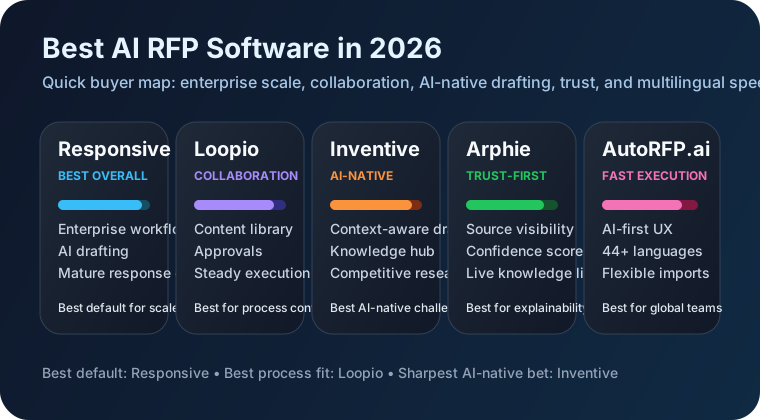
Quick answer: which AI RFP software should you use?
- Use Responsive if you want the best overall AI RFP software for mature response teams, enterprise workflows, and strategic response management.
- Use Loopio if collaboration, content governance, and steady operational discipline matter more than buying the flashiest AI story.
- Use Inventive if you want the most aggressive AI-native drafting and context-aware response engine for faster first drafts.
- Use Arphie if you care most about source visibility, knowledge connections, and trust in every generated answer.
- Use AutoRFP.ai if you want a fast-moving AI-first product with strong multilingual support and a lower-friction user experience.
For most established teams, Responsive is the best AI RFP software in 2026 because it balances enterprise maturity, large-scale content handling, and AI-driven workflow speed better than the rest of the field. If your biggest pain is coordination and answer reuse, Loopio is still the safest operational pick. If you want the sharpest AI-native challenger, Inventive is the most interesting product in the category right now.
Why AI RFP software became its own buying category
Response teams used to piece this work together with shared folders, spreadsheets, stale answer docs, and a lot of chasing subject-matter experts in Slack. Traditional proposal software improved storage and assignment workflows, but it still left teams rewriting too much and second-guessing whether the answer they copied last quarter was still safe to use.
That is why this category now splits into clearer lanes:
- Strategic response management platforms focus on content governance, enterprise workflows, and repeatable collaboration across complex requests.
- AI-native RFP platforms focus on first-draft speed, answer quality, and reducing manual drafting work as much as possible.
- Trust-first response tools focus on cited answers, source visibility, and keeping AI output explainable enough for high-stakes reviews.
- Operationally simple teams-first products focus on getting the workflow out of spreadsheets without making the software itself another problem.
- Knowledge-connected response systems matter now because the real bottleneck is often not writing — it is finding the current approved answer fast enough to use it.
You can see the adjacency clearly. Our AI knowledge management guide gets at the same trust and retrieval problem from the company-memory side. Our workflow automation comparison touches the approvals and handoff side. AI RFP software matters now because bid teams finally expect the system to draft, route, justify, and help maintain the knowledge behind the response.
| Tool | Best for | What it does best | Link |
|---|---|---|---|
| Responsive | Best overall | Combines enterprise-scale response workflows, AI drafting, and mature content operations for serious proposal teams | → Visit Responsive |
| Loopio | Collaboration and governance | Keeps content organized, current, and easier to reuse across RFPs, DDQs, RFIs, and security questionnaires | → Visit Loopio |
| Inventive | AI-native drafting | Pushes context-aware first drafts, knowledge-hub connectivity, and AI agents harder than most legacy vendors | → Visit Inventive |
| Arphie | Trust-first AI answers | Shows sources and confidence levels while connecting live company knowledge to proposal workflows | → Visit Arphie |
| AutoRFP.ai | Fast AI-first execution | Moves quickly on drafting, collaboration, document import/export, and multi-language response support | → Visit AutoRFP.ai |
Responsive — Best overall AI RFP software for mature response teams and enterprise buying workflows
Website: responsive.io
Responsive gets the top spot because it looks the most like a real system of record for response teams, not just an AI wrapper around old answers. Its current positioning centers on strategic response management, AI drafting, maintained Q&A libraries, and broad team usage across proposals, questionnaires, and assessments. The scale signals matter too: Responsive highlights 2,000+ companies, 8.7M+ Q&A pairs on platform, and broad Fortune 100 usage. That does not automatically make it the best, but it does tell you the product is built for sustained operational volume.
The deeper reason it wins is that RFP work is rarely just writing. It is version control, SME coordination, deadline management, content trust, and being able to answer the same hard security question correctly under pressure. Responsive looks strongest when your team already feels those operational pressures and needs the software to behave like infrastructure rather than a clever drafting toy.
Responsive is best for:
- Established proposal and bid teams handling frequent, high-stakes response work
- Organizations that need mature workflow controls and content reuse at scale
- Revenue, pre-sales, security, and proposal teams collaborating across one response system
- Buyers who want AI drafting without giving up enterprise process discipline
Where Responsive falls short: if you want the freshest AI-native feel or the simplest product for a smaller team, it can look heavier than newer challengers. Some buyers will prefer Inventive for sharper AI momentum or Loopio for cleaner everyday collaboration.
Bottom line: Responsive is the best AI RFP software in 2026 for teams that need enterprise-grade response operations and AI speed in the same platform.
Loopio — Best for collaboration, content freshness, and reliable proposal operations
Website: loopio.com
Loopio stays near the top because it solves the coordination problem better than most teams solve it on their own. The product remains tightly focused on helping teams respond to RFPs, RFIs, RFQs, DDQs, and security questionnaires with a searchable answer library, approval workflows, and cross-functional collaboration that is actually designed around how response work happens. Loopio also still speaks directly to the content-freshness problem, which matters more than many AI buyers admit. Bad answers reused quickly are still bad answers.
That is why Loopio is such a credible choice for teams that do not just want faster drafting. They want steadier execution. If your subject-matter experts are already tired of being pinged for the same material, and your proposal team is tired of hunting through old files to find the least wrong version of an answer, Loopio's operational discipline is a feature, not a boring detail.
Loopio is best for:
- Proposal teams that need stronger collaboration and answer governance
- Organizations responding to repeated RFP, DDQ, and security-questionnaire workflows
- Teams that value predictable process, approvals, and reusable content libraries
- Buyers who want AI help without abandoning structured content management
Where Loopio falls short: the AI story is less provocative than the newer AI-native vendors. If your team mostly wants the most aggressive first-draft acceleration and AI agents on top of live knowledge, Inventive or Arphie may feel more forward-leaning.
Bottom line: Loopio is the best AI RFP software here for teams that win through cleaner collaboration, better content hygiene, and fewer operational misses.
Inventive — Best AI-native RFP software for teams that want sharper drafts and faster response cycles
Website: inventive.ai
Inventive is the most compelling AI-native challenger in this roundup because it is explicitly optimizing for answer quality and speed, not just library maintenance. Its current messaging leans into context-aware drafting, a unified knowledge hub, duplicate and stale-content cleanup, and AI agents that help with competitive research and brainstorming in addition to direct response work. That is a more modern view of the job. A strong proposal is not just a filled-in form. It is also positioning.
This matters because a lot of teams are now using AI RFP response tools to improve throughput without turning every response into obvious machine writing. Inventive's pitch around contextual drafting and knowledge-based responses suggests it understands that buyers do not want generic prose faster. They want good-enough first drafts that experts can refine quickly instead of rewriting from zero.
Inventive is best for:
- Teams that want more AI leverage than legacy proposal software usually delivers
- Organizations with messy knowledge spread across docs, past RFPs, and internal systems
- Proposal leaders trying to cut first-draft time dramatically
- Buyers comfortable betting on a newer, AI-first product direction
Where Inventive falls short: some conservative buyers will still prefer the maturity and reference depth of Responsive or Loopio. If vendor stability and long-track-record proof matter more than product sharpness, Inventive can feel like the bolder choice rather than the safer one.
Bottom line: Inventive is the best AI RFP software in 2026 for teams that want the strongest AI-native push toward faster, better first drafts.
Arphie — Best for trust-first response workflows and knowledge-connected AI answers
Website: arphie.ai
Arphie earns its place because it is taking the trust problem seriously. Its current product framing emphasizes live knowledge connections, source visibility, confidence scores, auditing, and governance controls instead of pretending AI accuracy is something you should take on faith. That is the right posture for response work. If your AI software cannot show where an answer came from, it is harder to trust it on a security questionnaire or a high-value enterprise bid.
Arphie also looks strong for teams whose real bottleneck is not just one proposal library but fragmented company knowledge. The product explicitly connects into systems like Google Drive, SharePoint, Confluence, Notion, Seismic, and Highspot. That makes it feel adjacent to the larger knowledge-management trend, which is why the fit is especially strong for organizations where answer quality depends on current information scattered across multiple systems.
Arphie is best for:
- Teams that need generated answers to be explainable and reviewable
- Organizations pulling response material from many live knowledge sources
- Security- and compliance-sensitive teams that care about governance details
- Buyers who want AI help but refuse black-box drafting
Where Arphie falls short: it may be less familiar to buyers who want the most widely established vendor in the category, and some teams may prefer Loopio's more traditional workflow feel or Responsive's scale story.
Bottom line: Arphie is the best AI RFP software here for teams that want faster answers without surrendering source trust and knowledge control.
AutoRFP.ai — Best for fast-moving global teams that want AI-first drafting without legacy baggage
Website: autorfp.ai
AutoRFP.ai stands out because its whole pitch is that the product was designed for AI from the start. That shows up in the messaging around fast first drafts, confidence and source visibility, one-click rewriting actions, collaboration without per-seat friction, support for Excel, Word, PDF, and portal-based RFP inputs, and translation across dozens of languages. That is a practical feature set for teams dealing with mixed document formats and cross-region response work.
The strongest reason to consider AutoRFP.ai is probably speed-to-value. Some products in this category still feel like mature workflow systems with AI layered on top. AutoRFP.ai feels more like an AI-first response engine that also happens to support the surrounding process. That can be a real advantage if your team is smaller, global, or simply tired of older proposal software that feels like it was built for governance first and usability second.
AutoRFP.ai is best for:
- Global teams handling multilingual bids and questionnaires
- Organizations that want AI-first drafting with a lighter operational feel
- Teams dealing with complex import/export formats and portal workflows
- Buyers who want a product shaped around modern AI UX rather than legacy software habits
Where AutoRFP.ai falls short: the category leaders still have stronger brand recognition and broader enterprise proof. Teams making a highly conservative long-term platform bet may still lean Responsive or Loopio first.
Bottom line: AutoRFP.ai is the best AI RFP software in 2026 for fast-moving teams that want AI-native speed, simpler collaboration, and multilingual response help.
How to pick the right AI RFP software
- You want the strongest overall platform for mature response operations: Responsive
- You want collaboration, answer governance, and steadier proposal process control: Loopio
- You want the most compelling AI-native first-draft engine: Inventive
- You want source visibility and trust-first AI answers: Arphie
- You want fast AI-first execution with strong format and language flexibility: AutoRFP.ai
If your proposal stack decision is broader than RFP software alone, also read our sales-team guide, consultants guide, and workflow automation guide. Many teams need one response system, one customer context layer, and one automation layer — not one tool pretending to replace all three.
What not to do with AI RFP software
- Do not judge the category only by demo drafting quality. Ask how the system keeps answers current and trustworthy over time.
- Do not confuse a better prompt box with an actual response workflow. Deadlines, reviewers, approvals, and versioning still matter.
- Do not assume your existing content library is clean enough for AI just because it is large.
- Do not buy the heaviest platform if your team mostly needs speed and a usable process, not a new internal bureaucracy.
- Do not let AI write security or compliance answers with no source traceability if the stakes are high.
Verdict
Responsive is the best AI RFP software in 2026 for most serious response teams because it combines mature response operations, AI drafting help, and enterprise workflow depth in a way the rest of the market is still chasing.
Loopio is the best fit for teams that win through operational discipline and content governance. Inventive is the strongest AI-native challenger for faster first drafts and sharper AI leverage. Arphie is the best trust-first option for knowledge-connected, explainable answers. AutoRFP.ai is the best fast-moving AI-first option for teams that want speed, UX, and multilingual flexibility.
The smart buyer question is not “which vendor says AI the most?” It is whether your team mainly needs workflow maturity, cleaner collaboration, better answer trust, stronger AI drafting, or easier global execution. Buy for that bottleneck and the best AI RFP software becomes much easier to pick.