The best AI sales prospecting tools in 2026 are not the ones promising a fully autonomous SDR and then blasting generic junk into your market. The useful ones help you find the right accounts, notice real buying signals, personalize outreach with context, and keep execution tight enough that reps book more qualified meetings instead of just generating more noise.
This category is moving because the product shapes are finally separating. Apollo.io keeps leaning into the all-in-one AI sales platform model with data, targeting, and sequencing in one place. Clay is pushing signal-rich enrichment, custom workflows, and AI-led research across more than 150 data providers. HubSpot Breeze Prospecting Agent is explicitly selling an always-on AI BDR that watches for buying signals and drafts outreach from CRM context. Common Room is turning always-on buying signals and identity resolution into outbound timing advantage. Regie.ai is pitching an AI sales engagement platform that combines enrichment, dialing, email, sequencing, and reporting. That is a real buying shift: prospecting AI is no longer just copy generation. It is becoming data + signals + orchestration + rep execution.
If your real decision is broader than prospecting, start with our guides to the best AI tools for sales teams, best AI CRM tools, and best AI workflow automation tools. If you are still choosing a general assistant for internal research and drafting, our ChatGPT vs Claude comparison is the better starting point. But if your bottleneck is finding, prioritizing, and reaching the right prospects, this is the category that matters.
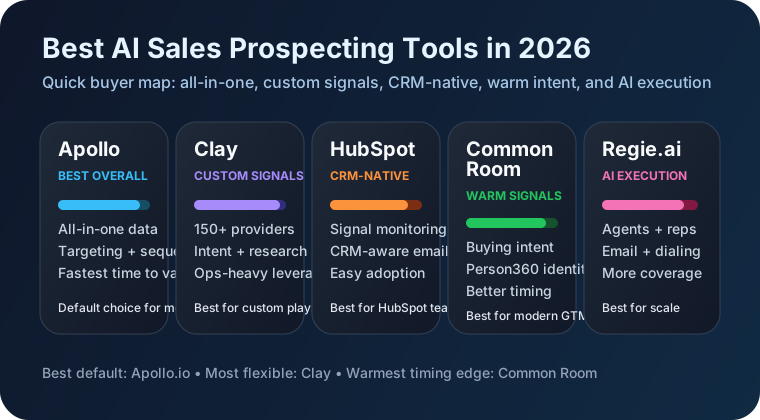
Quick answer: which AI sales prospecting tool should you use?
- Use Apollo.io if you want the best overall balance of prospect data, targeting, sequencing, and AI help in one platform.
- Use Clay if you want the most flexible signal-rich prospecting system for custom outbound plays and GTM ops-heavy teams.
- Use HubSpot Breeze Prospecting Agent if your team already lives in HubSpot and wants CRM-aware prospect research plus AI outreach timing.
- Use Common Room if your edge comes from buying signals, identity resolution, and reaching warm accounts before everyone else does.
- Use Regie.ai if you want AI prospecting agents paired with reps across email, dialing, sequencing, and repeatable outbound execution.
For most teams, Apollo.io is the best default AI sales prospecting tool in 2026 because it covers the most common prospecting jobs in one place without demanding a custom ops build. If your team wins through signal design and data orchestration, Clay is the sharper choice. If your team already runs on HubSpot, Breeze Prospecting Agent is the more natural buy.
Why AI prospecting is a real buying category now
Prospecting used to mean list building, manual research, basic sequencing, and too many reps doing expensive grunt work. Now buyers expect the software to do more of the ugly middle: monitor intent, enrich accounts, resolve identities, score fit, draft better first touches, time outreach better, and keep the whole thing tied to an actual system of record.
That is why this category now breaks into clearer lanes:
- All-in-one prospecting platforms combine database, targeting, sequencing, and analytics.
- Signal-first platforms focus on finding warmer accounts and better timing instead of just bigger lists.
- CRM-native prospecting tools matter when the real advantage is using customer and pipeline context instead of another disconnected workflow.
- Ops-heavy orchestration tools matter when your team wants custom enrichment, waterfall logic, and reusable GTM systems.
- AI execution platforms matter when leadership wants more outbound coverage without proportional headcount growth.
You can see the same pattern in adjacent categories. Our AI CRM guide shows where prospecting data eventually needs to land. Our AI tools for operations teams guide matters because prospecting quality often depends on workflow discipline more than the email copy does.
| Tool | Best for | What it does best | Link |
|---|---|---|---|
| Apollo.io | Best overall | Combines contact data, targeting, sequencing, and analytics in one prospecting workflow | → Visit Apollo.io |
| Clay | Custom signal-rich outbound | Turns enrichment, intent signals, and AI-led research into flexible prospecting systems | → Visit Clay |
| HubSpot Breeze Prospecting Agent | HubSpot-native prospecting | Monitors buying signals and drafts contextual outreach directly inside the CRM workflow | → Visit HubSpot Breeze Prospecting Agent |
| Common Room | Signal-based modern GTM teams | Connects buying signals, identity resolution, and AI activation so reps know who to engage and why | → Visit Common Room |
| Regie.ai | AI-assisted execution at scale | Pairs AI prospecting agents with reps across outreach, dialing, sequencing, and reporting | → Visit Regie.ai |
Apollo.io — Best overall AI sales prospecting tool for teams that want one system instead of five
Website: apollo.io
Apollo.io gets the top spot because it solves the most common prospecting problem directly: teams want accurate contacts, strong filtering, built-in outreach, and usable reporting without having to stitch the stack together first. Apollo's current product story still centers on a large B2B contact database, precise targeting, sequence automation, CRM sync, and analytics. That combination matters because many prospecting motions fail before the first reply — not because the copy is weak, but because the targeting and execution layer is fragmented.
Apollo is strongest when you want speed and operational simplicity. SDR teams, founder-led outbound teams, and lean RevOps environments can get from list to message to follow-up without buying a separate enrichment tool, sequencing layer, and analytics system on day one. That is why it stays the easiest recommendation for most growing teams.
Apollo.io is best for:
- Outbound-heavy SMB and mid-market sales teams
- Teams that want prospect data, targeting, and outreach in one tool
- Organizations that need fast ramp-up without a heavy GTM ops build
- Leaders who want fewer disconnected prospecting tools to govern
Where Apollo.io falls short: it is not the most flexible system for deeply custom signal logic, waterfall enrichment, or unusual GTM workflows. If your team already has serious ops muscle and wants more tailored account-scoring logic, Clay is the better fit.
Bottom line: Apollo.io is the best AI sales prospecting tool in 2026 for most teams because it makes prospecting operationally easier, not just more “AI-powered.”
Clay — Best for custom prospecting systems built on unique signals and richer data
Website: clay.com
Clay is the most interesting tool in this roundup if your team thinks prospecting advantage comes from data quality and workflow design, not from having the biggest contact list. Clay's public positioning is blunt: go to market with unique data and the ability to act on it. The platform pulls from more than 150 data providers, watches intent signals, and uses Claygent for AI-led research across public sources and custom workflows.
That makes Clay unusually powerful for GTM ops teams, modern outbound teams, and anyone trying to escape generic list-based prospecting. You can build workflows around job changes, product usage, hiring signals, competitor mentions, market segments, or niche custom prompts that would be painful inside a simpler platform. If everyone else is prospecting off the same generic filters, Clay is how you stop sounding like everyone else.
Clay is best for:
- RevOps and GTM teams designing custom outbound systems
- Organizations that care about waterfall enrichment and signal-based prioritization
- Teams that want AI research layered onto unique account and contact criteria
- Operators who are willing to trade simplicity for leverage
Where Clay falls short: it is not the easiest default for a small team that just needs to start prospecting next week. Clay gives you leverage, but it also assumes someone will think carefully about the workflow. If that sounds exhausting, Apollo or HubSpot is safer.
Bottom line: Clay is the best AI sales prospecting tool here for teams that want a real prospecting system, not just a faster lead list.
HubSpot Breeze Prospecting Agent — Best for teams that want AI prospecting inside HubSpot
Website: hubspot.com/products/sales/ai-prospecting-agent
HubSpot Breeze Prospecting Agent is the cleanest fit for teams already operating inside HubSpot. HubSpot is not positioning this as a toy writing assistant. The product page openly frames it as an always-on AI sales BDR that monitors companies for buying signals, researches them, and drafts contextual outreach using CRM insights. HubSpot is even making unusually concrete performance claims around response rates, rep research time, and total lead engagement.
That matters because a lot of prospecting AI still lives outside the CRM, which creates a familiar problem: the AI layer gets smarter while the system of record stays messy. Breeze Prospecting Agent is strongest when the real goal is reducing prospecting drag without adding another major tool or another sync layer.
HubSpot Breeze Prospecting Agent is best for:
- HubSpot-centered SMB and mid-market teams
- Organizations that want CRM context embedded into prospect research and outreach
- Sales leaders who want easier adoption and less workflow switching
- Teams that care about timing and signal monitoring more than custom ops complexity
Where HubSpot Breeze Prospecting Agent falls short: it is naturally strongest if HubSpot is already the center of gravity. If your data layer lives elsewhere or your team wants more open-ended custom signal design, Clay or Common Room can be more interesting.
Bottom line: HubSpot Breeze Prospecting Agent is the best AI sales prospecting tool in 2026 for teams that want AI prospecting to happen where the CRM context already lives.
Common Room — Best for signal-based prospecting and modern buying intent
Website: commonroom.io
Common Room deserves a spot because a lot of prospecting is no longer about discovering whether a company exists. It is about detecting whether somebody is showing real buying behavior before your competitors notice. Common Room's current pitch is explicit: know who to target, when to engage, and how to convert with more informed GTM AI. The stack centers on always-on buying signals, Person360 identity resolution, and RoomieAI Activate for personalizing outbound based on those signals.
This makes Common Room especially attractive for modern GTM teams that want better timing and warmer starting points. If your team is selling into product-led companies, developer audiences, community-heavy motions, or accounts that leave traces across multiple channels before they ever fill out a form, Common Room can be more strategically useful than a larger cold database.
Common Room is best for:
- Teams that care about buying signals and earlier intent capture
- Modern GTM motions where anonymous activity must be connected to real buyers
- Organizations that want outbound triggered by context instead of calendar discipline alone
- Revenue teams trying to prioritize warmth over sheer volume
Where Common Room falls short: it is not the simplest all-in-one default if you mainly want a conventional prospect database and sequencing tool. It works best when signals are the strategic advantage, not just a nice bonus.
Bottom line: Common Room is the best AI sales prospecting tool here when better timing and better context matter more than having the broadest static list.
Regie.ai — Best for AI-assisted prospecting execution across rep workflows
Website: regie.ai
Regie.ai stands out because it is not trying to be just a message generator. Its homepage frames the product as the world's only AI SEP and pushes a very execution-heavy promise: unify enrichment, dialing, email, sequencing, and reporting while AI prospecting agents handle repetitive busywork. That is a strong message for sales orgs that do not just want better targeting — they want more consistent execution without hiring at the same pace as their market coverage goals.
In practice, Regie looks strongest for teams that want AI paired with reps, not fully replacing them. The value proposition is better coverage, more personalized touches, and more plays actually getting run. That is a meaningful distinction. Plenty of sales leaders do not trust “autonomous SDR” marketing, but they absolutely do want the busywork reduced.
Regie.ai is best for:
- Sales teams that want more outbound coverage without proportional headcount growth
- Organizations that care about consistent play execution across reps
- Teams that want email, dialing, sequencing, and enrichment tied together
- Leaders who like the idea of AI paired with reps rather than AI replacing reps
Where Regie.ai falls short: it is a more opinionated execution platform than Apollo, and it is less obviously the choice if your main edge comes from designing custom data systems or warm-signal monitoring. It shines when execution scale is the problem to solve.
Bottom line: Regie.ai is the best AI sales prospecting tool here for teams that want AI to increase outbound coverage and consistency, not just write nicer emails.
How to pick the right AI sales prospecting tool
- You want the best all-around database + targeting + sequencing system: Apollo.io
- You want custom enrichment, unique signals, and a more powerful GTM build layer: Clay
- You already live in HubSpot and want prospecting tied tightly to CRM context: HubSpot Breeze Prospecting Agent
- You care most about buying signals, warm timing, and identifying real people behind activity: Common Room
- You want AI-assisted multichannel execution that scales rep coverage: Regie.ai
If your outbound stack question is wider than prospecting, pair this with our sales teams guide and AI CRM guide. A lot of teams need one prospecting layer, one CRM layer, and one automation layer — not one bloated platform pretending to be all three.
What not to do with AI prospecting tools
- Do not mistake more AI-written touches for better prospecting. Bad targeting plus good wording is still bad prospecting.
- Do not buy a signal-heavy platform if nobody on the team will actually maintain the workflow logic.
- Do not let the AI layer outrun your CRM hygiene, permission model, and compliance standards.
- Do not optimize for “autonomous” theater if your real need is simply cleaner research, timing, and execution.
- Do not ignore reply quality. If the platform increases activity but decreases conversation quality, it is making your market colder.
Verdict
Apollo.io is the best AI sales prospecting tool in 2026 for most teams because it keeps the highest-value prospecting jobs together: find the right people, target them cleanly, reach out consistently, and measure what actually works.
Clay is the best fit for ops-heavy teams that want more custom, signal-rich prospecting systems. HubSpot Breeze Prospecting Agent is the best fit for HubSpot-native teams that want prospecting to stay close to CRM context. Common Room is the best choice when buying signals and timing are the real strategic edge. Regie.ai is the best execution-focused pick for teams trying to scale outbound without scaling busywork.
The smartest buyer question is not “which AI prospecting tool is most autonomous?” It is whether you need a simpler all-in-one workflow, a better data-and-signal engine, CRM-native prospecting, warmer timing intelligence, or tighter rep execution. Buy for that bottleneck and the category gets much easier.