The best AI scheduling assistants in 2026 do more than throw a booking link at your problem. The useful ones protect focus time, time-block tasks, adapt when meetings move, and help you stop rebuilding your week by hand every time reality changes.
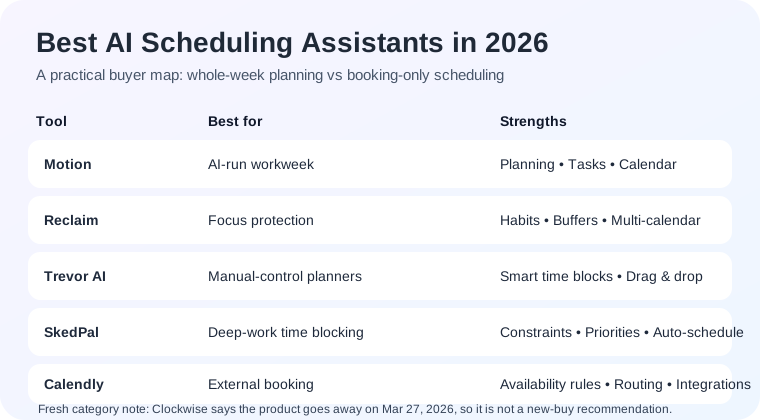
That matters more right now because this category is finally splitting into clear buyer lanes. Motion is pushing the full AI workday planner angle with tasks, calendar, projects, docs, and meeting support. Reclaim is still the cleanest fit for protecting focus time and balancing work plus personal calendars. Trevor AI is the better choice if you want smart scheduling suggestions without giving up manual control. SkedPal stays strong for serious time-blocking and priority-based planning. Calendly remains the easiest answer when the real problem is external booking, not whole-week planning.
The timing also matters because the category just lost one of its longtime names: Clockwise says its product will no longer be available starting March 27, 2026. So if you are evaluating AI calendar tools today, you need an updated map, not a recycled 2025 list. If your bigger problem is meeting capture instead of calendar control, start with our AI meeting assistant comparison. If you schedule on behalf of someone else, our AI tools for executive assistants guide is the better workflow fit. And if scheduling is tangled up with delivery work, our AI tools for project managers roundup is worth reading too.
Quick answer: which AI scheduling assistant should you use?
- Use Motion if you want the strongest all-in AI planner for workdays packed with tasks, meetings, and shifting priorities.
- Use Reclaim if your biggest problem is protecting focus time and keeping multiple calendars from wrecking each other.
- Use Trevor AI if you want smart suggestions but still want to drag, drop, and stay in control of your own schedule.
- Use SkedPal if you are serious about time-blocking deep work and want your task list turned into a realistic calendar.
- Use Calendly if your main scheduling pain is getting clients, candidates, or customers booked cleanly.
Why AI scheduling assistants matter right now
This category used to be easier to dismiss because plenty of products were really just prettier booking pages or rigid calendars with some smart suggestions on top. The better tools now do one of three genuinely useful things:
- Protect time: automatically defend focus blocks, habits, and buffers when meetings start eating the week.
- Schedule work, not just meetings: turn tasks and priorities into actual calendar time instead of wishful to-do lists.
- Reduce rescheduling drag: adapt quickly when meetings move, projects slip, or capacity changes.
That means you should buy based on the real failure mode in your week. If you mostly lose time to inbound booking, you do not need a full AI planner. If you already know what matters but never protect time for it, you do. If your inbox is where scheduling chaos starts, pair this category with our AI email assistants guide.
| Tool | Best for | What it does best | Link |
|---|---|---|---|
| Motion | Busy operators, managers, and founders | Full-workweek planning across tasks, projects, and calendar time | → Visit Motion |
| Reclaim | Focus protection across work and life calendars | Auto-scheduling tasks, habits, focus time, and meeting optimization | → Visit Reclaim |
| Trevor AI | People who want control, not black-box automation | Smart time-block suggestions with easy manual planning | → Visit Trevor AI |
| SkedPal | Deep-work-heavy solo planners | Priority-based auto-scheduling and realistic time maps | → Visit SkedPal |
| Calendly | External booking and handoff automation | Availability rules, booking flows, and integrations at scale | → Visit Calendly |
Motion — Best overall for people who want AI to run the week
Motion is the strongest overall pick if your week is a constant tradeoff between meetings, tasks, deadlines, and reactive work. Its current positioning is much broader than “calendar assistant”: Motion is selling AI tasks, AI projects, AI docs, AI workflows, AI meetings, and an AI calendar assistant in one stack.
Why Motion stands out: it treats scheduling as part of a bigger planning problem. That makes it a better fit than lighter calendar tools for founders, operators, project leads, and anyone whose schedule keeps changing because work itself keeps changing.
- People with too many moving priorities for a static calendar to stay useful
- Managers or operators who want the schedule tied to actual work, not just meetings
- Buyers who would rather let the system take stronger planning control
Where Motion falls short: it can be heavier than you need if your problem is simple meeting booking or basic focus-time protection. If you already know exactly when you want to do the work and just need better buffering, Reclaim or Trevor AI will feel less opinionated.
Bottom line: Motion is the best AI scheduling assistant in 2026 for most busy professionals who want AI to actively organize the week instead of just helping around the edges.
Reclaim — Best for protecting focus time and balancing work plus life
Reclaim is still the cleanest answer if your calendar is already full and the real goal is to stop meetings from consuming everything. Its pitch remains specific and useful: automatically schedule meetings, focus time, tasks, and habits around your existing calendar while flexibly adapting as priorities shift.
Why Reclaim stands out: it is excellent at defending time instead of only filling it. The ability to sync multiple calendars and keep personal commitments from colliding with work is a real differentiator for people whose day gets fragmented fast.
- Knowledge workers who need uninterrupted deep work to survive the week
- Managers who want better one-on-one rhythm and cleaner meeting load
- Teams that care about focus policies and calendar hygiene more than full project planning
Where Reclaim falls short: it is less of an all-in-one AI planner than Motion. If you want the calendar to become the command center for tasks, projects, docs, and execution, Reclaim is narrower by design.
Bottom line: Reclaim is the best AI calendar assistant for people whose main win is protecting focus time without manually policing their schedule all week.
Trevor AI — Best for smart scheduling with manual control
Trevor AI is the best fit for people who hate rigid black-box automation but still want real scheduling help. It pulls multiple task lists and calendars into one place, predicts task duration, suggests time blocks, and lets you plan by dragging things around instead of surrendering everything to autopilot.
Why Trevor AI stands out: it feels like a planner you collaborate with, not a planner you obey. That matters if you want the benefits of AI time-blocking without losing the ability to make fast judgment calls yourself.
- People who already know their priorities but need help turning them into a real day plan
- Users who want AI suggestions plus visible calendar control
- Anyone who bounces between tasks and calendars and wants one cleaner planning surface
Where Trevor AI falls short: it is not the best choice for company-wide meeting policies, team analytics, or enterprise-style scheduling governance. It is much more personal-planner first.
Bottom line: Trevor AI is the scheduling tool I would point manual-control people to first. It gives you meaningful AI help without making the week feel opaque.
SkedPal — Best for deep-work-heavy time blockers
SkedPal has always appealed to people who think in priorities, constraints, and blocks of focused time rather than a flat task list. Its current pitch is straightforward: turn your to-do list into a smart, adaptive schedule based on goals, preferences, constraints, and changing reality.
Why SkedPal stands out: it is built around realistic time-blocking. That makes it a strong buy for solo consultants, makers, researchers, and operators who need actual planned work sessions on the calendar, not just reminders that work exists.
- Solo professionals doing lots of self-directed deep work
- People who want priorities translated into a realistic week map
- Buyers who want a calendar centered on work blocks, not meeting throughput
Where SkedPal falls short: it is less friendly for simple inbound scheduling and less mainstream than Calendly or Motion. If your schedule is mostly about coordinating with other people, its deeper planning model can feel like too much system.
Bottom line: SkedPal is the best AI scheduling tool here for serious time-blockers who want the calendar to reflect what matters, not just what other people booked.
Calendly — Best for external meeting booking
Calendly is not the smartest whole-week AI planner in this list, but that is fine because most buyers looking for scheduling help do not actually need one. They need a simple way to expose availability, route meetings cleanly, apply buffers and rules, and connect booking into the rest of the workflow.
Why Calendly stands out: it is still the easiest answer when the problem is external scheduling. Calendly says it is trusted by more than 100,000 organizations, can connect up to six calendars, supports detailed availability rules, and has 100+ integrations. For sales, recruiting, consulting, and customer calls, that matters more than fancy AI claims.
- Teams booking demos, interviews, calls, or client sessions
- Service businesses that want low-friction meeting scheduling
- Buyers who need booking reliability and workflow integrations more than task planning
Where Calendly falls short: it will not run your workday the way Motion, Reclaim, Trevor AI, or SkedPal can. It solves appointment scheduling extremely well, but it does not become your broader AI planner.
Bottom line: choose Calendly if the real job is getting meetings onto the calendar cleanly. Do not buy it expecting a full AI day-planning system.
Why Clockwise is not in the top picks
Clockwise used to belong in this conversation. But the company now says the Clockwise team is joining Salesforce and the product will no longer be available starting March 27, 2026. That makes it the wrong recommendation for any new rollout, even if your team liked the category it pioneered.
If you are an existing Clockwise customer, the practical move is planning your migration path now. For most teams, the closest replacements will split between Reclaim for focus-time protection and Motion for a broader AI planning layer.
How to pick the right AI scheduling assistant
- You want AI to actively organize the whole week: Motion
- You want cleaner calendars and more defended focus time: Reclaim
- You want AI help without giving up manual control: Trevor AI
- You live by deep-work blocks and priority maps: SkedPal
- You mainly need outside people to book time with you: Calendly
If your scheduling problem is really downstream from communication overload, our AI email assistants guide may solve more of the root cause. If it is downstream from meetings creating too much admin, read the AI meeting assistant comparison next.
What not to do with AI scheduling tools
- Do not confuse booking automation with full scheduling intelligence. Those are different problems.
- Do not ignore multi-calendar support if your work and personal time regularly collide.
- Do not expect task-duration estimates to be perfect. The best tools reduce planning friction; they do not eliminate judgment.
- Do not roll out a team-wide system just because it demos well for one person. Team policy and personal planning are different buying motions.
- Do not start a new Clockwise deployment now that the product is going away.
Verdict
Motion is the best AI scheduling assistant in 2026 for most people who want real planning help, not just nicer booking. It has the strongest overall mix of task scheduling, calendar control, and broader work orchestration.
Reclaim is the better buy if your real problem is defending focus time and balancing multiple calendars. Trevor AI is the smarter choice for people who want AI support with visible manual control. SkedPal is the strongest deep-work time-blocker. Calendly still wins external booking.
The right question is not “which AI scheduling assistant has the coolest AI?” It is whether your scheduling failure mode is booking, focus protection, task planning, or full-week orchestration. Buy for that problem and the category gets much easier.