The best AI SEO tools in 2026 do two jobs now: they help you rank in Google, and they help you show up in AI answers from ChatGPT, Gemini, Perplexity, and Google AI Overviews. That is the real shift. If a tool still behaves like it only lives in the old keyword-era SEO workflow, it is already behind.
You can see that change in the market language itself. March 2026 product positioning across the category keeps repeating the same phrases: AI visibility, GEO, AI search tracking, and getting cited by AI. That makes this a real buyer-intent category right now, not just another lazy "AI for marketers" list. If your broader problem is campaign execution rather than search visibility, start with our AI tools for marketers guide. If your bottleneck is mostly drafting and editing, our AI writing tools comparison is closer to that decision. And if you are still comparing general AI assistants rather than dedicated SEO platforms, our ChatGPT vs Claude comparison is the better earlier stop.
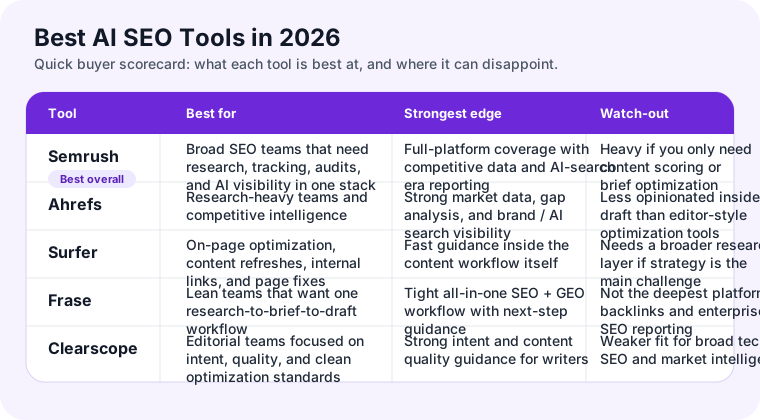
Quick answer: which AI SEO tool should you use?
- Use Semrush if you want the best all-around AI SEO platform for keyword research, competitive analysis, site auditing, and AI-search visibility tracking in one place.
- Use Ahrefs if research depth, competitor intelligence, and brand visibility in AI search are the main reasons you are buying.
- Use Surfer if your bottleneck is on-page optimization, content refreshes, and internal-linking help rather than broad SEO intelligence.
- Use Frase if you want a leaner all-in-one workflow for research, briefing, writing, optimization, and GEO-style tracking without stitching five tools together.
- Use Clearscope if you run an editorial team and care most about search intent, content quality, and clean optimization workflows.
For most teams, Semrush is the best overall AI SEO tool in 2026 because it covers the broadest real workflow. But if you already know your weak spot, the better buy is narrower: Surfer for on-page work, Ahrefs for research, Frase for lean all-in-one execution, or Clearscope for editorial optimization.
Why this category is hot right now
The freshness signal is unusually obvious. Vendor homepages are no longer pitching "better keyword research" alone. Semrush now frames its SEO toolkit around the AI search era. Ahrefs is pushing brand and AI search visibility. Surfer talks about visibility in Google, ChatGPT, and beyond. Frase literally pitches ranking on Google and getting cited by AI. Clearscope is now selling discovery across Google and AI search.
That matters because buyers are dealing with a harder problem than "write faster." They need to decide what to publish, how to structure it, how to optimize it, how to update old pages, and how to measure whether the brand is showing up where people are now asking questions. If your content ops are also getting messy, our AI workflow automation tools guide is relevant because SEO work increasingly depends on repeatable refresh and publishing workflows, not just one-off articles.
Semrush — Best overall AI SEO platform
Website: semrush.com
Semrush is the strongest overall pick because it covers the full shape of the SEO job. It is not just an optimizer and it is not just a keyword database. It gives you competitor research, keyword and prompt discovery, site audits, backlink analysis, content planning, position tracking, and increasingly explicit AI-visibility reporting.
That broader coverage is what makes it the best default recommendation. Most teams do not only need help writing a better brief. They also need to know what the market is doing, what topics matter, what pages are slipping, and whether AI search is changing where attention goes. Semrush is one of the few products that looks built for that full workflow instead of one slice of it.
Semrush is best for:
- Agencies and in-house teams that need one broad platform
- SEO plus content plus reporting workflows
- Teams that care about both Google rankings and AI-search visibility
- Competitive research and ongoing site health monitoring
Where Semrush falls short: if your only real need is improving drafts and content scores, it can feel heavier and more expensive than a focused optimizer like Surfer or Clearscope.
Bottom line: Semrush is the safest overall buy when you need the broadest SEO operating system, not just an AI writing layer.
Ahrefs — Best for research-heavy teams and AI search visibility tracking
Website: ahrefs.com
Ahrefs is the research-first pick. It has always been strong when you need to understand demand, competition, backlinks, and search opportunity with real depth. In 2026 that story has expanded into brand and AI-search visibility too, which makes it especially interesting for teams that want hard market data more than guided writing help.
That distinction matters. Some tools tell you how to tune a page. Ahrefs is better when you need to decide which battle is worth fighting at all. For content teams that start with research, topic selection, gap analysis, and competitive intelligence, that is often the higher-value layer.
Ahrefs is best for:
- Research-heavy SEO teams
- Competitive intelligence and market mapping
- Teams tracking brand presence across search and AI surfaces
- Operators who want strong data before they write
Where Ahrefs falls short: it is not the most opinionated content-optimization workflow. If your writers need stronger hand-holding inside the draft itself, a dedicated editor-style tool may fit better.
Bottom line: Ahrefs is the best AI SEO tool here if your biggest advantage comes from better research and sharper market intelligence.
Surfer — Best for on-page optimization and content refreshes
Website: surferseo.com
Surfer is the most practical pick when the problem is not "what should we target?" but "how do we improve this page fast?" Its workflow is built around content scoring, missing topic coverage, structure guidance, optimization feedback, and increasingly internal-linking support plus AI-assisted drafting.
That makes Surfer especially useful for teams with an existing content backlog. If you already have pages to improve, briefs to tighten, and rankings to rescue, Surfer is often easier to operationalize than a giant all-in-one platform. It helps answer the day-to-day content operator question: what should I fix on this page right now?
Surfer is best for:
- On-page optimization and refresh workflows
- Content teams improving existing blog libraries
- Marketers who want help with internal linking and content gaps
- Writers who need guidance inside the draft, not just research beforehand
Where Surfer falls short: it is not the deepest choice for backlink analysis, broad market intelligence, or enterprise-style SEO reporting. You may still want a larger data layer beside it.
Bottom line: Surfer is the best AI SEO software in 2026 for people whose real bottleneck is page-level optimization, not market discovery.
Frase — Best lean all-in-one SEO and GEO workflow
Website: frase.io
Frase is the most interesting all-in-one option for lean teams because it keeps collapsing more of the workflow into one place: research, brief generation, drafting, optimization, AI-search tracking, and next-step recommendations. That is a different buying story from the more classic SEO suites.
If you are a small team that does not want to live across five tabs, Frase makes a lot of sense. Its pitch is basically: let the platform handle the market scan, help structure the content, score it for SEO and GEO, and then tell you what to do next. That is appealing when you care as much about operating speed as raw feature depth.
Frase is best for:
- Lean content teams that want fewer moving parts
- Research-to-brief-to-draft workflows
- Teams experimenting with GEO and AI-search tracking without adding another separate product
- Operators who want one system to guide the next action
Where Frase falls short: if you need the deepest backlink intelligence, enterprise reporting, or the broadest keyword universe, Semrush or Ahrefs are still stronger foundations.
Bottom line: Frase is the best AI SEO tool here for lean teams that want one tight workflow instead of a stitched stack.
Clearscope — Best for editorial teams and search-intent control
Website: clearscope.io
Clearscope remains the editorial-quality pick. It is strong when your team cares about search intent, topic coverage, content quality, and optimization discipline more than having the biggest all-purpose SEO suite. In 2026 it is also leaning harder into discoverability across Google and AI search, which keeps it relevant as the category shifts.
This is the tool I would look at if you already have writers, editors, and a content process, but want cleaner guidance and better standards inside that process. It is less about novelty and more about producing pages that are genuinely comprehensive and organized.
Clearscope is best for:
- Editorial teams with real review processes
- Search intent analysis and topic planning
- Teams optimizing content quality at scale
- Operators who want cleaner optimization guidance than generic AI drafting provides
Where Clearscope falls short: it is not your best pick if you need broader technical SEO, backlink research, or heavyweight competitor intelligence in the same platform.
Bottom line: Clearscope is the right choice when the core problem is publishing better, more complete content — not managing the whole SEO universe in one dashboard.
What about pure GEO and AI-search-visibility tools?
This is the fast-rising edge of the market. If your real question is less "how do I rank in Google?" and more "how do I get cited inside AI answers?" then newer AI-search-visibility products like Writesonic are worth watching closely. But for most teams, buying a pure GEO layer before you have your core SEO research and content workflow under control is backwards.
The better sequence is usually: pick your core SEO platform first, then add a narrower AI-visibility layer only if you actually have the process maturity to use it. The same logic shows up in our AI tools for content creators guide: the right stack starts with the bottleneck you really have, not the newest acronym.
How to pick the right AI SEO tool
- You need one broad platform: Semrush
- You care most about research depth: Ahrefs
- You need on-page wins and content refreshes: Surfer
- You want a lean all-in-one workflow: Frase
- You run a serious editorial process: Clearscope
If budget matters, do not buy two overlapping optimizers by accident. A lot of teams would be better off with one research layer plus one drafting/optimization workflow than three tools that all promise "AI content." If you are a smaller operator deciding where to spend first, our best AI tools for small business guide is a useful sanity check before you commit to a more specialized SEO stack.
What not to do with AI SEO tools
- Do not confuse AI-assisted optimization with permission to publish weak, generic content at scale.
- Do not buy a GEO tracking layer before you have a decent research and content process.
- Do not optimize only for content scores and ignore whether the page is actually useful.
- Do not assume being "mentioned by AI" matters if the underlying page is thin, outdated, or untrustworthy.
That last point matters most. The market is moving, but the core rule did not change: the useful page still wins more often than the over-optimized page. AI search just changes where the proof of usefulness shows up.
Verdict
Semrush is the best AI SEO tool in 2026 for most teams because it covers the full job better than the others here: research, content planning, technical SEO, reporting, and AI-search-era visibility tracking.
Ahrefs is the best research-first choice. Surfer is the best page-optimization tool. Frase is the smartest lean all-in-one workflow. Clearscope is the best editorial optimization tool for serious content teams.
The mistake most buyers will make is shopping for "an AI SEO tool" as if the category is one thing. It is not. Some tools help you decide what to publish. Some help you improve pages. Some help you measure visibility in AI search. Buy for the actual bottleneck.