Best AI tools for accountants has become a real buying search because finance teams are stuck between two pressures at once: they need to close faster and they have less patience for extra headcount, extra spreadsheets, and extra software tabs. The useful tools in this category are not the ones with the flashiest chatbot demo. They are the ones that remove painful work from AP, reconciliations, reporting, and review without making controls worse.
March 2026 freshness signals are strong here. Major accounting and finance publishers have updated roundups this month, and the conversation has clearly shifted from "should accounting use AI?" to "which tools actually help specific finance workflows?" That is a good sign. It usually means the market is moving from curiosity to budget.
If you are still choosing your general-purpose assistant first, start with our guides to ChatGPT vs Claude, Copilot vs ChatGPT for work, and using ChatGPT for Excel formulas. But if your real bottleneck is finance operations, the tools below are more relevant.
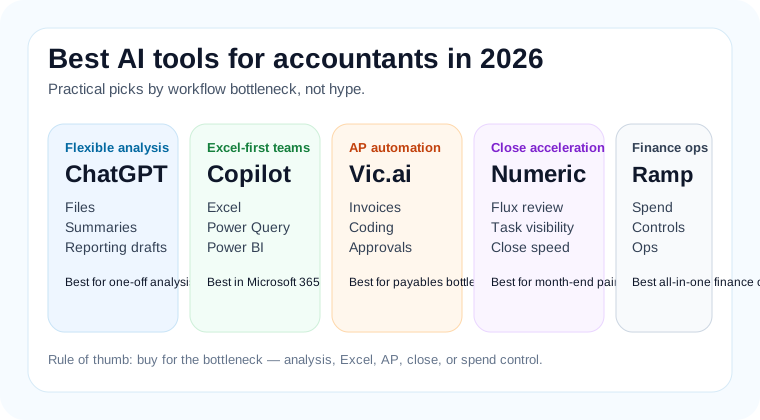
The best AI tools for accountants at a glance
- Best low-friction starting point for analysis and reporting help: ChatGPT
- Best for Excel-heavy finance teams already in Microsoft: Microsoft Copilot
- Best for AP automation and invoice processing: Vic.ai
- Best for month-end close visibility and flux explanations: Numeric
- Best for finance teams that want spend control tied to AI workflows: Ramp
Why this category is heating up
Fresh March coverage from Rightworks, Ramp, and the Journal of Accountancy all points the same direction: AI adoption in accounting is no longer just about drafting emails faster. The real money is in invoice capture, anomaly detection, close acceleration, better reporting, and reducing repetitive cleanup work inside existing finance systems.
That matters because accounting teams usually do not need another generic writing tool. They need fewer bottlenecks. They need cleaner transaction handling, faster review cycles, and better explanations when numbers move. That is why the best AI tools for accountants in 2026 are increasingly workflow-specific.
1. ChatGPT: best for flexible analysis, drafting, and explanations
ChatGPT is still the easiest place for many accountants to start because it can help across a weirdly broad set of tasks: draft process docs, explain formula logic, summarize policy updates, turn rough notes into client-ready language, analyze uploaded CSVs, and help think through reporting narratives. OpenAI is now positioning ChatGPT more directly around professional work with file analysis, charting, web search, and agent-style task support, which makes it more useful for finance work than the old "just a chatbot" framing.
The limitation is obvious: ChatGPT is not accounting software. It does not know your close checklist, your ERP, or your control environment unless you deliberately build a process around it. That makes it strong as a flexible sidekick, not a replacement for finance infrastructure.
- Best fit: ad hoc analysis, reporting drafts, formula help, policy explanations, management-summary writing, one-off file reviews
- Weak spot: not natively tied to your accounting stack or audit trail, so humans still need to verify outputs
2. Microsoft Copilot: best for Excel-centric finance teams
For finance teams living in Excel, Power Query, Outlook, and Power BI, Microsoft Copilot has a cleaner workflow argument than most standalone tools. Recent accounting coverage keeps pointing back to Copilot because it can help generate formulas, explain transformations, assist with data cleanup prompts, and support charting or summarization inside the Microsoft environment people already use all day.
If the accounting team is already standardized on Microsoft 365, Copilot often becomes the lowest-friction AI upgrade. It is not the deepest accounting specialist, but it is practical. That matters more than hype in finance.
- Best fit: Excel-heavy teams, reporting packs, Power Query support, recurring analysis work, finance teams already committed to Microsoft
- Weak spot: less useful if your team is not deeply Microsoft-based or needs workflow-specific accounting automation rather than productivity help
3. Vic.ai: best for AP automation at scale
Vic.ai is the clearest specialist pick on this list. Its current product positioning is straightforward: autonomous accounting focused on invoice processing, approval acceleration, and high-fidelity AP data. The company's public claims around high no-touch rates and fast invoice accuracy are exactly the kind of operational outcome AP leaders care about.
This is where specialist AI wins. A generic assistant can help explain an AP policy. Vic.ai is built to attack the actual bottleneck: getting invoices captured, coded, approved, and paid with less manual work. If your month still gets clogged by invoice handling, this is the most obvious category fit.
- Best fit: AP teams, invoice-heavy environments, scaling finance ops without adding AP headcount, ERP-connected invoice workflows
- Weak spot: narrow if your main pain is reporting or close management rather than payables
4. Numeric: best for close management and flux review
Numeric is one of the more interesting accounting AI products because it is not trying to be a general assistant. Its current product story centers on close automation, flux explanations, bottleneck detection, and scaling accounting output without scaling the org chart. That is a real finance pain point, not marketing fluff.
If your accounting team spends too much time chasing close status, reconciling movement explanations, and figuring out why the month slipped again, Numeric looks like one of the better-aligned tools in the market. It is especially compelling for high-growth teams where the close is still too manual and too spreadsheet-dependent.
- Best fit: month-end close, variance explanations, task visibility, controller-led process improvement, teams wanting fewer spreadsheet bottlenecks
- Weak spot: probably overkill for very small teams that mostly need drafting help or simple reporting support
5. Ramp: best for spend workflows plus AI-native finance ops
Ramp is not just an accounting AI tool in the narrow sense, but that is part of the point. Its recent finance content is pushing the idea that AI should sit inside integrated finance workflows: spend management, close support, automation, and decision support together. For a lot of lean finance teams, that is more attractive than buying isolated point solutions.
Ramp makes the most sense if your accounting function overlaps heavily with spend controls, card operations, reimbursements, and finance process automation. It is less of a pure accountant's analysis tool and more of a finance-ops platform with meaningful AI positioning.
- Best fit: startup and SMB finance teams, spend control, procurement-adjacent workflows, teams wanting one operational finance system with automation baked in
- Weak spot: less specialized than tools built only for close or only for AP
What most accounting teams should buy first
Most accounting teams should not start by shopping for the "smartest" AI. They should start by buying for the slowest part of the workflow.
- Start with ChatGPT if the pain is drafting, explanation, one-off analysis, and file interpretation
- Start with Copilot if the team basically lives in Excel and Microsoft 365 all day
- Start with Vic.ai if AP is still manual and invoices are the bottleneck
- Start with Numeric if month-end close is too slow, too opaque, or too spreadsheet-driven
- Start with Ramp if spend workflows and finance operations are where the friction really lives
This is the same buying logic we use in our small-business AI tools guide and our free AI tools for small business roundup: do not buy AI for the label. Buy it for the bottleneck.
What not to do
- Do not let a general AI assistant post journals, approve payments, or make final judgment calls without review.
- Do not treat polished explanations as evidence that the underlying accounting is correct.
- Do not add a specialist tool unless it integrates with the systems the team actually uses.
- Do not confuse workflow acceleration with control maturity. Faster bad processes are still bad processes.
If governance is the concern, our ChatGPT safety guide is still worth reading before teams start pasting sensitive finance data into consumer tools.
Our verdict
The best AI tools for accountants in 2026 are increasingly specialized. ChatGPT is still the easiest flexible starting point. Microsoft Copilot makes the most sense for Excel-first finance teams. Vic.ai is the strongest clear AP specialist. Numeric is one of the better fits for close acceleration and flux review. Ramp is compelling when spend control and finance ops are tightly linked.
If you only take one thing from this list, make it this: the right accounting AI tool is the one that removes repetitive finance work without weakening controls. Anything else is just another tab.