Best AI tools for consultants is a more serious search in 2026 than it was a year ago. Consultants are under pressure to research faster, synthesize messy client input, turn calls into crisp next steps, and deliver useful outputs without burying junior team time in note cleanup and slide formatting.
The freshness signal is real. OpenAI spent late February pushing deeper into the consulting channel with new enterprise alliances built around agent deployment and workflow redesign, which is a pretty clear sign that consulting firms are becoming a frontline distribution path for business AI. At the same time, the broader market is shifting toward vertical AI agents and workflow-specific tools instead of generic “chatbot everywhere” thinking.
If your work is more internal-ops heavy than client-service heavy, start with our guide to AI tools for operations teams. If you spend more time in discovery and PRDs than in client recommendations, the product managers guide is a better fit. But if your bottlenecks are research, synthesis, proposals, workshops, and client deliverables, the stack below is the practical place to start.
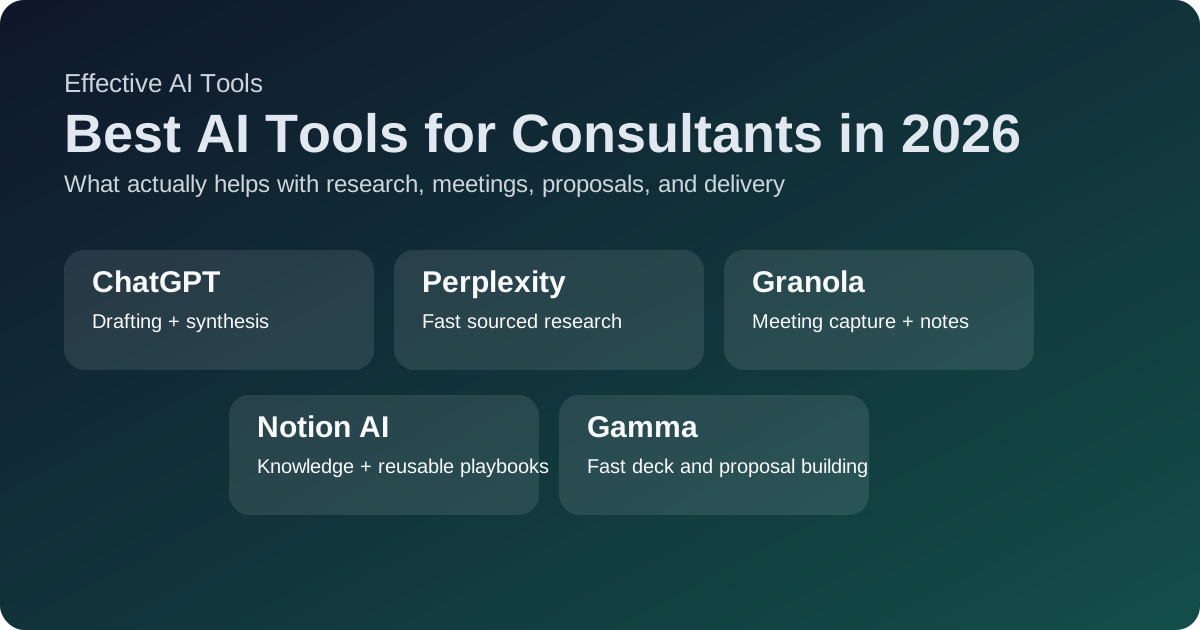
The best AI tools for consultants at a glance
- Best for drafting, synthesis, and turning messy input into useful output: ChatGPT
- Best for fast research with visible sources: Perplexity
- Best for client call capture without drowning in notes: Granola
- Best for reusable engagement knowledge and internal playbooks: Notion AI
- Best for turning ideas into fast decks and proposal-style deliverables: Gamma
Why consultants are buying AI differently in 2026
Consultants do not need the flashiest demo. They need tools that shorten billable work without lowering quality. That usually means faster research, better meeting capture, cleaner synthesis, and more reusable thinking across projects.
The useful consulting stack now looks less like one magic assistant and more like a small system: one tool for drafting and synthesis, one for source-backed research, one for meeting memory, one for knowledge reuse, and optionally one for turning ideas into presentable client outputs quickly.
1. ChatGPT: best for drafting and synthesis
ChatGPT is still the most flexible assistant on this list for consultants because consulting work produces a constant stream of half-structured material: interview notes, workshop takeaways, project updates, proposal fragments, issue trees, risk summaries, executive emails, and “can you turn this into something coherent by tomorrow” moments. ChatGPT is good at that layer.
It works especially well for first-draft synthesis, reframing raw client input into options, generating sharper meeting follow-ups, structuring analyses, and pressure-testing messaging before it goes into a deck. It is not a substitute for judgment, and it should not be trusted blindly on factual claims, but it is one of the fastest ways to reduce consulting admin drag. If you are still deciding on the base assistant layer, read our ChatGPT vs Claude comparison and Copilot vs ChatGPT for work.
- Best fit: synthesis, workshop recaps, executive summaries, proposal drafts, email cleanup, interview-analysis scaffolding
- Weak spot: still needs human verification before anything client-facing becomes “fact”
2. Perplexity: best for fast source-backed research
Perplexity earns its place because consultants spend a lot of time doing “quick but defensible” research. You need market context, vendor overviews, competitor movements, industry benchmarks, recent announcements, and source links you can trace back before they end up in a recommendation. Perplexity is much faster than normal search for that kind of work.
It is especially useful in the first 30 minutes of a new workstream, when you are building a read on the landscape and trying to find out which claims are real. That makes it a strong pair with ChatGPT: Perplexity gets you source-grounded inputs, and ChatGPT helps shape those inputs into usable narrative or recommendations. If research is the main bottleneck, our Perplexity vs ChatGPT research guide goes deeper.
- Best fit: rapid market scans, competitor research, sourcing current examples, finding citations, workshop prep
- Weak spot: still not a replacement for deeper primary research or careful fact-checking
3. Granola: best for client call capture and cleaner follow-through
Granola is one of the more useful specialist tools for consultants because client work lives and dies on meetings. A lot of value gets lost between the call itself and what the team remembers afterward. Granola helps by making meeting capture lighter, cleaner, and easier to turn into action without forcing everyone into a heavy transcription workflow.
This matters more than it sounds. Better notes mean better follow-ups, fewer missed stakeholder nuances, faster internal handoffs, and fewer hours spent reconstructing what a client actually said. It is a strong fit for consultants who are constantly in discovery calls, steering meetings, interviews, and working sessions. If your role is more project-orchestration heavy, the nearby tool landscape in our project managers guide overlaps here too.
- Best fit: client calls, stakeholder interviews, working sessions, next-step extraction, meeting-memory hygiene
- Weak spot: narrower value if most of your work happens asynchronously or outside meetings
4. Notion AI: best for reusable engagement knowledge
Notion AI is useful for consultants who want to stop reinventing every deliverable from scratch. Good consulting teams build repeatable assets: project plans, discovery question sets, proposal skeletons, workshop agendas, decision logs, retrospective formats, and reusable client playbooks. Notion AI is good at helping organize and reshape that internal operating memory.
It is especially helpful when you have multiple client engagements running at once and need cleaner retrieval of prior thinking. Instead of searching through documents and old chats manually, you can use AI-assisted search and drafting to reuse your own best material faster. That makes it more of a leverage tool than a novelty feature.
- Best fit: playbooks, templates, knowledge bases, cross-engagement reuse, internal delivery systems
- Weak spot: weaker than dedicated research or meeting tools for those narrower jobs
5. Gamma: best for fast client-facing deliverables
Consultants often do not just need insight. They need insight in a format clients can absorb quickly. Gamma is useful because it shortens the distance between rough thinking and a presentable deck-like deliverable. It is especially good for proposal drafts, workshop recaps, executive summaries, internal alignment decks, and first-pass storylining.
That does not mean you should let it write your thinking for you. The value is speed. Gamma helps get structure and visual packaging in place so you can spend time sharpening the argument instead of formatting slides for two hours. If decks are a central deliverable type for your team, our AI presentation tools guide covers the broader category.
- Best fit: proposals, executive summaries, workshop outputs, first-pass decks, storylining support
- Weak spot: not the right final layer for highly customized strategy decks that need a lot of precise editorial control
What most consultants should buy first
Most consultants should buy for the recurring bottleneck in their actual client workflow, not the tool with the most impressive launch video.
- Start with ChatGPT if synthesis, writing, and turning messy notes into useful deliverables is your main drag
- Start with Perplexity if quick research and source-finding keep eating project time
- Start with Granola if meetings are the main place where client signal gets lost
- Start with Notion AI if your team has good knowledge but poor reuse
- Start with Gamma if deck production and proposal packaging are the slowest part of delivery
This is the same buying rule behind our guides for sales teams, customer success, and designers: buy for the friction point, not the category label.
What not to do
- Do not let AI-generated summaries replace direct understanding of what the client actually said.
- Do not paste sensitive client information into tools casually without checking data controls and permissions.
- Do not rely on one general assistant for research, memory, note capture, and deliverables if your workflow clearly needs specialized tools.
- Do not ship AI-written recommendations without checking the logic, evidence, and tone yourself.
- Do not mistake faster deliverables for better consulting. Speed is only useful if the judgment stays intact.
If your team is still working through the risk side of client-facing AI use, our ChatGPT safety guide is still worth reading before you normalize sharing sensitive material with consumer-grade tools.
Our verdict
The best AI tools for consultants in 2026 are the ones that compress research, synthesis, and delivery without making the work sloppier. ChatGPT is still the most useful general assistant for turning messy client inputs into coherent outputs. Perplexity is the fastest way to get source-backed research moving. Granola is a smart specialist pick for meeting-heavy work. Notion AI helps turn past engagements into reusable leverage. Gamma is the quickest path from rough thinking to presentable client material.
If you only buy one thing, buy the tool that fixes your slowest repeatable step. That is where consulting AI stops being a toy and starts paying for itself.