Best AI tools for customer success has become a real buying query because post-sale teams are under a weird kind of pressure in 2026. Leadership wants retention, expansion, and cleaner renewal forecasting. Customers still expect fast, personal help. Headcount is not keeping up. So the question is no longer whether AI belongs in customer success. It is which tools actually reduce manual account triage, surface health signals earlier, and help teams cover more customers without faking “relationship-driven” work.
Fresh March 2026 signals are strong. Gainsight is openly framing customer success around a new retention-and-growth charter, ChurnZero is pushing embedded AI agents for customer growth, and newer platforms like Velaris are leaning hard into AI-native post-sale visibility and orchestration. At the same time, onboarding and product-adoption platforms are getting more AI-heavy, which means the line between support, onboarding, and customer success is getting blurrier.
If your main pain is still reactive ticket handling, start with our AI tools for customer support guide. If the problem is cross-functional handoffs after sales, our AI tools for sales teams and AI tools for project managers are worth reading too. But if you are buying for onboarding, health scoring, renewals, expansion signals, and tech-touch scale, the tools below are the better shortlist.
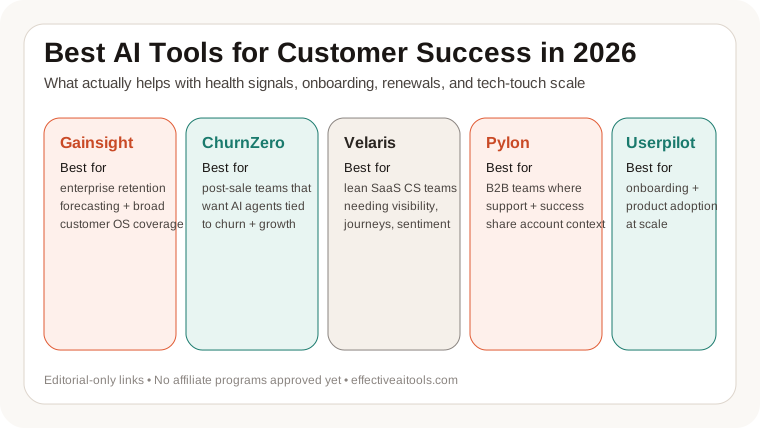
The best AI tools for customer success at a glance
- Best for enterprise-scale retention forecasting and broad customer-success coverage: Gainsight Atlas
- Best for post-sale teams that want AI agents built around churn and growth workflows: ChurnZero
- Best for lean SaaS customer-success teams that need modern visibility and journey orchestration: Velaris
- Best for B2B teams where support and success share customer context: Pylon
- Best for onboarding, adoption, and in-product success motions: Userpilot
Why customer success buyers are changing how they evaluate tools
Customer success teams used to buy mostly for dashboards, tasks, playbooks, and renewals reporting. That still matters, but it is incomplete now. In 2026, the more useful question is whether the platform helps the team do four things better: spot risk sooner, personalize outreach at scale, close execution gaps, and coordinate with support, product, and sales without context collapse.
That is why vendor messaging has shifted from generic “AI insights” to agentic workflows, account intelligence, churn prediction, conversation analysis, onboarding automation, and expansion signals. The category is maturing. Teams are not buying AI to sound modern. They are buying because manual coverage models break when every CSM owns too many accounts.
1. Gainsight Atlas: best for enterprise retention forecasting and coverage
Gainsight is still the heavyweight pick when the customer-success motion is broad, cross-functional, and hard to replace. Its recent Atlas positioning is clearly aimed at retention forecasting, customer growth, and scaled coverage instead of just reporting. That matters because larger CS orgs rarely need one flashy AI feature. They need a system that can sit across customer data, playbooks, and renewal workflows without falling apart under real complexity.
If your team needs executive-level visibility, more mature renewal forecasting, and a platform that can support multiple segments and motions, Gainsight is the strongest enterprise answer in this category.
- Best fit: large SaaS teams, mature CS orgs, renewal forecasting, executive reporting, broad customer lifecycle programs
- Weak spot: can be heavier than necessary for smaller teams that mainly want faster execution and simpler setup
2. ChurnZero: best for AI agents tied to post-sale work
ChurnZero’s 2026 positioning is unusually direct: AI should not just summarize what happened. It should act on risks and opportunities inside customer-growth workflows. That is a better story than generic copilots because CS teams live and die by consistent execution: the right outreach, the right follow-up, the right escalation, and the right next step after a warning signal shows up.
For teams that want AI connected to onboarding, churn prevention, adoption, and expansion actions instead of just analytics dashboards, ChurnZero looks like one of the sharper fits right now.
- Best fit: SaaS retention teams, scaled books of business, churn reduction programs, post-sale operations that need more automation
- Weak spot: less compelling if your broader customer-data stack already revolves around another deeply embedded platform
3. Velaris: best for lean, AI-native customer success teams
Velaris is interesting because it is not trying to sound like a generic CRM with an AI layer bolted on. Its pitch is much closer to what lean CS teams actually need: visibility across accounts, AI-enriched health scores, conversation intelligence, sentiment tracking, and journey orchestration without the usual enterprise bloat. That makes it attractive for post-sale teams that need more leverage now, not after a six-month implementation cycle.
If your main problem is that the team cannot keep a clean, current view of every account while still running proactive journeys, Velaris is one of the better newer options to look at.
- Best fit: B2B SaaS, lean CS teams, health scoring, success planning, proactive outreach, teams growing past spreadsheets and lightweight hacks
- Weak spot: may not match the governance depth or ecosystem breadth that some larger enterprises expect
4. Pylon: best for B2B teams where support and success overlap
Pylon sits in a useful middle ground because many B2B teams do not have clean walls between support and customer success. The same account context matters to both. Pylon is pushing AI agents, knowledge management, omnichannel support, and account intelligence in one system, which makes sense for companies where post-sale work includes Slack channels, escalation management, technical onboarding, and relationship coverage all mixed together.
This is the pick for teams that are tired of losing account context between support tickets, shared channels, and customer-success follow-through. If your post-sale motion is collaborative and messy, Pylon makes more sense than a pure CS tool pretending support is somebody else’s problem.
- Best fit: B2B support-plus-success teams, Slack-heavy customer communication, account intelligence, shared post-sale ownership
- Weak spot: not the cleanest choice if you want a classic, standalone customer-success platform with a strong renewal-operations center of gravity
5. Userpilot: best for onboarding and product adoption
Userpilot is not a full customer-success platform in the same way Gainsight or ChurnZero are, and that is exactly why it belongs on this list. A lot of customer-success pain starts before the renewal conversation. It starts in onboarding friction, poor feature adoption, weak in-app guidance, and lack of personalized product experience. Userpilot’s AI and onboarding stack are useful when the real lever for retention is product activation rather than yet another CSM task board.
If your churn problem begins with adoption, time-to-value, or messy onboarding, Userpilot may move the needle more than buying a heavier platform first.
- Best fit: product-led growth, onboarding programs, feature adoption, in-app guidance, teams optimizing activation and expansion paths
- Weak spot: not enough on its own if you need deep renewal forecasting, full CS operations, or broad customer account management
What most customer success teams should buy first
Most teams should not buy the most expensive platform first. They should buy for the bottleneck they actually have.
- Start with Gainsight if the core problem is enterprise-scale retention visibility and broad lifecycle management
- Start with ChurnZero if you want AI tied directly to churn prevention, expansion, and post-sale execution
- Start with Velaris if the team needs a more modern, lighter-weight success platform with strong AI-native visibility
- Start with Pylon if support and success are already blended and shared account context matters more than tool purity
- Start with Userpilot if onboarding and adoption are the real retention lever
This is the same rule behind our guides to the best AI tools for small business and AI tools for operations teams: do not buy for the category label. Buy for the failure point in the workflow.
What not to do
- Do not use AI health scoring as a substitute for understanding why customers are actually unhappy.
- Do not automate outreach so aggressively that every account feels like it is being handled by a template farm.
- Do not split customer context across five tools if one of your main problems is already fragmented post-sale execution.
- Do not ignore data governance. Customer calls, ticket histories, and account notes can get sensitive fast.
If your team is unsure what should or should not go into general AI systems, read our ChatGPT safety guide before people start dumping customer data into consumer AI tools without rules.
Our verdict
The best AI tools for customer success in 2026 are the ones that help teams scale judgment, not just output. Gainsight Atlas is the strongest enterprise pick for retention visibility and broad lifecycle coverage. ChurnZero stands out for AI agents tied to customer-growth execution. Velaris is a strong modern option for lean AI-native CS teams. Pylon is the best fit when support and success need one shared account view. Userpilot is the right buy when retention depends on onboarding and adoption more than account dashboards.
If you only take one thing from this list, make it this: customer-success AI works best when it reduces blind spots and execution gaps without removing the human layer customers still expect when their account actually matters.