Best AI tools for customer support is one of the clearest buyer-intent searches in AI right now because support leaders are no longer asking whether to use AI. They are asking which kind of AI is actually worth deploying. The category is moving fast in March 2026: fresh roundups, vendor launches, and support-ops coverage are all converging on the same real question—who can resolve real tickets, cut repetitive agent work, and avoid making customers hate the experience.
The practical answer is that there is no single winner for every team. Some platforms are best when you want a true AI agent in front of customers. Some are better when you already have a help desk and just need automation layered on top. Some are strongest at internal agent assist, not customer-facing resolution. If your team is still deciding between a general assistant and a work suite, read Copilot vs ChatGPT for work. If you want a broader business stack, also see the best free AI tools for small business owners and our small-business AI tools guide.
But if your bottleneck is support volume, first-response speed, repetitive tickets, and keeping human agents focused on harder cases, the tools below are the better shortlist.
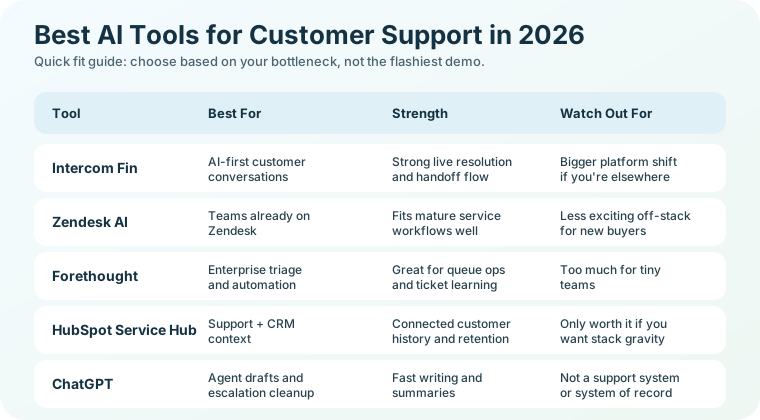
The best AI tools for customer support at a glance
- Best AI-first customer support platform: Intercom Fin
- Best for teams already on Zendesk: Zendesk AI
- Best for enterprise ticket automation and triage: Forethought
- Best for support plus CRM context in one stack: HubSpot Service Hub
- Best lightweight support sidekick for drafts and escalations: ChatGPT
What is changing in this category
Support AI used to mean glorified chatbots and FAQ trees. That is not the real market anymore. The stronger 2026 tools are all pitching some version of the same thing: higher resolution rates, cross-channel automation, richer handoffs, and more action-taking instead of keyword-matching. Intercom is framing Fin around outcome-based pricing and complex query handling. Zendesk is positioning AI around resolution, copilot workflows, and large-scale service ops. Forethought is leaning into agentic automation, historical ticket learning, and multi-agent systems. HubSpot is pushing the connected-data angle so support teams can work with service history, retention signals, and CRM context in one place.
That is why the buying mistake in 2026 is not “buying AI too early.” It is buying the wrong category of AI. If your main problem is low-quality human responses, buy agent assist. If your main problem is repetitive tickets, buy resolution automation. If your main problem is fragmented customer context, buy the stack that unifies support with CRM.
1. Intercom Fin: best AI-first support platform
Intercom Fin is the clearest recommendation if you want AI to sit directly in front of customers and actually handle a meaningful share of conversations. Intercom's current product messaging is aggressive for a reason: it is selling Fin as a real AI agent, not just a workflow add-on. The product page emphasizes complex-query handling, training on procedures and policies, support across channels, and continuous performance improvement. The pricing page also makes the commercial model unusually concrete: Fin is priced per outcome, which is cleaner than vague “AI add-on” pricing if you care about operational ROI.
The practical strength here is that Intercom is built around conversational support already. Fin makes the most sense for SaaS and digital-first teams that want one system where customer messaging, AI resolution, and human handoff all live together.
- Best fit: AI-first support orgs, SaaS support, high chat volume, teams that want strong handoff design
- Weak spot: may be a bigger platform change than you want if your help desk is already deeply embedded elsewhere
2. Zendesk AI: best for Zendesk-centered support teams
Zendesk AI is the safer recommendation when your company is already committed to Zendesk and wants deeper automation without ripping out the core support system. Zendesk is now explicitly framing its AI around fast resolutions, AI agents that can resolve 80%+ of interactions, copilot support for agents, and admin-level optimization tools. More importantly, it is doing that inside a product support leaders already know how to buy and manage.
That makes Zendesk AI less exciting than a greenfield AI-first rollout, but often more realistic. If your reporting, routing, knowledge base, and service workflows already run through Zendesk, staying in-stack is usually the smarter move.
- Best fit: mature support teams already on Zendesk, omnichannel support, orgs that want AI without a platform migration
- Weak spot: less compelling if you are not already getting value from Zendesk's broader service stack
3. Forethought: best for enterprise automation, triage, and routing
Forethought is one of the more credible enterprise AI support bets because it is not just claiming to answer customer questions. Its product story is built around learning from historical tickets and help-center content, classifying requests, automating resolution, and supporting agents through the whole support journey. The company is leaning hard into “fully agentic” language, but the practical read is simpler: Forethought is strongest when you need better ticket handling at scale, not just a friendlier support widget.
This is why Forethought is a serious option for larger support teams that care about queue shape, deflection, routing, and resolution metrics. It feels less like a chatbot and more like support operations infrastructure.
- Best fit: enterprise support operations, large ticket queues, triage automation, teams with rich historical support data
- Weak spot: probably too much platform for a tiny team that mainly needs a good help center and a few AI replies
4. HubSpot Service Hub: best for support teams that need CRM context
HubSpot Service Hub is the best pick on this list when the real problem is not just support replies. It is customer context. HubSpot's service pitch is built around AI-powered help desk workflows tied directly to the broader customer platform. That matters because support often has to work with the full account story: deal stage, marketing touchpoints, customer health, retention signals, and historical interactions. HubSpot is making that one-system argument directly with Service Hub, Breeze Customer Agent, knowledge-base automation, and customer-success workflows.
For growing teams, that can be more valuable than slightly better bot sophistication. If support, sales, and success are all stepping on each other because nobody shares context well, a connected stack beats another isolated AI layer.
- Best fit: SMB and mid-market teams using HubSpot, support-plus-success workflows, retention-focused support operations
- Weak spot: less attractive if you already have a strong standalone help desk and do not want the CRM gravity
5. ChatGPT: best lightweight sidekick for human agents
ChatGPT is not a customer support platform, and pretending otherwise is how teams end up with messy shadow workflows. But it still belongs on this list because many support teams do not need a full AI support suite as the first purchase. They need something that helps human agents write clearer replies, summarize long threads, turn messy notes into macros, extract patterns from tickets, and draft escalation updates faster.
OpenAI's current product positioning makes ChatGPT useful for exactly that layer of work: writing, file analysis, web search, charts, and broader professional-task support. Used carefully, it can be a cheap way to improve agent throughput before you commit to a specialized support platform.
- Best fit: response drafting, macro creation, QA summaries, ticket pattern analysis, escalation rewrite help
- Weak spot: not a system of record, not a help desk, and risky if agents paste sensitive customer data into it carelessly
What most support teams should buy first
Most support leaders should buy based on the workflow that is actually breaking.
- Choose Intercom Fin if you want AI handling live customer conversations and you are willing to optimize around an AI-first support model.
- Choose Zendesk AI if your team already runs on Zendesk and wants stronger automation without adding migration pain.
- Choose Forethought if support operations, triage, and enterprise-scale queue management are the real bottlenecks.
- Choose HubSpot Service Hub if support quality depends on CRM context, retention workflows, and connected customer data.
- Choose ChatGPT first if you mostly need your human agents to write faster and think more clearly before investing in a larger support stack.
The simple rule is the same one we use in other buyer guides: buy for the bottleneck, not the demo. Teams that follow that rule usually waste less money and get to measurable value faster.
What to watch out for
- Do not judge support AI only on deflection. A bad automated answer that avoids a human is not a win.
- Do not buy a customer-facing AI agent if your help content and policies are still chaos.
- Do not skip handoff quality. The AI should make human support better, not dump contextless leftovers into the queue.
- Do not use a general AI app as your support stack just because it writes nice sentences.
If the trust question is still unresolved internally, our guide to whether ChatGPT is safe is worth reading before you normalize AI use inside a support team.
Our verdict
The best AI tools for customer support in 2026 are getting more specialized, which is good news for buyers. Intercom Fin is the strongest AI-first pick. Zendesk AI is the smartest in-stack choice for Zendesk teams. Forethought is a serious operations play for larger support orgs. HubSpot Service Hub is the best connected-data choice for growing teams. ChatGPT is still the easiest lightweight sidekick for support agents who need faster drafting and summarization.
If you only remember one thing, make it this: the best support AI is not the one with the flashiest demo. It is the one that improves resolution quality, preserves trust, and makes your human team sharper where customers actually feel it.