Best AI tools for lawyers is a real buyer search now because legal teams have moved past curiosity and into workflow pressure. They want faster drafting, better document review, stronger research support, and less admin drag — but they also need defensible outputs, clear security boundaries, and something that fits how legal work actually gets done.
That makes legal AI a different category from generic productivity AI. A flashy chatbot is not enough. The useful tools are the ones that either ground answers in verifiable legal sources, stay connected to matter context, or materially speed up contract review inside the environments lawyers already use. If you are still evaluating general-purpose assistants first, our guides to ChatGPT vs Claude, whether ChatGPT is safe, and AI writing tools compared are the better starting point.
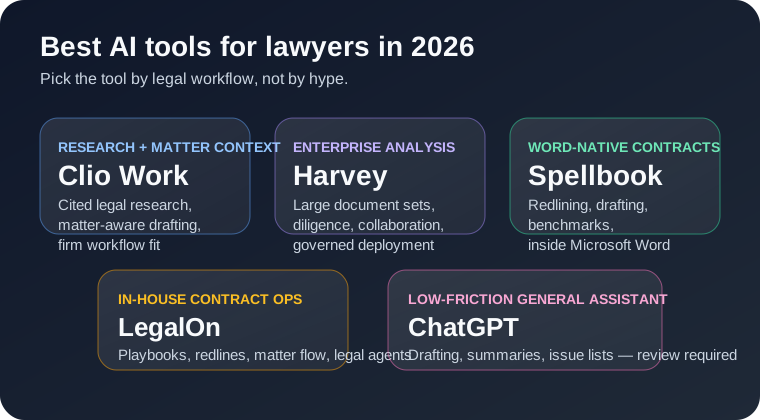
The best AI tools for lawyers at a glance
- Best for broad legal research plus matter-aware workflow: Clio Work
- Best for enterprise legal analysis and large document sets: Harvey
- Best for contract drafting and redlining in Microsoft Word: Spellbook
- Best for in-house contract review with built-in playbooks: LegalOn
- Best starting point for solo lawyers who need low-friction drafting help: ChatGPT
Why this category is hot right now
Fresh demand is obvious. In just the last few weeks, Clio has pushed its AI research and matter-aware positioning harder, Harvey has been publicly highlighting collaboration features and enterprise adoption, and vendors like Spellbook and LegalOn are leaning into agent-style workflows and faster contract execution. That is usually what happens when a category moves from experiments to budget line items.
The practical shift is this: lawyers are no longer just asking whether AI can help. They are asking which kind of AI fits their actual work. Litigation research, contract review, matter management, and intake are different jobs. One tool rarely wins all of them.
1. Clio Work: best for research with matter context
Clio Work looks strongest when a legal team wants AI grounded in legal authority and connected to the daily operating context of the firm. Clio’s current positioning emphasizes a legal library with over a billion documents, cited outputs, good-law validation, and awareness of what is already happening inside Clio Manage. That combination matters. Legal work gets a lot more useful when the system knows the documents, deadlines, communications, and matter history without needing a new upload ritual every time.
This makes Clio Work a better fit for firms that want research and drafting help inside a broader practice system, not just a standalone prompt box. It is especially appealing for teams that want one platform handling both the business of law and the work product around it.
- Best fit: cited legal research, matter-aware drafting, timeline building, document analysis inside a Clio-centric workflow
- Weak spot: strongest value shows up when the firm is already committed to Clio rather than piecing together separate systems
2. Harvey: best for complex analysis at enterprise scale
Harvey is the tool on this list that feels most aligned with large law firms and enterprise legal departments dealing with complexity, collaboration, and large document collections. Harvey’s public messaging centers on secure legal AI, measurable time savings, enterprise controls, and use across more than a thousand law firms and in-house teams. Separate recent legal-tech coverage has also highlighted Harvey’s push around shared spaces and collaboration, which fits the kind of work where one lawyer is not the only user in the loop.
That makes Harvey less of a casual drafting assistant and more of a legal-analysis platform. If your workflow involves diligence, issue spotting across large repositories, or multi-person review on high-value matters, Harvey is one of the strongest names in the category.
- Best fit: enterprise legal teams, large-scale analysis, diligence, cross-team collaboration, governed deployments
- Weak spot: likely too heavy and too expensive for solo firms or teams that mainly need contract help and light drafting
3. Spellbook: best for contract work inside Word
Spellbook is interesting because it is not trying to be everything. Its positioning is blunt: legal AI for contracts, directly in Microsoft Word, with review, drafting, research, and benchmarking grounded in market data. That narrower scope is a strength. A lot of contract work stalls because lawyers lose time jumping between Word, email, precedent folders, and generic AI tools that do not understand the negotiation context.
If your team lives in commercial agreements and wants faster redlines without changing the basic workflow, Spellbook is one of the clearest fits. It also has a stronger argument than many competitors for transactional teams that want AI help without abandoning the Word-native review process they already trust.
- Best fit: contract review, redlining, clause drafting, transactional teams, law firms doing high-volume commercial work
- Weak spot: narrower value if your core pain is legal research, litigation analysis, or practice management rather than contracts
4. LegalOn: best for in-house legal teams standardizing contract review
LegalOn’s current product story is built around one thing legal departments care about: reviewing contracts faster while keeping standards consistent. The platform leans heavily on AI-assisted redlining, customizable playbooks, matter management, knowledge systems, and new AI agents designed for in-house legal workflows. Its positioning is more operational than flashy, which is usually a good sign in legal software.
That makes LegalOn especially compelling for in-house teams dealing with repeatable commercial agreements, policy guardrails, and pressure to turn contracts faster without burning outside counsel budget. It feels less like a broad legal-intelligence system and more like a serious contract operations platform.
- Best fit: in-house legal departments, standardized contract review, business-side collaboration, repeatable playbook enforcement
- Weak spot: less compelling if your main need is research-heavy legal analysis outside the contracting workflow
5. ChatGPT: best low-friction starting point for solo lawyers and small firms
ChatGPT is still the easiest first stop for lawyers who need help with drafting, summarizing, brainstorming, client communications, and workflow cleanup. It is not legal-tech-native in the way the tools above are, and that matters. But it is flexible, fast, and familiar. For solos and small firms, that can be enough to justify the subscription before investing in legal-specific software.
The rule is the same one we keep making elsewhere on this site: use ChatGPT for acceleration, not blind trust. It can help produce first drafts, issue lists, document summaries, and client-facing explanations. It should not be treated as a final authority. That is especially true in legal work, where a polished wrong answer is still wrong. If you want the broader version of that decision, see how to use ChatGPT to save time and our plain-English ChatGPT explainer.
- Best fit: solos, small firms, first drafts, summarization, client communication, general workflow support
- Weak spot: not grounded in your matter system or verified legal authority by default, so review discipline matters a lot
What most legal teams should actually pay for first
Most teams should not buy five legal AI tools at once. A better order looks like this:
- Start with ChatGPT if the biggest pain is drafting, summarizing, and internal writing speed
- Choose Clio Work if you want legal research plus matter-aware context in a firm operating system
- Choose Harvey if you are an enterprise team doing high-complexity analysis across large document sets
- Choose Spellbook or LegalOn if contract review is where the time and risk actually live
The honest buying question is not “which legal AI is smartest?” It is “where does our legal workflow still feel slow, repetitive, or fragile?” Buy for that bottleneck first.
Our verdict
The best AI tools for lawyers in 2026 are more specialized than many buyers expect. Clio Work is the strongest fit for firms that want cited legal intelligence tied to matter context. Harvey looks strongest for enterprise-grade analysis and collaboration. Spellbook and LegalOn are the clearer fits for contract-heavy teams, with Spellbook leaning harder into Word-native drafting and LegalOn leaning harder into in-house legal operations.
For many solos and small firms, ChatGPT is still the easiest place to begin — just not the place to stop if legal AI becomes a real part of the workflow. The smartest path is not buying the most advanced platform first. It is buying the tool that removes the most expensive friction in your actual legal work.