The best AI tools for marketers in 2026 are not just copy generators anymore. The useful stack now covers research, planning, creative iteration, meeting notes, analytics cleanup, and faster campaign production without forcing you into a giant enterprise suite.
That shift matters because the job changed. Fresh 2026 marketing coverage keeps pointing to the same pressure: AI is now shaping how people search, compare products, and evaluate brands before they ever click through. Marketers need tools that help them move faster and think more clearly, not just flood the internet with more bland content.
If you are a solo creator or small team, our AI tools for content creators guide is a strong companion read. If you mainly need help choosing a writing assistant, go to our AI writing tools comparison. And if your work touches pipeline and revenue, our AI tools for sales teams guide covers the adjacent handoff problems marketers keep running into.
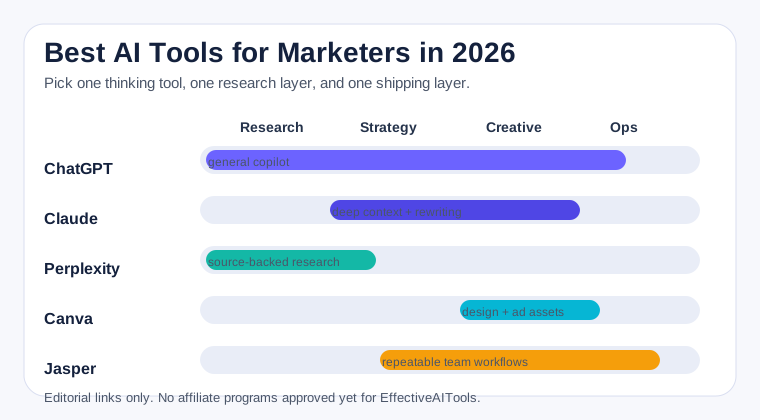
Quick answer: which AI tools should marketers use?
- Use ChatGPT if you want the best general-purpose marketing copilot for briefs, messaging, campaign ideas, and analysis.
- Use Claude if you work with long strategy docs, positioning work, research synthesis, or nuanced rewriting.
- Use Perplexity if your bottleneck is fast market research, competitor scanning, and source-backed answers.
- Use Canva if you need fast ad creative, social graphics, and branded visual output without a designer for every asset.
- Use Jasper if you are trying to scale repeatable marketing workflows across a team, especially with brand controls.
For most marketers, ChatGPT is the best AI tool to start with in 2026 because it is the most flexible across campaign planning, drafting, analysis, and ideation. But the best stack is usually not one tool. It is one general model, one research tool, and one production layer.
Why this category is hot right now
The freshness signal is real. Recent marketing coverage in March 2026 keeps centering the same themes: zero-click search pressure, AI-assisted research, faster content operations, and workflow automation that goes beyond drafting. That makes "best AI tools for marketers" a commercially strong topic right now because buyers are actively trying to rebuild their stack around those shifts.
It also avoids duplicate risk cleanly on this site. Effective AI Tools already covers content creators, sales teams, small business owners, and writing tools, but there is still no direct guide for marketers as a role. That leaves room for a genuinely useful hub article instead of another near-copy of an existing comparison.
ChatGPT — Best overall marketing copilot
Website: chatgpt.com
ChatGPT is still the most broadly useful AI tool for marketers because it handles the messy middle of the job well. It can turn scattered notes into campaign briefs, rewrite weak messaging, generate test angles, summarize customer feedback, and help structure content calendars without making you learn a niche workflow first.
ChatGPT is best for:
- Campaign planning and creative briefs
- Email, landing page, and ad copy iteration
- Persona and messaging exploration
- Basic analytics interpretation and reporting cleanup
Where it falls short: it is easy to get generic output if you give it generic inputs. It also is not the best source-backed research tool when you need citations and fast web context. For that, pair it with Perplexity.
Bottom line: if you only buy one tool first, ChatGPT is the safest starting point for most marketers. Our ChatGPT workflows guide shows the kind of repeatable time savings you can actually build around.
Claude — Best for strategy work and long-form thinking
Website: claude.com
Claude is especially useful when the work is more strategic than transactional. It tends to be strong at digesting long documents, spotting weak logic in messaging, improving tone, and turning sprawling ideas into cleaner positioning. That makes it a strong fit for marketers doing narrative work, brand strategy, or deep content planning rather than just short-form asset generation.
Claude is best for:
- Brand voice refinement
- Messaging strategy and positioning work
- Summarizing long research or call transcripts
- Rewriting dense drafts into cleaner copy
Where it falls short: it is not as naturally search-oriented as Perplexity, and some teams will still prefer ChatGPT as the all-purpose default because the surrounding ecosystem is broader.
Bottom line: Claude is the better second tool when your marketing work involves judgment, nuance, or long context windows. If you are deciding between the two, our ChatGPT vs Claude comparison breaks down the tradeoffs more directly.
Perplexity — Best for fast research and competitive scanning
Website: perplexity.ai
Perplexity has become one of the most useful AI tools for marketers because the research step matters more now. If your team needs to scan a market, compare positioning, pull quick source-backed answers, or understand what people are already saying around a topic, Perplexity is often faster and cleaner than traditional search plus 20 tabs.
Perplexity is best for:
- Competitor research
- Topic discovery and search intent exploration
- Pulling source-backed summaries quickly
- Preparing research notes before writing or planning
Where it falls short: it is not your main content-production tool. It is strongest upstream, before you draft, decide, or package the campaign.
Bottom line: Perplexity is one of the easiest AI subscriptions to justify if research bottlenecks are slowing your marketing team. It also pairs well with our Perplexity vs ChatGPT research guide if you are unsure where each tool fits.
Canva — Best for fast creative production
Website: canva.com
Canva is not a language model first, but it absolutely belongs in the best AI tools for marketers conversation because it compresses visual production. For marketers who need social graphics, ad variants, pitch decks, one-pagers, and branded assets quickly, Canva's AI features are useful because they sit inside a tool normal marketing teams already know how to use.
Canva is best for:
- Social creative and ad asset production
- Lightweight image editing and expansion
- Presentation and lead magnet design
- Fast variation on branded templates
Where it falls short: it is not where you do deep market analysis or nuanced copy strategy. It is a production layer, not the brain of the stack.
Bottom line: Canva is the right complement when your team needs to ship more visuals without adding more design bottlenecks. That also makes it relevant beside our AI presentation tools comparison if slide work is a big part of your role.
Jasper — Best for team-scale marketing workflows
Website: jasper.ai
Jasper still matters because it is one of the few tools built very explicitly for marketing operations rather than general chat. In 2026 its positioning is even more focused on repeatable workflows, brand context, and campaign systems. That makes it interesting for teams that need governance, templates, and more consistent output across many contributors.
Jasper is best for:
- Marketing teams with established brand rules
- Repeatable campaign workflows
- Template-heavy content operations
- Organizations that want more structure than a general chatbot gives them
Where it falls short: for solo marketers or tiny teams, Jasper can feel more operationally heavy than necessary. If you do not need governance or scale, ChatGPT plus Canva may be the simpler stack.
Bottom line: Jasper makes the most sense when your real problem is consistency across a marketing org, not just generating one more draft.
How to build the right marketing AI stack
- Solo marketer or lean startup: ChatGPT + Canva
- Content-heavy team: ChatGPT + Claude + Canva
- Research-heavy growth team: Perplexity + ChatGPT
- Larger brand or agency: Jasper + ChatGPT + Canva
That stack logic matters more than individual feature checklists. Most marketers do not need five overlapping writing tools. They need one tool for thinking, one for research, and one for shipping assets.
What marketers should not do with AI tools
- Do not publish raw AI copy without editorial judgment.
- Do not confuse faster content production with better strategy.
- Do not use AI summaries as a substitute for reading important source material.
- Do not buy an enterprise workflow tool if your team still does not have a clean process manually.
If budget matters, start with one flexible tool and add from there. Our free AI tools for small business guide is a good reality check if you are trying to stay useful without turning software spend into its own line item problem.
Verdict
ChatGPT is the best AI tool for marketers in 2026 for most people because it covers the widest range of actual marketing work without much setup friction.
Claude is the best strategy and rewriting partner. Perplexity is the best research layer. Canva is the best creative production layer. Jasper is the best fit for teams that need scalable, governed workflows.
The smart move is not buying everything. It is picking the smallest stack that helps you think faster, ship faster, and still sound like a human being who knows what they are doing.