Best AI tools for operations teams is a better search in 2026 than it was a year ago because the market finally looks less like chatbot theater and more like real process leverage. Ops leaders are no longer asking whether AI can draft an email. They are asking whether it can route requests, update systems, summarize messy work, catch process drift, and remove repetitive coordination.
The fresh March 2026 signal is strong. Recent workflow-automation roundups, technical guides, and business-agent coverage all point in the same direction: buyers want AI that sits inside operations, not beside it. That usually means workflow builders, AI-native automation layers, better documentation, and a reliable general-purpose model for exception handling.
If your main problem is project delivery rather than business operations, start with our AI tools for project managers guide. If you are choosing a general assistant first, read ChatGPT vs Claude and Copilot vs ChatGPT for work. But if your day is held together by workflows, handoffs, approvals, SOPs, spreadsheets, and too many tabs, the tools below are the better fit.
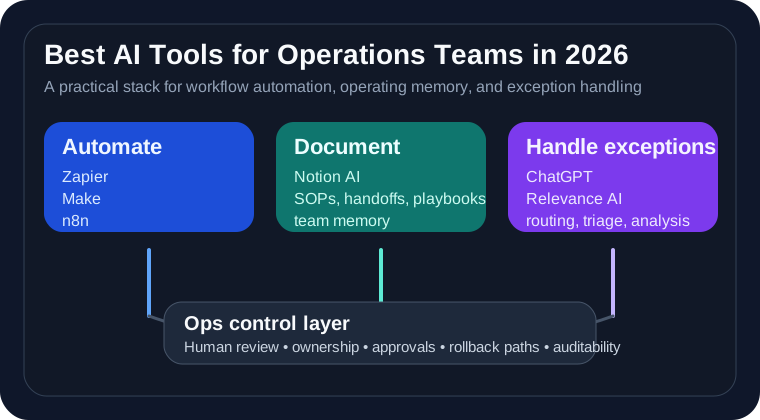
The best AI tools for operations teams at a glance
- Best overall for ops workflow automation without code: Zapier
- Best for more flexible multi-step automation design: Make
- Best for technical teams that want control and self-hosting options: n8n
- Best for process docs, internal knowledge, and operating memory: Notion AI
- Best flexible assistant for analysis, exceptions, and workflow cleanup: ChatGPT
- Best for agent-style business workflows beyond simple zaps: Relevance AI
Why this category is moving fast
Operations has become one of the clearest commercial AI categories because ops pain is measurable. If a tool removes a manual handoff, reduces time-to-resolution, or prevents a status chase, teams feel it immediately. That is different from softer AI categories where the value is real but harder to pin down.
Fresh 2026 coverage keeps reinforcing the same themes: workflow automation is shifting from static triggers toward AI-assisted routing and decision support; business teams want agents that can do multi-step work across systems; and the winning tools are the ones that combine automation, visibility, and human override. That is why the best AI tools for operations teams in 2026 are increasingly stack decisions, not single-app decisions.
1. Zapier: best overall for fast, practical ops automation
Zapier is still the easiest recommendation for many ops teams because it solves the real adoption problem: most teams do not need maximum theoretical flexibility first. They need workflows that actually get built and maintained. Zapier is good at that. Its current positioning now leans harder into AI actions and agent-style workflow creation, which matters because ops work increasingly includes messy inputs, conditional routing, and light reasoning between steps.
For operations, Zapier shines when the work spans common SaaS tools: forms, inboxes, CRM updates, spreadsheet logging, Slack alerts, approval notifications, and routine follow-up. If your team keeps saying "someone should automate this," Zapier is often the lowest-friction way to stop saying it and do it.
- Best fit: request intake, approvals, routing, cross-tool sync, lightweight AI enrichment, recurring admin work
- Weak spot: can get expensive or hard to reason about when workflows become extremely branch-heavy or deeply technical
2. Make: best for visual multi-step workflows with more flexibility
Make is the stronger fit when ops automations need more branching, richer data handling, and more visible scenario design than simple no-code workflows usually offer. A lot of operations people like Make because it feels closer to designing a process map than filling out a form. That is useful when your process is not just "if X happens, send Y" but "if this request came from this channel, transform it, enrich it, route it differently, log the exception, and notify the right owner."
In practice, Make is often where teams graduate when they have outgrown basic automations but do not want to jump straight into engineering-heavy tooling. It can be a very good middle layer for revenue ops, marketing ops, support ops, and internal operations where the process complexity is real but the team still wants visual control.
- Best fit: multi-step workflows, richer logic, data transformation, scenario-based operations, teams comfortable with a bit more complexity
- Weak spot: steeper learning curve than Zapier for non-technical operators
3. n8n: best for technical ops teams that want control
n8n is one of the most interesting tools in this category because it gives operations-minded teams a real control story. If your company cares about self-hosting, custom integrations, cost efficiency at scale, or building automations that feel closer to internal infrastructure, n8n is a serious option. It is especially attractive for technical operations teams, RevOps teams with engineering support, and anyone who hates being boxed in by SaaS pricing or platform limits.
The upside is obvious: flexibility, control, and the ability to build AI-assisted workflows that are not trapped inside someone else's guardrails. The tradeoff is also obvious: n8n is not the best first automation tool for every business user. It rewards teams that can own what they build.
- Best fit: technical ops teams, internal tooling, custom APIs, self-hosted workflows, lower-cost scale for heavier automation volume
- Weak spot: more setup and operational responsibility than mainstream no-code tools
4. Notion AI: best for process documentation and operating memory
Operations teams do not just run workflows. They maintain institutional memory. SOPs, playbooks, request rules, onboarding docs, handoff notes, meeting summaries, vendor details, and incident patterns all pile up fast. That is why Notion AI belongs here. It is not the best automation engine on this list, but it is one of the most useful operating layers for teams drowning in process sprawl.
Notion AI helps when your operations problem is not "how do I trigger an action" but "how do I keep the team aligned on how work is supposed to happen?" Searchable knowledge, cleaner summaries, faster SOP drafts, and reusable operating docs are not glamorous, but they are high-leverage. Ops teams that ignore this layer usually end up re-solving the same process confusion every month.
- Best fit: SOPs, internal documentation, process libraries, meeting summaries, onboarding, policy memory
- Weak spot: not a substitute for an automation platform when you actually need systems to take action
5. ChatGPT: best for exceptions, analysis, and ops cleanup
Every operations stack still needs a flexible brain. That is where ChatGPT fits. It is useful for cleaning up messy spreadsheet exports, drafting SOPs from rough notes, summarizing long threads, classifying requests, proposing workflow logic, and helping operators think through edge cases before they automate them. OpenAI's work-focused feature set now makes it more practical for operations than the old "chatbot" framing suggests.
The key point is that ChatGPT is best as the exception handler and analysis layer, not the whole ops stack by itself. If you try to use it as a stand-alone operations system, you will create fragile process theater. If you use it to support actual workflows, it becomes one of the highest-ROI tools on the list.
- Best fit: spreadsheet cleanup, SOP drafting, request classification, workflow design help, ad hoc reporting explanations, exception handling
- Weak spot: needs surrounding process and verification; not an operations system of record
6. Relevance AI: best for agentic business-ops workflows
Relevance AI is worth watching because it is built around the idea that business teams want AI workers and agents that can operate across tools, not just answer questions. That maps well to where operations is heading. Teams increasingly want systems that can triage, enrich, assign, summarize, follow up, and surface patterns with less manual orchestration.
This is not the safest first tool for every team, but it is one of the more interesting picks if your ops org is already beyond basic automation and actively exploring agentic workflows. The main question is not whether it sounds futuristic. It is whether your process is stable enough that you can let agents do useful work inside it.
- Best fit: agentic workflows, AI-led triage, multi-step business operations, teams experimenting beyond classic automation
- Weak spot: requires better process discipline than many teams actually have at the start
What most ops teams should buy first
Most operations teams should not start with the flashiest AI agent. They should start with the most painful repeated workflow.
- Start with Zapier if the pain is routine cross-tool work that should have been automated already
- Start with Make if the workflows are more conditional, multi-step, or data-heavy
- Start with n8n if your team has technical ownership and wants more control than SaaS no-code tools allow
- Start with Notion AI if your operations problem is really documentation debt and process confusion
- Start with ChatGPT if you need a flexible helper to map the process, clean the data, and handle exceptions before you automate
This is the same buying logic behind our guides to AI tools for sales teams, AI tools for customer support, and AI tools for marketers: buy for the bottleneck, not for the category label.
What not to do
- Do not automate a broken process just because AI makes it look easier.
- Do not let AI routing or summaries become unreviewed truth in high-risk workflows.
- Do not buy three overlapping workflow tools because each one demos well.
- Do not ignore documentation; a clever automation on top of undocumented chaos does not stay clever for long.
- Do not use agentic workflows as an excuse to avoid defining ownership, escalation paths, and rollback steps.
If security and data handling are part of the hesitation, our ChatGPT safety guide is a useful companion read before piping internal information into consumer AI tools without a policy.
Our verdict
The best AI tools for operations teams in 2026 are not the ones promising magical autonomy. They are the ones that remove repetitive coordination, make workflows more visible, and keep humans in control where judgment still matters. Zapier is the best default starting point. Make is stronger when workflow logic gets more complex. n8n is the control pick for technical teams. Notion AI handles the documentation layer too many ops teams neglect. ChatGPT is the best flexible ops sidekick. Relevance AI is one of the more serious agentic bets if your team is ready for it.
If you only take one thing from this guide, make it this: operations AI works best when it removes friction from a process you already understand. If the process is still vague, document it first. Then automate it.