Best AI tools for product managers is finally a useful search in 2026 because PMs now have better options than generic chatbot drafting. The real leverage is not "AI writes your PRD." It is AI helping you digest feedback faster, spot patterns across calls and tickets, draft cleaner specs, summarize tradeoffs, and keep stakeholders aligned without spending half your week in synthesis mode.
The fresh March 2026 signal is strong. Anthropic just published a product-management workflow piece arguing the PM rhythm is moving toward rapid experimentation and tighter feedback loops. Productboard is pushing AI-native discovery and product-brief generation harder. monday.com is leaning into AI blocks for categorization, planning, and delay prediction. The common pattern is obvious: AI is becoming most useful where product work gets noisy, not where it needs final judgment.
If your bottleneck is execution and handoff control more than discovery, start with our AI tools for project managers guide. If you mostly need cross-functional workflow automation, read the operations teams guide. But if your day revolves around feedback, prioritization, specs, roadmap decisions, and stakeholder updates, the stack below is the better fit.
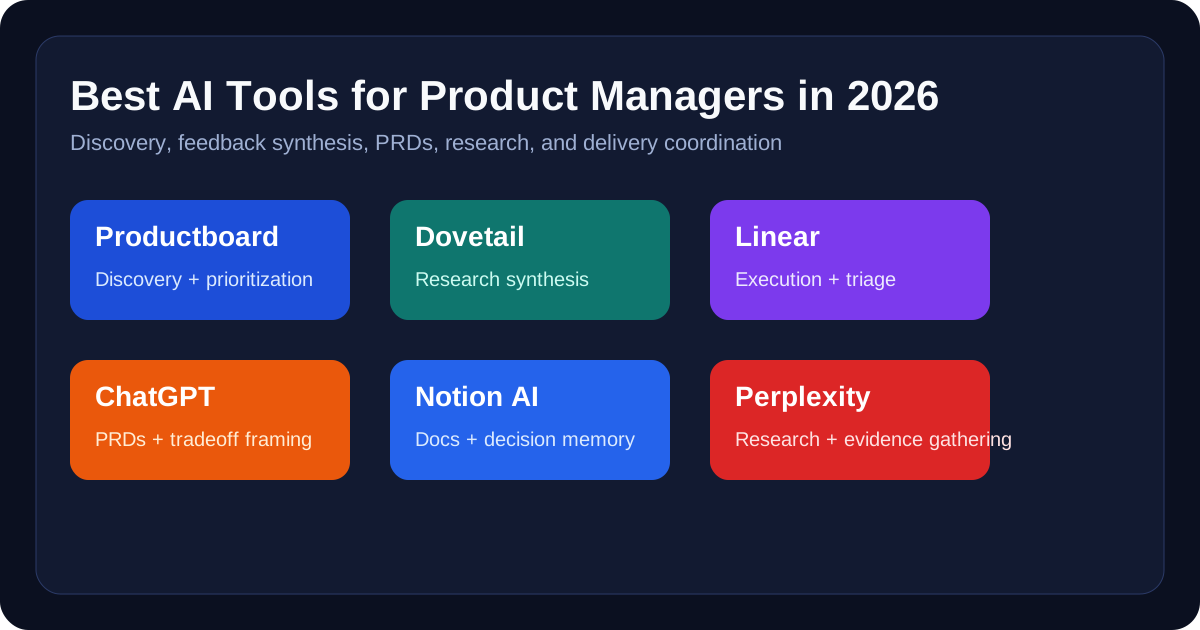
The best AI tools for product managers at a glance
- Best for product discovery and turning feedback into priorities: Productboard
- Best for qualitative research synthesis and customer-insight tagging: Dovetail
- Best for engineering-adjacent execution and issue triage: Linear
- Best flexible assistant for PRDs, tradeoff framing, and synthesis cleanup: ChatGPT
- Best for product docs, wiki cleanup, and decision memory: Notion AI
- Best for fast competitive research and evidence gathering: Perplexity
Why product managers are buying differently in 2026
PM AI buying has shifted from curiosity to workflow economics. Product managers do not win because they generated one more polished paragraph. They win when they reduce the lag between signal and decision. That means fewer hours buried in notes, cleaner feedback synthesis, faster PRD first drafts, better visibility into what users keep repeating, and tighter communication with design, engineering, support, and leadership.
That is also why this category overlaps with, but does not duplicate, the broader AI tools for small business angle or our role-based business stack articles. Product managers need tools that help with discovery, prioritization, and product communication specifically. A generic business assistant is not enough if it cannot structure product evidence or keep the team close to actual user pain.
1. Productboard: best for AI-assisted product discovery and prioritization
Productboard is one of the strongest fits for PMs because it is aimed directly at the work product teams actually do: collecting customer signals, organizing opportunities, prioritizing ideas, and turning scattered evidence into structured product direction. Its newer AI layer matters because this is exactly where product work gets bottlenecked. Feedback piles up across support tickets, call notes, CRM comments, Slack threads, and survey responses. PMs do not need another blank page. They need help clustering the noise into decisions.
If your team already has a lot of inputs but weak synthesis, Productboard is a serious first buy. It is especially useful for PMs who need to connect roadmap discussions back to customer evidence instead of whoever talked loudest in planning.
- Best fit: discovery workflows, feedback clustering, feature opportunity framing, roadmap evidence
- Weak spot: more value for teams with meaningful feedback volume than for solo builders with very little customer data
2. Dovetail: best for qualitative research synthesis
Dovetail is the tool on this list that most directly attacks PM synthesis debt. If you spend too much time rewatching calls, cleaning up interview notes, tagging themes manually, or trying to explain user pain from memory, Dovetail helps. Product managers who work closely with research, design, or customer-facing teams usually get the most value because the platform is built around making qualitative data easier to search, structure, and reuse.
That matters more in 2026 because product teams are expected to move faster while staying close to customer reality. AI-generated summaries are only useful if they stay grounded in source material. Dovetail is better than a general chatbot when you need that traceability.
- Best fit: interview synthesis, call-note analysis, research repositories, theme extraction, evidence-backed product insights
- Weak spot: less essential if your product org rarely runs interviews or already has strong research ops
3. Linear: best for fast execution close to engineering
Linear belongs here because some PMs do not primarily suffer from discovery chaos. They suffer from execution drag. Linear works well when the product manager is deeply embedded with engineering and needs clean issue triage, strong velocity, and less project-management sludge. AI features that help summarize issues, triage work, and reduce admin overhead are more meaningful in this environment than big abstract strategy promises.
It is not the best product-discovery system on this list, but it is one of the best fits for PMs working on software products where turning product decisions into shipped work quickly is the main advantage.
- Best fit: engineering-heavy product teams, issue triage, execution flow, cleaner product-engineering handoffs
- Weak spot: not a complete answer for discovery, research, or executive-facing roadmapping by itself
4. ChatGPT: best for PRDs, strategy memos, and messy product thinking
Every PM stack still needs a flexible thinking partner, and ChatGPT is one of the most useful tools for that layer. It is strong for drafting PRD skeletons, rewriting unclear requirements, turning rough product notes into stakeholder-ready updates, pressure-testing tradeoffs, and cleaning up product thinking before it gets exposed to the whole company. Used well, it reduces the friction between "I know what I mean" and "the team can act on this."
The catch is the same as always: a PM who treats ChatGPT as the source of product truth will make worse decisions. It should be paired with actual user evidence, not used as a substitute for it. For raw drafting leverage, though, it is still one of the highest-ROI tools on the list. If writing is your weakest or slowest PM skill, also see our AI writing tools comparison and ChatGPT vs Claude.
- Best fit: PRD drafts, strategy memos, release notes, stakeholder updates, tradeoff framing, brainstorming
- Weak spot: needs source grounding and review; it will happily produce clean nonsense if you feed it weak inputs
5. Notion AI: best for product docs and decision memory
PM teams often underestimate how much product work breaks because nobody can find the old decision, the latest spec, the rationale behind a roadmap call, or the current onboarding notes for a feature area. Notion AI is useful because it improves the product-memory layer. It helps summarize long docs, answer questions across the workspace, clean up draft pages, and make product documentation less painful to maintain.
This is not the most exciting category, but it is real leverage. Product organizations that get bigger without a decent decision-memory system spend months re-litigating work they already decided once.
- Best fit: PRD repositories, decision logs, wiki cleanup, handoff docs, launch planning, onboarding new PMs
- Weak spot: weak substitute for dedicated discovery or delivery tools if those are your actual bottlenecks
6. Perplexity: best for competitive research and fast evidence gathering
Product managers do a lot of lightweight research that is too messy for a normal search engine and too factual for freestyle brainstorming. Competitive checks, market scans, documentation lookups, adjacent-product examples, and fast evidence gathering all fit here. Perplexity is useful because it speeds up that layer while keeping citations visible. That makes it a better fit than generic chat when you need to move fast but still want something you can verify.
It is especially helpful during early discovery, positioning work, and stakeholder prep. If your product role has a lot of market-facing or competitive pressure, this is one of the easiest tools to justify.
- Best fit: competitive scans, market research, evidence gathering, faster product briefs, launch prep
- Weak spot: still needs verification, especially when you are making bets off fast summaries
What most product managers should buy first
Most PMs should not start by asking which AI tool looks smartest in a demo. Start with the worst bottleneck in your current product loop.
- Start with Productboard if your biggest issue is too much feedback and weak prioritization
- Start with Dovetail if research synthesis keeps getting delayed or lost
- Start with Linear if delivery is bogged down and product-engineering flow is too heavy
- Start with ChatGPT if documentation, PRDs, and stakeholder communication are the drag
- Start with Notion AI if your product org keeps losing context and redoing decisions
- Start with Perplexity if market research and competitive intelligence are too slow and too manual
This is similar to the buying logic in our guides for customer success teams and sales teams: buy for the recurring decision bottleneck, not the flashiest AI category label.
What not to do
- Do not let AI summaries replace reading enough raw user evidence to know what is real.
- Do not assume a polished PRD means the product decision was good.
- Do not buy separate AI tools for notes, docs, roadmaps, and research if one stack already covers 80 percent of the need.
- Do not feed sensitive customer or roadmap context into tools without understanding your data controls.
- Do not confuse product-manager AI with project-manager AI; synthesis and prioritization are different problems than tracking execution.
If your team is still figuring out where to trust general assistants versus grounded product tools, our ChatGPT safety guide is worth reading before pasting customer notes or internal strategy into consumer AI products casually.
Our verdict
The best AI tools for product managers in 2026 are the ones that reduce synthesis debt and speed up better decisions, not the ones pretending to replace product judgment. Productboard is the best fit for discovery and prioritization. Dovetail is the research-synthesis pick. Linear is strongest for PMs close to engineering execution. ChatGPT remains the flexible writing and thinking layer. Notion AI is the practical product-memory system. Perplexity is the fastest research helper on the list.
If you only take one thing from this guide, make it this: product AI works best when it shortens the path from customer signal to team action. If it only gives you prettier documents, you bought the wrong thing.