Best AI tools for project managers is now a real buyer-intent search because PMs are getting squeezed from both sides. Leadership wants faster delivery and cleaner reporting. Teams want fewer check-ins, fewer duplicate updates, and less death by admin. The useful tools in this category are not the ones that merely generate prettier text. They are the ones that help project managers see risk earlier, keep decisions visible, and turn messy meetings into actual follow-through.
March 2026 freshness signals are strong. Asana is pushing AI Teammates built around cross-team execution, monday.com is leaning hard into predictive work management and digital workers, ClickUp keeps expanding workspace-native AI, and Notion is now framing AI as an internal team that can write updates, answer questions, and automate recurring work. That usually means the category is maturing from novelty to budget line item.
If your main problem is still meeting capture, start with our AI meeting assistant comparison. If you are choosing a general work assistant first, read Copilot vs ChatGPT for work. But if the bottleneck is planning, coordination, reporting, and project follow-through, the tools below are a better fit.
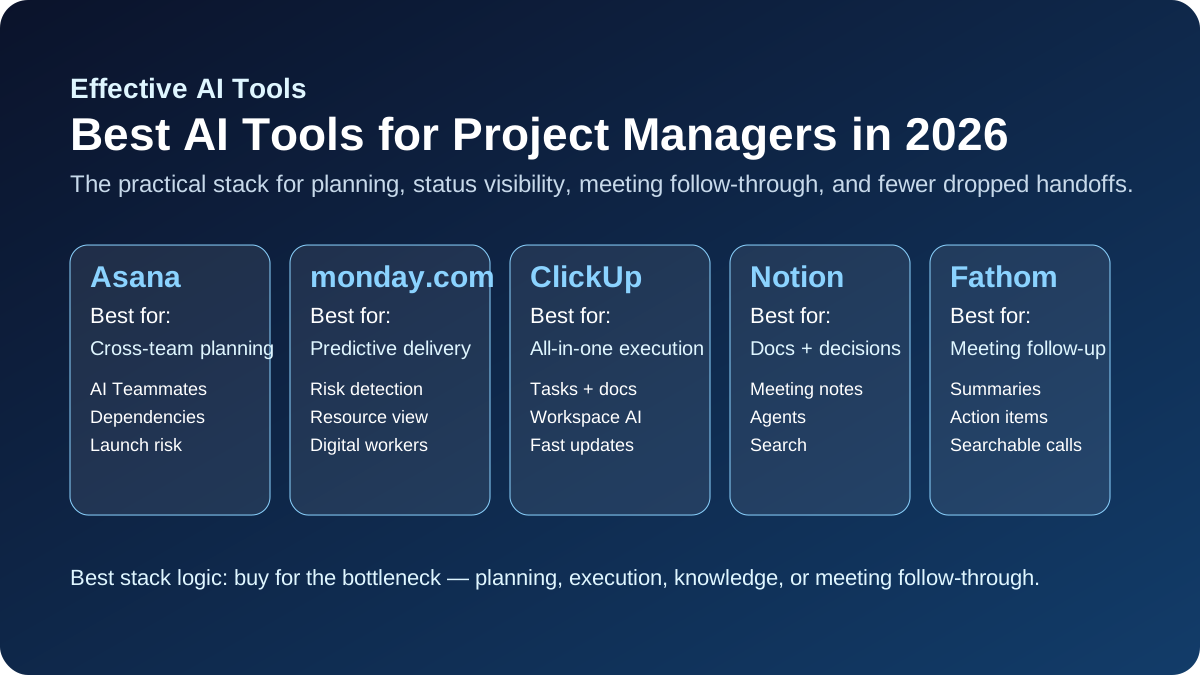
The best AI tools for project managers at a glance
- Best for cross-team planning and dependency-heavy launches: Asana AI Teammates
- Best for predictive delivery visibility and resource planning: monday work management
- Best for teams that want tasks, docs, and AI in one place: ClickUp Brain
- Best for project documentation, decisions, and searchable team knowledge: Notion AI
- Best for turning meetings into action items without extra admin: Fathom
Why project managers are buying differently now
Project managers used to evaluate software mostly on boards, timelines, and reporting dashboards. That is still part of the decision, but it is no longer enough. In 2026, the question is whether the tool helps the PM do less manual coordination while seeing more of the real project state.
That is why current vendor messaging has shifted toward predictive risk detection, AI-generated status reports, workload balancing, meeting summaries, and agents that can execute recurring workflow steps. The market is not just selling “AI for productivity.” It is selling fewer dropped handoffs.
1. Asana: best for cross-team planning and launch risk
Asana currently has one of the clearest stories for serious project coordination. Its latest AI Teammates push is explicitly about work that spans teams, dependencies, approvals, and handoffs instead of personal to-do-list fluff. The interesting part is not the label. It is the use case. Asana is positioning specialized agents for campaign briefs, workflow optimization, status reporting, and launch planning, all tied to work already happening inside the system.
That makes Asana especially compelling for PMs running launches or cross-functional programs where one slip in engineering, legal, or ops can quietly wreck another team’s timeline. If your projects are mostly about dependency management and alignment across departments, Asana has a strong argument.
- Best fit: launch planning, dependency-heavy work, structured cross-functional execution, PMOs that need clearer status visibility
- Weak spot: can feel heavier than you need if the team mainly wants lightweight task tracking and simple checklists
2. monday.com: best for predictive delivery and resource visibility
monday.com is leaning into a practical AI message for work management: move from reacting to problems after the deadline slips to seeing trouble earlier. Its recent 2026 work-management coverage centers on predictive insights, smarter resource allocation, no-code AI blocks, and digital workers that handle recurring coordination tasks.
That is a good fit for project managers dealing with portfolio risk, team capacity, or projects that fail slowly before anyone says it out loud. monday.com makes the most sense when the problem is not just task tracking, but early visibility into workload imbalance and delivery risk.
- Best fit: delivery forecasting, workload balancing, multi-project visibility, operational teams that want AI without a big technical setup
- Weak spot: less appealing if your organization already has deep process investment in a competing work-management stack
3. ClickUp: best for all-in-one execution with built-in AI
ClickUp keeps pushing the all-in-one angle, and for project managers that matters more than people admit. A lot of PM pain is not lack of intelligence. It is context fragmentation. Work lives in tasks, docs, chats, status comments, and scattered notes. ClickUp Brain is designed to sit inside that workspace context so the PM can summarize updates, draft plans, pull task context, and reduce the constant tab-switching tax.
If your team wants one environment for tasks, docs, and AI-assisted project updates, ClickUp is one of the more obvious picks. It is not always the cleanest option for every enterprise process, but it is strong when execution speed matters more than architectural purity.
- Best fit: fast-moving teams, startups, combined docs-plus-tasks workflows, PMs tired of stitching together five tools
- Weak spot: can become noisy if the workspace itself is already messy or poorly governed
4. Notion: best for project docs, decisions, and team memory
Notion AI is not the best project-management engine on this list. It is here because a lot of projects break down in the knowledge layer, not the board layer. PMs lose decisions in docs, strategy notes, Slack threads, meeting recaps, and scattered specs. Notion is now pushing AI meeting notes, enterprise search, custom agents, and workspace-aware assistance, which makes it more useful for project documentation and async coordination than the old “smart notes app” framing suggested.
If your project environment is document-heavy and the real pain is finding context, summarizing decisions, or keeping everyone aligned on the latest plan, Notion punches above its weight. It is especially good as the knowledge hub that complements another execution tool.
- Best fit: project briefs, status docs, decision logs, searchable team memory, async-heavy collaboration
- Weak spot: weaker than purpose-built PM platforms for deep dependency planning and delivery operations
5. Fathom: best for meeting follow-through
Fathom is the specialist pick here. It is not a full project-management suite, and that is the point. A lot of project slippage starts in meetings: unclear owners, forgotten commitments, fuzzy next steps, and status conversations nobody wants to re-watch. Fathom's current pitch is straightforward — capture meetings, generate summaries and action items, make conversations searchable, and sync outcomes into tools like Notion and Asana.
For PMs buried in standups, stakeholder reviews, vendor calls, and status meetings, that is real leverage. If meetings are where your projects lose clarity, Fathom can save more pain than another planning board feature.
- Best fit: heavy meeting load, stakeholder alignment, searchable call history, action-item capture, teams that already work in Zoom/Meet/Teams
- Weak spot: not enough on its own if the deeper issue is poor planning structure or weak project systems
What most project managers should buy first
Most PMs should not buy the most impressive demo. They should buy for the current bottleneck.
- Start with Asana if cross-team dependencies and launch coordination are the main source of pain
- Start with monday.com if the team needs better visibility into risk, capacity, and delivery health
- Start with ClickUp if your workflow is fragmented and you want one place for execution plus AI help
- Start with Notion if the work keeps breaking down because context, decisions, and documentation are scattered
- Start with Fathom if meetings are swallowing your week and still not producing reliable follow-through
This is the same logic behind our guides to the best AI tools for small business, AI tools for customer support, and AI tools for sales teams: do not buy AI for the label. Buy it for the failure point in the workflow.
What not to do
- Do not let AI-generated status updates replace direct reality checks with the people doing the work.
- Do not assume a smarter meeting summary will fix a broken planning process.
- Do not add another layer of AI unless it reduces tool sprawl instead of making it worse.
- Do not forget governance. The more project context and internal docs you feed into AI tools, the more permission controls matter.
If governance and data exposure are part of the buying conversation, our ChatGPT safety guide is still worth reading before teams dump sensitive project material into consumer-grade tools without a policy.
Our verdict
The best AI tools for project managers in 2026 are the ones that reduce coordination drag, not just typing effort. Asana is the strongest pick for structured cross-team planning. monday.com stands out for predictive visibility and resource management. ClickUp is strong for all-in-one execution with built-in AI context. Notion is the best support layer for project memory and decision capture. Fathom is the sharpest specialist for meeting follow-through.
If you only take one thing from this list, make it this: the right project-management AI tool is the one that makes handoffs, visibility, and follow-through less fragile. Anything else is just another dashboard.