Best AI tools for real estate agents is not really a search about shiny software. It is a search about speed. Speed replying to leads. Speed turning photos into marketable listings. Speed building listing packets, neighborhood copy, follow-up sequences, and market context without losing your whole night to admin work.
Fresh demand is obvious right now. Multiple real-estate trade sites pushed new 2026 AI roundups this month, and HousingWire also reported that AI adoption among agents is now mainstream enough that the question is no longer whether to use it, but where it actually pays off. That matters because most agents do not need an "AI stack." They need a few tools that help them win attention and keep deals moving.
This guide focuses on the practical setup. If you mainly need broader small-business tools, start with our free AI tools for small business guide. If your bottleneck is writing and repurposing marketing assets, our content creators roundup is useful context. And if you want the best general drafting model before choosing a niche tool, our ChatGPT vs Claude comparison is the right first read.
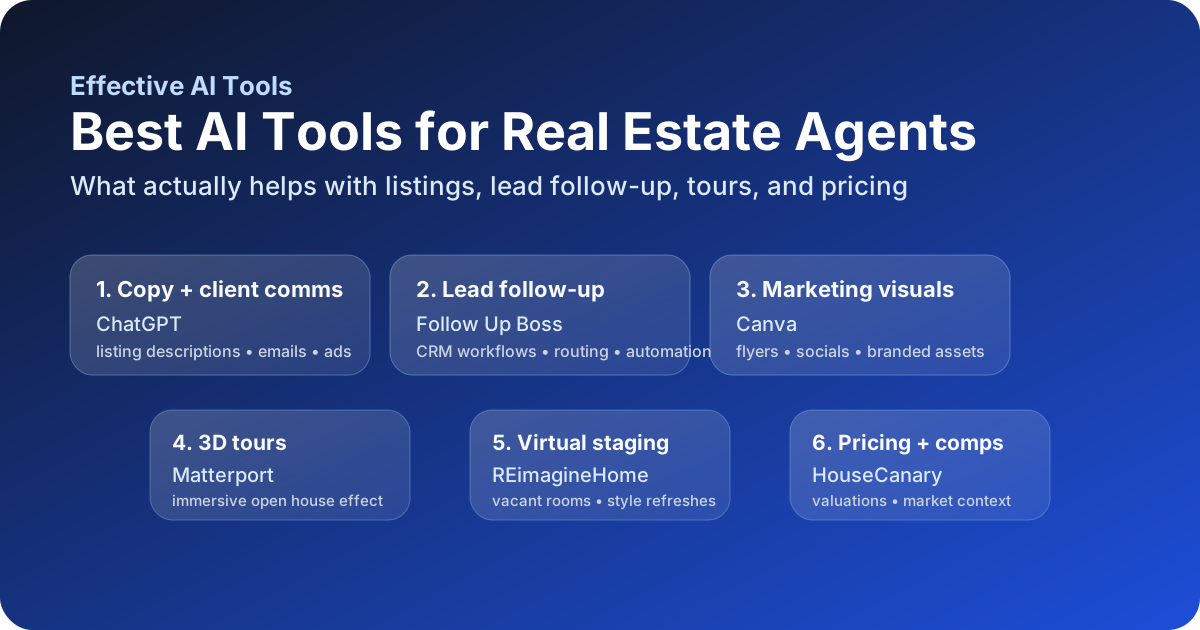
The best AI tools for real estate agents at a glance
- Best overall drafting and marketing assistant: ChatGPT
- Best for lead follow-up and CRM workflow: Follow Up Boss
- Best for fast listing graphics and social assets: Canva
- Best for immersive property tours: Matterport
- Best for AI virtual staging and room transformations: REimagineHome
- Best for valuations, comps, and market insight: HouseCanary
Why this category is heating up fast
The most credible signal is not general AI hype. It is how fast niche real-estate publications are updating their 2026 lists and training content. Recent coverage keeps clustering around the same pain points: lead response, listing presentation, virtual staging, valuation speed, and market analysis. That is a good sign for this topic because it shows real buyer intent, not just curiosity.
It also makes this article distinct from the site's existing profession pages. Our healthcare guide is about safety and compliance in a regulated profession. Real estate is a different problem: attention, responsiveness, trust, and presentation quality under brutal time pressure.
1. ChatGPT: best overall for listing copy, email, and client communication
For most agents, ChatGPT is still the most useful place to start because it handles the broadest range of daily work. OpenAI's current plans emphasize projects, tasks, custom GPTs, deeper research, memory, and stronger reasoning. In practice, that means you can use one workspace for listing descriptions, neighborhood summaries, open-house promo copy, buyer and seller FAQ drafts, objection handling, and follow-up email sequences.
The key is to treat it like a first-draft engine, not an autopilot. Give it the property facts, audience, tone, and fair-housing boundaries. Then edit the output before it goes live. The win is not "AI writes everything for me." The win is getting from blank page to good draft in minutes.
- Best fit: listing descriptions, email drafts, ad variants, buyer guides, neighborhood explainers
- Weak spot: generic output if you use lazy prompts or publish without review
2. Follow Up Boss: best for speed-to-lead and keeping conversations moving
Real estate money leaks out in follow-up. That is why Follow Up Boss belongs high on the list. Its value is not that it "does AI" in a vague way. Its value is that it gives teams a real system for routing, tracking, templating, and automating lead contact without turning the business into spreadsheet chaos.
Even its own pricing and support materials keep emphasizing monthly flexibility, data ownership, and the fact that it is built for agents who want systems rather than hobby-level lead handling. If you are already getting a meaningful number of internet leads every month, a CRM with serious follow-up automation will usually outperform adding a second chatbot subscription.
- Best fit: lead routing, text and email sequences, team accountability, repeatable follow-up
- Weak spot: overkill if you generate very few leads and still work mostly from personal referrals
3. Canva: best for fast property marketing assets
Canva is one of the highest-ROI tools for agents because real estate is a visual trust business. You need listing flyers, social posts, just-listed and just-sold graphics, open-house promos, neighborhood snapshots, and branded PDFs constantly. Canva makes that work fast enough that marketing no longer stalls because nobody had time to open a full design app.
This is especially useful for solo agents and small teams who need consistency across print and digital. A good template library plus quick resizing for different channels saves more time than most people realize.
- Best fit: listing flyers, Instagram carousels, postcard mockups, branded market updates
- Weak spot: not a substitute for strategy, copy judgment, or serious photo editing
4. Matterport: best for 3D tours and remote-buyer confidence
Matterport stays relevant because it solves a real sales problem: buyers want to pre-qualify their interest before booking time, and remote buyers need a stronger feel for the space than still photos can give them. Matterport positions its real-estate offering around immersive 24/7 open houses, and that is basically the right framing.
It will not make sense for every listing tier. But if you sell properties where presentation quality and remote confidence matter, immersive tours can help serious buyers self-select faster and cut some wasted showing time.
- Best fit: higher-value listings, relocation buyers, differentiated presentation
- Weak spot: harder to justify on every low-margin or fast-turn listing
5. REimagineHome: best for virtual staging without the old cost structure
Virtual staging is one of the clearest places where AI has immediate real-estate value. Empty rooms underperform. Dated rooms create friction. REimagineHome and similar tools let agents quickly test furnished looks, redesign directions, and room transformations without booking a traditional staging workflow for every scenario.
This is not a magic truth machine. The images still need taste, and disclosure norms still matter. But for online listing presentation, AI staging can be an efficient middle ground between raw photos and full physical staging.
- Best fit: vacant listings, style refreshes, marketing mockups, faster visual experimentation
- Weak spot: easy to overdo; unrealistic transformations can hurt trust if the output drifts too far from reality
6. HouseCanary: best for valuations, comps, and market context
HouseCanary is the more specialized pick here. It is not really for prettier marketing. It is for agents, investors, and lenders who need faster access to property data, valuations, CMAs, forecasts, and broader market insight. HouseCanary's positioning is blunt: instant access to property data and AI-powered analytics that help people make decisions faster.
That makes it more interesting for analytical agents, teams, and investor-adjacent workflows than for a brand-new solo agent who mainly needs better marketing. But if pricing confidence and property-level context are central to your business, this is the kind of niche tool that can justify itself.
- Best fit: comps, pricing support, investor conversations, market research
- Weak spot: narrower use case and steeper value threshold than a general-purpose writing or design tool
What most agents should actually pay for first
Most agents do not need all six tools. A smarter starting stack is:
- ChatGPT for copy, communication, and marketing drafts
- Follow Up Boss if lead handling is already a real volume problem
- Canva if your listing marketing looks inconsistent or slow
Add Matterport only when tour quality materially helps your listing mix. Add REimagineHome when vacant or dated interiors are costing you attention. Add HouseCanary when your business depends on stronger pricing and market analysis, not just faster content.
Our verdict
The best AI tools for real estate agents in 2026 are the tools that improve response time, listing presentation, and decision quality. For most agents, that means starting with ChatGPT for drafting, then choosing between Follow Up Boss and Canva based on where the actual bottleneck lives.
If your business is visually driven, add Matterport or REimagineHome. If your edge is analytical, HouseCanary is the more interesting upgrade. The mistake is buying AI because everyone else is talking about it. The smarter move is paying for the part of your workflow that keeps losing deals today.