Best AI tools for recruiters is now a high-intent search because recruiting teams are under the same pressure everywhere: fill roles faster, screen more applicants, and keep candidate quality high without drowning in tabs. The useful tools are not the ones promising “fully automated hiring.” They are the ones that remove the slowest parts of the workflow while keeping human judgment in the loop.
The practical stack in 2026 usually looks like this: one tool for drafting and intake support, one for sourcing, one for candidate relationship management, one for ATS and analytics, and sometimes one extra platform for faster inbound screening. If you are hiring across another specialized workflow, our guides to AI tools for real estate agents and AI tools for nurses and healthcare workers show how profession-specific constraints change the tool choice. If you are helping candidates on the other side of the table, our AI interview prep guide is the closer fit.
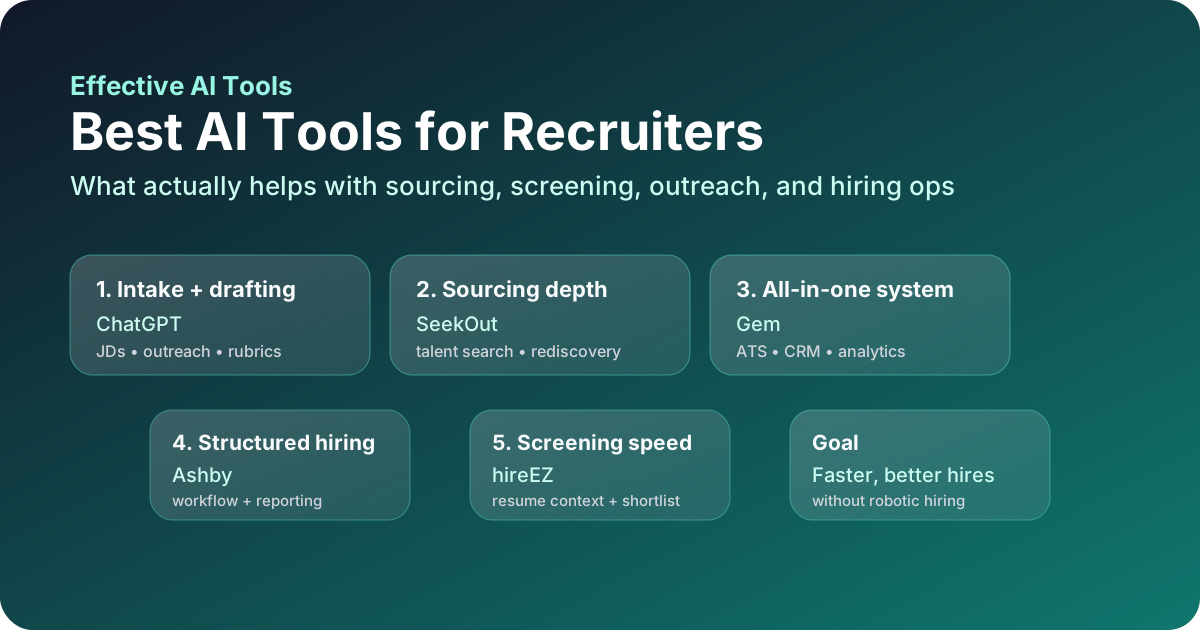
The best AI tools for recruiters at a glance
- Best overall drafting and recruiter copilot: ChatGPT
- Best for AI-powered sourcing and rediscovery: SeekOut
- Best all-in-one recruiting platform with built-in AI: Gem
- Best ATS plus structured analytics for ambitious teams: Ashby
- Best for resume screening and AI shortlisting speed: hireEZ
Why this category is hot right now
Fresh demand is obvious. In the last few weeks alone, updated 2026 recruiting-tool roundups have been published by Zapier, Recruiterflow, Bullhorn, and several recruiting vendors. That usually means buyers are actively re-evaluating their stack, not casually browsing. The pattern across those updates is consistent: sourcing, inbound screening, and recruiter productivity are where teams feel the biggest pressure.
That is why a useful recruiter roundup has to be role-based, not hype-based. The real decision is not “which AI tool is smartest?” It is “which tool removes the most friction from the part of hiring that keeps stalling?”
1. ChatGPT: best overall for intake, job descriptions, and recruiter workflows
ChatGPT is still the easiest starting point for recruiters because it handles the messy work around the hiring process better than most recruiting-specific tools. OpenAI’s current plans emphasize projects, tasks, deep research, agent mode, workspace features, and connectors. For recruiters, that translates into practical wins: turning kickoff notes into a sharper job description, rewriting outreach copy by persona, summarizing interview feedback, drafting scorecards, and building repeatable hiring playbooks.
It is especially strong when the team does not need another full recruiting system yet. If your bottleneck is recruiter communication or light workflow support, ChatGPT is often the highest-leverage first subscription. That matches the broader workflow logic in our guide to saving time with ChatGPT and the writing-side use cases in our ChatGPT email workflow guide.
- Best fit: intake notes, job descriptions, outreach drafts, interview rubrics, recruiter documentation
- Weak spot: it is not a recruiting database, ATS, or sourcing engine by itself
2. SeekOut: best for sourcing hidden talent and rediscovering past candidates
SeekOut stands out because it is not just selling keyword search. Its current positioning is built around AI recruiting workflows, inbound evaluation, search across 1B+ profiles, ATS rediscovery, and role-specific shortlisting. That matters for recruiters because a lot of strong candidates are either buried in the ATS or hard to surface with basic filters.
If your team spends too much time sourcing or revisiting old applicants manually, SeekOut is one of the clearest fits on this list. It looks strongest for sourcers, talent acquisition teams, and recruiters filling harder roles where broad search and structured evaluation matter more than basic applicant tracking.
- Best fit: sourcing, talent mapping, inbound triage, silver-medalist rediscovery
- Weak spot: likely overkill if you only hire occasionally or mostly work from warm inbound pipelines
3. Gem: best if you want one platform instead of five recruiting tools
Gem’s pitch is simple and commercially smart: ATS, CRM, sourcing, scheduling, analytics, and AI in one place. Its current site frames the product as an AI-first all-in-one recruiting platform with 800M+ profiles and built-in automation across the workflow. For teams tired of stitching together separate sourcing, nurture, and analytics tools, that is a real buying angle.
This is the right type of tool for recruiting leaders who care as much about reducing tool sprawl as adding AI. If your current recruiting stack feels like six subscriptions and a spreadsheet, Gem is one of the strongest “consolidate the mess” options.
- Best fit: unified ATS + CRM + sourcing workflows, recruiter productivity, reporting in one system
- Weak spot: migration effort can be substantial if your current ATS is deeply embedded
4. Ashby: best for structured hiring and analytics-driven teams
Ashby is not just “an ATS with AI.” Its real value is that it combines ATS, CRM, scheduling, analytics, and structured hiring workflows in a system that power users tend to like. The company’s current messaging leans heavily on AI embedded throughout the workflow, instant visibility, customization, and fairer candidate assessment.
That makes Ashby especially appealing for teams that want recruiting ops discipline, better visibility, and reporting that actually changes decisions. If Gem is the strongest consolidation play for some teams, Ashby is the stronger fit when hiring process design and analytics are part of the strategy.
- Best fit: structured interviews, recruiting ops, pipeline visibility, better reporting
- Weak spot: less useful if the company is too small to take advantage of deeper process design
5. hireEZ: best for fast resume screening and shortlisting
hireEZ is worth watching because its current positioning is very specific: agentic AI for recruiting, with a heavy emphasis on context-aware resume screening and faster shortlisting. That narrower promise is good. Recruiters rarely need another vendor claiming to do everything. They do need a faster way to identify who is actually relevant in a pile of resumes.
If inbound volume is the problem, hireEZ is the clearest specialist on this list. It looks most useful for teams that get flooded with applicants and need help narrowing to a real shortlist without relying only on crude keyword matching.
- Best fit: inbound resume review, relevance scoring, shortlist acceleration
- Weak spot: less compelling if sourcing, CRM, or ATS analytics is the bigger bottleneck
What most recruiting teams should actually pay for first
Most teams do not need five new subscriptions. A smarter order looks like this:
- Start with ChatGPT if your pain is drafting, intake quality, and recruiter admin work
- Add SeekOut or hireEZ if sourcing or screening speed is the actual bottleneck
- Choose Gem or Ashby if your bigger problem is fragmented systems, weak reporting, or inconsistent process
The honest buying rule is simple: pay for the tool that fixes the step where candidates currently get stuck. If the real problem is slow feedback loops, a sourcing tool will not save you. If the problem is weak sourcing, better interview rubrics are not enough.
Our verdict
The best AI tools for recruiters in 2026 are the tools that make hiring faster without stripping out human judgment. For most teams, ChatGPT is still the easiest place to start because it improves job descriptions, outreach, and process documentation immediately.
After that, the choice depends on the real bottleneck: SeekOut for sourcing depth, hireEZ for screening speed, Gem for all-in-one consolidation, and Ashby for structured hiring plus analytics. That is the practical frame to use. Do not buy “AI recruiting.” Buy the shortest path to a better hiring workflow.