Best AI tools for sales teams is a hot buyer-intent search right now because sales leaders are getting buried under two opposite problems at once: too much manual work and too many shiny AI promises. March 2026 coverage is full of fresh “AI sales” roundups, but most of them blur together. The real question is simpler: which tools actually help your team prospect better, coach reps better, and move deals forward without turning your stack into a mess?
The answer depends on where your sales motion is breaking. Some teams need stronger prospecting and sequence automation. Others need call intelligence, deal coaching, and forecast visibility. Others mostly need better CRM context and less rep admin. If you are still choosing a general work assistant, start with Copilot vs ChatGPT for work. If your bottleneck is adjacent to pipeline handoff and customer conversations, also read our customer-support AI guide and the AI meeting assistant comparison.
But if your goal is better outbound, cleaner pipeline management, sharper rep execution, and faster follow-up, the shortlist below is where most teams should begin.
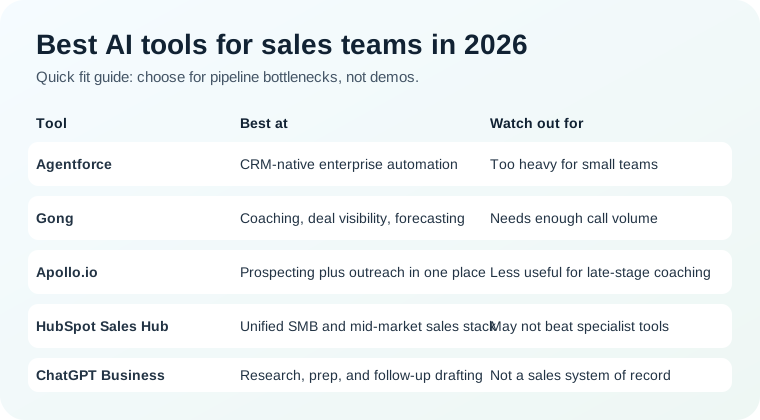
The best AI tools for sales teams at a glance
- Best for CRM-centered enterprise sales execution: Salesforce Agentforce
- Best for revenue intelligence and rep coaching: Gong
- Best for all-in-one prospecting and outreach: Apollo.io
- Best for SMB and mid-market sales teams on one customer platform: HubSpot Sales Hub
- Best lightweight sidekick for drafts, prep, and account research: ChatGPT Business
What is changing in this category
Sales AI used to be sold as a narrow add-on: call recording, email suggestions, or lead scoring. That is not the center of the market anymore. In 2026, the strongest vendors are all pushing bigger claims: agentic prospecting, AI-guided selling, autonomous follow-ups, revenue graphs, forecast correction, and customer-context orchestration. That sounds like hype until you map it to actual work. Sales teams are trying to reduce rep admin, stop dropping next steps, and improve pipeline quality without adding headcount.
That is why the buying mistake in 2026 is not “waiting too long to use AI.” It is buying the wrong layer of AI. If your pain is weak outbound execution, buy prospecting and sequence help. If your pain is rep inconsistency and forecast surprises, buy intelligence and coaching. If your pain is fragmented CRM context, buy the platform that makes your sellers more operationally consistent.
1. Salesforce Agentforce: best for CRM-centered enterprise sales execution
Salesforce Agentforce is the strongest fit when your sales motion already revolves around Salesforce and you want AI that can work inside existing workflows instead of living as another disconnected app. Salesforce is positioning Agentforce as a full agent platform that can build, test, deploy, supervise, and orchestrate AI agents across customer and employee workflows. The pitch is broader than sales alone, but that is also the point: enterprise sales teams often need AI that can act on data, not just summarize it.
For revenue teams, the practical appeal is unified context. Salesforce is leaning on intelligent context, guardrails, and action-taking across systems. If your org already depends on Salesforce for account history, routing, approvals, and pipeline management, Agentforce can be the most realistic way to layer AI into the actual revenue engine.
- Best fit: enterprise sales orgs already standardized on Salesforce, complex process automation, cross-functional account workflows
- Weak spot: overkill for smaller teams that just need better outbound and follow-up without heavy platform gravity
2. Gong: best for revenue intelligence and rep coaching
Gong remains one of the clearest answers when the real problem is execution quality. Its current positioning is explicit: a revenue AI operating system with a revenue graph, revenue-focused AI applications, and tuned agents for prospecting through expansion. In plain English, Gong is strongest when you need better visibility into calls, deals, rep behavior, forecast health, and coaching opportunities.
This matters because many sales orgs do not lose deals due to a lack of AI-generated emails. They lose because reps miss patterns, managers coach too late, and forecasts drift away from reality. Gong is good when you need the system to surface what is really happening in pipeline conversations and turn that into action.
- Best fit: coaching-heavy teams, multi-rep organizations, forecast discipline, call-rich sales motions
- Weak spot: less valuable if your team is tiny, your motion is mostly transactional, or you do not have enough sales activity to generate useful intelligence
3. Apollo.io: best for all-in-one prospecting and outreach
Apollo.io is still one of the easiest recommendations for teams that need AI help at the top of funnel, not another enterprise transformation project. Apollo's platform story is built around a large B2B contact database, precise lead targeting, sequence automation, follow-up workflows, CRM syncing, and analytics. That combination matters because many growing sales teams are really trying to solve one ugly operational problem: reps spend too much time finding people, cleaning lists, and chasing manual follow-ups.
If that sounds familiar, Apollo is often the most direct fix. It is especially useful for teams that want prospecting, enrichment, and outreach in one place instead of stitching together separate data and sequencing tools.
- Best fit: SDR teams, founder-led sales, outbound-heavy SMB and mid-market orgs, lean RevOps setups
- Weak spot: not the strongest choice if your bigger issue is post-meeting coaching, enterprise governance, or deeper CRM-native process control
4. HubSpot Sales Hub: best for growing teams that want one customer platform
HubSpot Sales Hub is the best pick here for teams that want AI in the sales workflow without buying into a highly fragmented sales stack. HubSpot is now pitching AI-guided selling, Breeze Prospecting Agent, AI-powered forecasting, meeting prep and follow-up, and unified lead management inside one customer platform. That is attractive because a lot of small and mid-market teams do not need the “best point solution” for every part of sales. They need the system to be easy enough that reps actually use it.
In practice, HubSpot wins when your sales team also depends heavily on marketing and service context. If handoffs, lifecycle visibility, and clean shared CRM data matter more than squeezing every edge-case workflow out of an enterprise platform, HubSpot is a strong middle path.
- Best fit: SMB and mid-market teams, HubSpot-centered organizations, sales + marketing alignment, teams that want simpler admin
- Weak spot: less compelling for teams that already have a mature specialist stack and do not want to consolidate
5. ChatGPT Business: best lightweight sidekick for research and follow-up
ChatGPT Business is not a sales platform, and using it as your system of record would be sloppy. But it still deserves a place on this list because many teams are not ready to buy a full AI sales stack first. They just need help with account research, follow-up drafts, discovery-question prep, objection handling, proposal rewrites, and deal-summary cleanup. OpenAI's current business positioning leans into connected company tools, custom GPTs, analysis, research, and team knowledge access, which maps well to sales support work.
Used carefully, ChatGPT Business can make reps faster without forcing a platform migration. It is best as an augmenting layer, not the thing that replaces CRM discipline or actual revenue process design.
- Best fit: follow-up drafting, call prep, account research, proposal rewrite help, lightweight sales enablement
- Weak spot: not a forecasting system, not a sequencing engine, and risky if reps use it loosely with sensitive customer data
What most sales teams should buy first
Most sales leaders should buy according to the workflow that is actually broken.
- Choose Salesforce Agentforce if your revenue engine already lives in Salesforce and you want AI that can act inside governed CRM workflows.
- Choose Gong if your biggest problem is coaching quality, deal visibility, and forecast accuracy.
- Choose Apollo.io if prospecting drag and inconsistent outreach are the clearest constraints on pipeline creation.
- Choose HubSpot Sales Hub if you want an all-in-one sales platform with AI features that your team will actually adopt.
- Choose ChatGPT Business first if your immediate win is faster rep thinking and writing rather than a full platform replacement.
The simple rule is the same one that applies across our business guides: buy for the bottleneck, not the product demo. Teams that do that usually get to revenue impact faster and spend less on overlapping software.
What to watch out for
- Do not confuse more AI-generated activity with better pipeline quality.
- Do not buy a prospecting tool when your real problem is late-stage execution and manager coaching.
- Do not let reps spray AI-written follow-ups everywhere without process standards and review.
- Do not assume a general AI assistant can replace your CRM, sequence engine, or call intelligence layer.
If your team is still sorting out governance and trust, read our guide to whether ChatGPT is safe. If you need a broader business shortlist first, our small-business AI tools guide is the better starting point.
Our verdict
The best AI tools for sales teams in 2026 are getting more specialized, which is good for buyers. Salesforce Agentforce is the strongest CRM-native enterprise option. Gong is the best intelligence-and-coaching layer for teams that want sharper execution. Apollo.io is the fastest path to cleaner prospecting and outreach. HubSpot Sales Hub is the most practical one-platform choice for many growing teams. ChatGPT Business is still the simplest lightweight sidekick for reps who need better research and faster follow-up.
If you only remember one thing, make it this: the best sales AI is not the one that promises the most autonomy. It is the one that strengthens rep judgment, improves workflow discipline, and makes real deal motion easier to sustain.