The best AI voice agents in 2026 are not just glorified phone trees with a chatbot taped on top. The good ones can hold a real conversation, pull from knowledge sources, trigger actions like booking or routing, and stay reliable enough that a business can actually trust them with live calls.
That is why this category is getting hot right now. March 2026 coverage across vendor launches, enterprise roundups, and product comparisons keeps pointing at the same shift: buyers want AI that can do customer-facing work, not just summarize it afterward. If you are still deciding whether you need an AI voice agent or a meeting note tool, start with our AI meeting assistants comparison. If your real bottleneck is frontline ticket resolution instead of phone automation, our AI tools for customer support guide is the better fit.
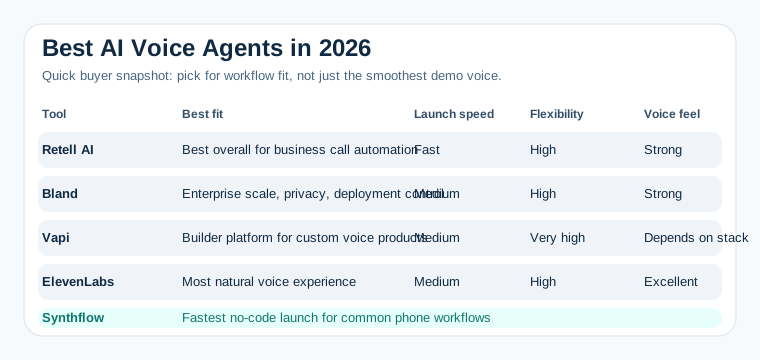
Quick answer: which AI voice agent should you use?
- Use Retell AI if you want the strongest all-around business voice agent platform for real phone workflows.
- Use Bland if you need enterprise-grade scale, tighter infrastructure control, and serious call-center ambitions.
- Use Vapi if you are technical and want to build your own custom voice stack with maximum flexibility.
- Use ElevenLabs Conversational AI if voice quality and natural feel matter most.
- Use Synthflow if you want a faster no-code path to launch with common business templates.
For most businesses trying to automate real inbound or outbound calls, Retell AI is the best default pick. For developers building a differentiated voice product, Vapi is the more interesting platform choice. For enterprises where security, deployment shape, and scale matter more than convenience, Bland is the stronger bet.
Why this category is moving fast
The freshness signal is obvious. Voice-agent vendors are now competing on latency, orchestration, deployment control, and business outcomes instead of just “listen and respond.” ElevenLabs is pushing sub-100ms conversational latency and multilingual coverage. Retell is emphasizing low-latency call performance, real-time function calling, and testing. Bland is selling infrastructure ownership, privacy, and enterprise deployment flexibility. Synthflow is leaning hard into end-to-end deployment speed. That tells you what the market actually cares about now.
In plain English: the category has moved from demo-worthy AI phone bots to platforms that are trying to replace or augment pieces of a real call center. That makes it commercially important in the same way browser automation is becoming important in our best AI browser agents guide. The value is in task completion, not novelty.
Retell AI — Best overall for real business call automation
Website: retellai.com
Retell AI is the strongest default choice because it looks the most balanced across the things that actually matter in production: responsiveness, voice quality, call-flow control, real-time actions, and clear business orientation. Its public product messaging is not vague. It is explicitly about automating calls, handling real-time function calls, syncing knowledge, and giving teams testing plus guardrails.
That matters because voice AI usually fails in the ugly middle: interruptions, transfers, turn-taking, and action steps that have to happen during a live conversation. Retell looks built around those realities instead of just pitching a pretty demo voice.
Retell AI is best for:
- Healthcare, service businesses, and operations teams automating real phone workflows
- Inbound and outbound calling where booking, routing, or data updates matter
- Teams that want a platform instead of stitching everything together themselves
- Buyers who care about testing and production reliability more than novelty
Where Retell falls short: it is not the lightest-weight choice for hobby projects, and it still lives in a category where careful prompt design, QA, and escalation logic matter a lot.
Bottom line: Retell AI is the best AI voice agent in 2026 for most businesses that want to automate calls without gambling on an unfinished stack.
Bland — Best for enterprise scale, control, and infrastructure seriousness
Website: bland.ai
Bland is the enterprise-shaped pick. Its positioning is much more infrastructure-heavy than most of the category: self-hosted options, dedicated instances, deployment flexibility, privacy control, and its own voice delivery stack. That is the right story for enterprises that do not want key customer conversations riding on a fragile chain of third-party providers.
This makes Bland more interesting than many buyers realize. A lot of AI voice evaluations focus only on how human the voice sounds. Enterprises also care about where data goes, whether deployment can happen inside their boundaries, and whether the vendor can handle serious call volume without turning into a support ticket of its own.
Bland is best for:
- Large enterprises building AI call-center capability
- Regulated or security-sensitive environments that care about stack control
- Teams that need dedicated deployment options or VPC/on-prem style flexibility
- High-volume repetitive calling operations
Where Bland falls short: it is overkill for many smaller teams, and it is less appealing if you mainly want a quick no-code launch with minimal setup work.
Bottom line: Bland is the best fit when your question is less “which AI voice agent sounds nice?” and more “which platform can we responsibly deploy at enterprise scale?”
Vapi — Best for developers building custom voice products
Website: vapi.ai
Vapi is the technical builder pick. Its homepage says exactly what the market thinks of it: build advanced voice AI agents. That is the appeal. Vapi is not trying to be the easiest boxed business product. It is attractive because developers can choose models, tune behavior, integrate deeply, and treat voice as a programmable surface rather than a fixed SaaS workflow.
If your company is building voice AI into its own product, or you care about owning the architecture more than buying a pre-shaped operations platform, Vapi is one of the clearest names to shortlist. It belongs in the same builder bucket as products we talk about in our AI coding assistants guide: more leverage, more responsibility.
Vapi is best for:
- Developers building custom voice applications or internal tools
- Teams that want flexibility around model and stack decisions
- Product teams where voice is core product functionality, not just an ops add-on
- Builders who want orchestration freedom
Where Vapi falls short: you get flexibility instead of guardrailed simplicity, which means you own more of the reliability and implementation burden.
Bottom line: Vapi is the best AI voice agent platform in 2026 for builders who want control more than convenience.
ElevenLabs Conversational AI — Best for natural voice quality
Website: elevenlabs.io
ElevenLabs has the clearest voice-quality story in this category. Its conversational platform messaging emphasizes expressive voice and chat, sub-100ms latency, multilingual support, and real-time interactions grounded in your own data. That matters because for many use cases, especially premium customer-facing ones, bad voice quality kills trust before the workflow logic even matters.
ElevenLabs is especially interesting if the voice itself is part of the product experience. If you are building a branded assistant, a multilingual front door, or something where emotional feel matters, ElevenLabs deserves a harder look than vendors whose real strength is mostly routing and infrastructure.
ElevenLabs is best for:
- Brands where natural voice quality really matters
- Multilingual or globally distributed customer interactions
- Teams that want a more premium voice feel
- Builders who care about voice experience as product differentiation
Where ElevenLabs falls short: great voice does not automatically mean the best call-operations stack, so workflow depth and enterprise operations fit still need scrutiny.
Bottom line: ElevenLabs is the best AI voice agent pick when sounding real is part of the value proposition, not just a nice extra.
Synthflow — Best for fast no-code launches
Website: synthflow.ai
Synthflow earns its spot because it is selling speed and deployment simplicity very directly. The platform pushes enterprise-ready voice AI, in-house telephony, example use cases, and workflow templates that make it easier to picture a business launching an AI receptionist, lead qualifier, or booking assistant without a long custom build cycle.
That makes Synthflow attractive for businesses that want to move now rather than fund a six-month voice platform project. It feels particularly relevant for SMB and mid-market teams that care more about getting a useful system live than about fine-grained infrastructure control.
Synthflow is best for:
- Businesses that want a quicker no-code or low-code launch
- Common use cases like reception, qualification, booking, and basic support
- Teams that want guided deployment rather than full-stack building
- Operators who value time-to-value over architectural purity
Where Synthflow falls short: if your use case is highly custom, deeply regulated, or productized into your own application, builder-first platforms may fit better.
Bottom line: Synthflow is the best voice-agent option here for teams that want to get live fast without becoming a voice AI engineering shop.
How to pick the right AI voice agent
- You want the safest all-around business choice: Retell AI
- You need enterprise deployment control and infrastructure depth: Bland
- You are building your own voice product: Vapi
- You care most about natural voice quality: ElevenLabs
- You want the fastest path to launch: Synthflow
If your buying decision crosses teams, also read our AI tools for sales teams guide and AI tools for operations teams guide. Voice agents usually are not a standalone purchase. They sit inside lead routing, appointment booking, support operations, or revenue workflows.
What not to do with AI voice agents
- Do not buy based on a demo call alone. The real test is interruptions, handoffs, actions, and messy edge cases.
- Do not put an AI voice agent in front of customers if your policies, routing paths, and escalation logic are still chaos.
- Do not treat voice realism as the same thing as operational reliability.
- Do not skip privacy review, especially if the calls touch regulated or sensitive data.
If that sounds cautious, good. It should. The trust problem gets sharper when the model is speaking to customers in real time. Our AI safety guide is still relevant here because governance gets more important once AI can act — and speak — on your behalf.
Verdict
Retell AI is the best AI voice agent in 2026 for most businesses. It is the strongest balance of production realism, workflow capability, and practical business fit.
Bland is the best enterprise-scale infrastructure choice. Vapi is the best builder platform. ElevenLabs is the best voice-quality pick. Synthflow is the best fast-launch option.
The mistake most buyers will make is thinking this is only a voice-quality contest. It is not. The right choice depends on whether you are buying for call-center operations, developer flexibility, enterprise control, or speed to launch. That matters more than who has the prettiest demo.