The best AI website builders in 2026 are finally good enough to save real time, but they still do very different jobs. Some are best for getting a service business online tonight. Some are better for a polished startup landing page. Some give you an AI-generated starting point and then hand you enough control to keep scaling without rebuilding the whole site six weeks later.
That matters because the category kept maturing this year. Wix kept pushing the conversational "tell us about your business" workflow into a broader business stack, Webflow evolved its AI site builder in February 2026 into more of a real design-system starting point, Squarespace kept leaning into Blueprint AI for guided branded setup, Framer stayed strong for fast polished landing pages, and Durable kept aiming straight at the "I need a lead-gen site now" crowd. The buyer question is not whether AI can make a website. It is which AI website builder removes the right bottleneck for you.
If your site project is part of a bigger business stack, also read our AI tools for small business owners and AI tools for freelancers guides. If your main goal is sharper messaging and landing-page conversion, our AI tools for marketers and AI tools for designers coverage is a useful companion before you commit to a platform.
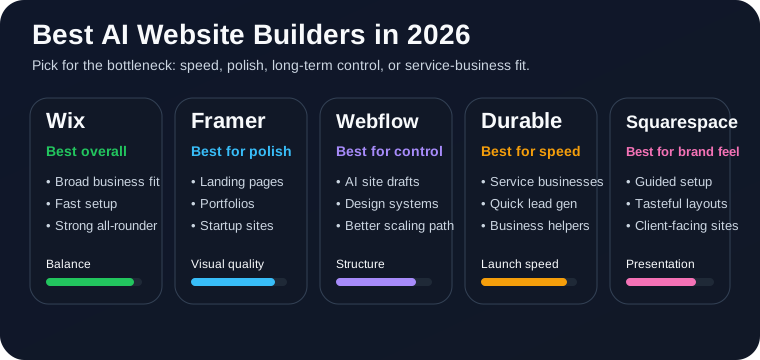
Quick answer: which AI website builder should you use?
- Use Wix if you want the best overall AI website builder for a small business, service business, or general-purpose site with room to grow.
- Use Framer if you want the fastest path to a polished landing page, portfolio, or startup site that does not look templated.
- Use Webflow if you want AI to generate the starting point but still need serious control, cleaner structure, and a better long-term scaling path.
- Use Durable if you need a service-business website fast and care more about leads, speed, and built-in business helpers than pixel-level design work.
- Use Squarespace if brand presentation matters most and you want a guided AI-assisted setup that still feels polished and client-facing.
If you only want one answer, Wix is the best AI website builder for most people in 2026. If you care most about visual polish, Framer is the better pick. If you care most about speed to a live service-business site, Durable is the easier buy.
1. Wix: best overall AI website builder for most small businesses
Wix is the easiest overall recommendation because it does the broad middle of the market well. Its AI website builder is not just a prompt toy. You describe the business, the builder creates a site brief and starting structure, and then you can keep refining layouts, text, sections, images, and brand direction without feeling trapped in a one-shot generation flow.
The bigger reason Wix wins for most buyers is that it is not only about page generation. Hosting, business tooling, SEO basics, analytics, forms, scheduling, and broader site management all live in the same place. That makes it more practical for the kind of owner who does not want to assemble a separate stack just to launch a functioning site.
- Best fit: small businesses, local services, solo operators, and general business sites
- Weak spot: less exciting than Framer for highly design-forward landing pages, and less flexible than Webflow if your team wants deeper structural control
- Buy it if: you want one platform that gets you from blank page to live site without a lot of technical choices
2. Framer: best for polished landing pages and portfolios
Framer is the pick when your standard is not just “website exists.” It is “this needs to look sharp.” The AI layer helps you skip the blank canvas by generating a responsive page with structure and starter copy, but the bigger value is what happens after that. Framer still feels like a design-first tool, which is why it keeps showing up in startup, creator, and portfolio workflows.
If your site is really a positioning asset, not just a digital business card, Framer makes more sense than the more utilitarian builders. It is especially good for founders, agencies, creators, and consultants who want a page that feels modern without dragging a design project out for weeks. It also pairs naturally with the workflows in our AI tools for content creators guide.
- Best fit: landing pages, portfolios, startup sites, agency pages, and visually opinionated personal brands
- Weak spot: not the best fit if you mainly care about built-in CRM, invoicing, or fast service-business operations
- Buy it if: the biggest risk is launching a site that looks generic or under-designed
3. Webflow: best for AI-generated starting points with serious control
Webflow is worth taking seriously now because its AI site builder has moved closer to something businesses can actually build on. The February 2026 evolution mattered because Webflow is not just trying to spit out pages. It is trying to generate a functional site plus a foundational design system you can keep shaping. That is a very different promise from “here is a quick site, good luck.”
That makes Webflow the strongest choice here for teams that want AI help at the beginning but do not want to sacrifice long-term control. If you expect to keep iterating, add CMS-heavy content, or hand the site off to someone who cares about structure, Webflow has a better scaling story than most faster builders. It is not the simplest tool on this list, but it may save you a migration later.
- Best fit: marketing teams, startups, in-house web teams, and anyone who wants stronger control after the AI draft
- Weak spot: more setup depth and a steeper learning curve than Wix or Durable
- Buy it if: you want AI to remove the blank-page problem, not replace thoughtful site ownership entirely
4. Durable: best for speed and lead-generation for service businesses
Durable stays focused on one of the most useful promises in the category: answer a few questions, get a business website fast, then use built-in helpers to start getting leads. That is why it keeps making sense for contractors, cleaners, consultants, solo service providers, and other businesses that do not need a precious design exercise. They need a site, contact forms, basic trust signals, and a way to move on with their day.
Its pitch around automated SEO, AI copy, CRM-style business tooling, and very fast setup is straightforward. If you are the kind of buyer who would rather be slightly less fancy and fully live this week, Durable is one of the clearest fits on the page.
- Best fit: local services, solo businesses, trades, and anyone who wants a fast lead-gen site
- Weak spot: less attractive if you care a lot about unique brand presentation or more advanced content structure
- Buy it if: speed to publish matters more than crafting a highly customized front-end experience
5. Squarespace: best for guided brand-first setup
Squarespace is still one of the safer recommendations for people who want their site to feel polished without turning the whole project into a technical hobby. Its Blueprint AI builder is a guided system rather than a chaotic prompt box. That matters if you want help with tone, layout direction, image suggestions, and a cleaner branded starting point instead of a one-click gamble.
I would not pick Squarespace over Framer for a cutting-edge landing page, and I would not pick it over Durable for raw speed. But for service brands, creator businesses, studios, and small shops that want a site that feels put together and client-facing, Squarespace stays very defensible.
- Best fit: service brands, creators, studios, coaches, and simple commerce or booking sites
- Weak spot: less appealing if you want either maximum speed or maximum structural control
- Buy it if: your site needs to feel tasteful and trustworthy more than experimental
What about Mixo, 10Web, and the rest?
They are not bad. They just are not my top five practical picks for most buyers right now.
Mixo is still interesting for ultra-fast idea validation and simple lead capture. 10Web makes more sense if your real requirement is AI-assisted WordPress generation plus the flexibility that comes with that ecosystem. Those are legitimate use cases. They just are not the cleanest first recommendations unless you already know that is the lane you want.
Final verdict
Wix is the best AI website builder in 2026 for most people because it balances fast setup, usable AI generation, broad business functionality, and a lower chance that you outgrow it immediately.
Framer is the best choice when design polish is the priority. Webflow is the smartest pick when you want AI to get you moving but still need a serious site foundation. Durable is the best speed buy for service businesses. Squarespace is the cleanest guided option for brand-led sites that need to feel polished and trustworthy.
The mistake is treating all AI website builders like interchangeable prompt wrappers. They are not. Decide whether your bottleneck is speed, design polish, business tooling, or long-term control. Then buy for that bottleneck.