The best AI workflow automation tools in 2026 do more than move data from one app to another. The useful ones can read messy inputs, decide what should happen next, draft or send the right follow-up, update systems across your stack, and keep a human in the loop when the workflow gets risky.
This category is moving fast right now. Direct product-source checks this week show Zapier explicitly selling an AI orchestration platform, Gumloop shipping Agent Tasks so agents can run on schedules and triggers, Gumloop launching Skills for Agents, n8n publishing fresh AI workflow integrations, and both Relay.app and Lindy leaning hard into agent-style work across inboxes, calendars, CRMs, and internal tools. That is a real buyer signal: workflow automation is shifting from static trigger chains toward AI-assisted execution.
If your main problem is broader operations design, start with our AI tools for operations teams guide. If you mostly want help with inbox and meeting admin, our AI email assistants roundup and AI scheduling assistants guide are better fits. And if you are still trying to keep costs near zero, check the free AI tools for small business list before you buy anything.
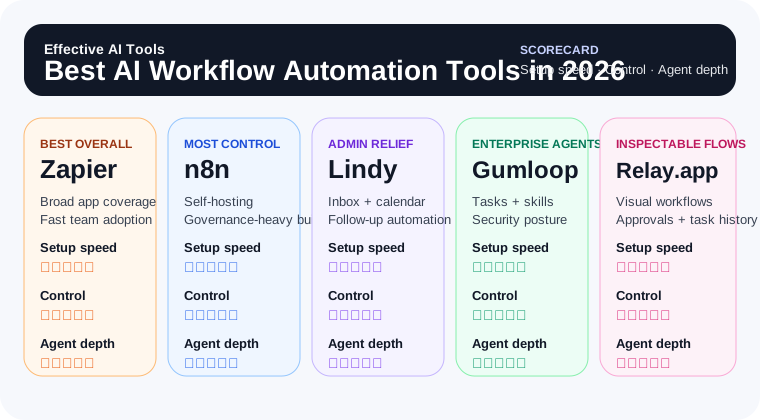
Quick answer: which AI workflow automation tool should you use?
- Use Zapier if you want the easiest overall AI workflow automation tool for common business apps, fast setup, and broad team adoption.
- Use n8n if you need more technical control, self-hosting options, stronger governance, and room to build serious AI workflows without getting boxed in.
- Use Lindy if your automation pain is mostly email, calendar, meeting prep, CRM follow-up, and executive-style admin work.
- Use Gumloop if you want more agent-style automation for GTM, internal teams, and enterprise workflows with security controls that actually matter.
- Use Relay.app if you want custom AI agents that turn plain-English instructions into inspectable workflows your team can review and refine.
For most teams, Zapier is the best default AI workflow automation tool in 2026. For technical teams and heavier governance needs, n8n is the stronger long-term platform. For lean operators and assistants buried in follow-up work, Lindy is the fastest visible time-saver.
Why AI workflow automation tools matter right now
Workflow automation has always been valuable, but old-school automation was brittle. It worked best when every field was clean, every trigger was predictable, and every next step was already fully defined. Real work does not behave like that. Emails are messy. Forms are incomplete. Leads are ambiguous. Tickets need context. Internal requests come in half-formed. That is where AI workflow automation tools are genuinely better than the old rule-only stack.
The split in the market is also clearer now:
- Broad automation platforms help teams connect apps and add AI anywhere in the workflow.
- Agent-style work assistants handle recurring admin and follow-up tasks across a narrower but highly valuable slice of work.
- Governed AI workflow platforms focus on observability, permissions, approvals, and production-grade control.
That is why this is becoming a real buying decision instead of a side feature buried in another SaaS subscription. The same pattern shows up in our AI tools for project managers and AI tools for small business guides too: buyers want AI that removes coordination work, not just another chatbot tab.
| Tool | Best for | What it does best | Link |
|---|---|---|---|
| Zapier | Fast, broad business automation | Connects a huge app ecosystem and lets teams add AI inside familiar workflows without much setup friction | → Visit Zapier |
| n8n | Technical teams that want control | Flexible AI workflows with self-hosting, governance, custom APIs, and fewer platform limits | → Visit n8n |
| Lindy | Inbox, calendar, and follow-up automation | Exec-assistant-style task handling across email, meetings, scheduling, and CRM actions | → Visit Lindy |
| Gumloop | Agentic team workflows with enterprise controls | Specialized agents, scheduled or trigger-based tasks, and stronger security posture for serious org use | → Visit Gumloop |
| Relay.app | Inspectable custom AI agents | Turns plain-English skill teaching into explicit workflows with approvals, task history, and app-level control | → Visit Relay.app |
Zapier — Best overall for the widest range of AI workflow automations
Website: zapier.com/ai
Zapier gets the top spot because it is still the easiest answer for the most common automation buyer. Most teams do not need the most exotic agent architecture first. They need automations that actually get built, actually connect to the apps they already use, and actually survive handoff from the person who made the workflow to everyone else who has to live with it.
That is where Zapier stays strong. Its current positioning is broader than classic Zaps now: AI inside workflows, agents, chatbots, and orchestration across a huge app surface. That matters because a lot of teams are not buying “AI agents” in the abstract. They are buying relief from lead routing, inbox triage, CRM updates, approvals, support tagging, and all the low-value switching between tabs.
Zapier is best for:
- Teams that want the fastest path from idea to working automation
- Businesses with lots of common SaaS tools and not much patience for engineering-heavy setup
- Operators who want AI steps added inside existing workflows instead of rebuilding everything around agents
- Companies that need broad app coverage first and deeper customization second
Where Zapier falls short: once workflows become very branch-heavy, deeply technical, or governance-sensitive, you can start to feel the limits. It is great at practical automation, but it is not always the best home for teams that want more infrastructure-level control.
Bottom line: Zapier is the best AI workflow automation tool in 2026 for most businesses because it balances app coverage, AI features, and real-world adoption better than anything else here.
n8n — Best for technical teams that want control, self-hosting, and AI governance
Website: n8n.io
n8n is the control pick. If Zapier is the easiest broad default, n8n is what you look at when you already know your workflow stack will not stay simple. Its pitch is strong for teams that care about architectural flexibility, custom APIs, self-hosting, Git-friendly workflows, and governance that does not disappear once AI gets involved.
The AI angle matters here because a lot of companies want more than a demo-friendly no-code layer. They want workflows that can survive production use, internal review, and eventual sprawl. n8n’s current product messaging is unusually direct about that: observability, audit logs, workflow history, guardrails, human-in-the-loop controls, and deployment flexibility. That is what serious buyers should be asking about.
n8n is best for:
- Technical operations teams, RevOps teams, and internal platform owners
- Businesses that want self-hosting or tighter control over data and credentials
- Teams building heavier AI workflows that need custom logic and API flexibility
- Organizations that care about governance instead of just “look, an agent did a thing”
Where n8n falls short: it is not the lightest-weight option for non-technical teams, and it expects more ownership. If nobody can actually maintain the workflows after setup, the theoretical flexibility becomes a liability.
Bottom line: n8n is the best AI workflow automation platform here for technical teams that want long-term control instead of convenience-first limitations.
Lindy — Best for automating inbox, calendar, meetings, and follow-up work
Website: lindy.ai
Lindy is the most assistant-shaped product on this list, and that is exactly why it belongs here. A lot of workflow automation demand in 2026 is not about giant cross-system process maps. It is about the admin layer that quietly wrecks a workday: scheduling, email triage, meeting prep, CRM updates, sending files, and remembering context across tools.
Lindy is appealing because it frames that work the way busy professionals experience it. It searches across tools, acts on requests, texts you useful context, and handles the kind of follow-up work people usually delegate to themselves and then forget. That is closer to the day-to-day pain of founders, operators, assistants, sales leaders, and client-facing professionals than many “automation platform” demos admit.
Lindy is best for:
- Executive-assistant-style workflows around email, meetings, and scheduling
- Busy professionals who want time back without becoming workflow designers
- Teams that want a more proactive agent feel than a traditional automation builder
- CRM updates, meeting prep, follow-up handling, and inbox coordination
Where Lindy falls short: it is less of a general-purpose automation substrate than Zapier or n8n. If your real need is broad systems orchestration across many departments, Lindy is usually a layer in the stack, not the whole stack.
Bottom line: Lindy is one of the best AI workflow automation tools in 2026 if the workflow you need to automate looks a lot like executive, founder, or operator busywork.
Gumloop — Best for agent-style team workflows with stronger enterprise posture
Website: gumloop.com
Gumloop stands out because it is unapologetically building for the “AI agents inside the company” future instead of pretending workflows stop at a single trigger. The current product story is clear: specialized agents, scheduled or trigger-based tasks, enterprise controls, role-based access, private cloud options, audit logging, and spend or model restrictions. That is much closer to how serious organizations evaluate AI automation now.
The March 2026 signals make it even more interesting. Agent Tasks pushes agents into real scheduled and event-based work, while Skills for Agents gives those agents reusable task-specific knowledge and tools. That combination matters because the difference between a flashy agent and a useful one is usually whether it can reliably do the same job more than once without re-explaining everything every time.
Gumloop is best for:
- GTM teams, operations teams, and internal platform teams experimenting beyond simple automation
- Organizations that want AI agents with more structure than consumer assistant products provide
- Businesses that care about role controls, auditability, and deployment choices
- Teams that want agents to run on schedules or external triggers instead of waiting for manual prompting
Where Gumloop falls short: it is not the simplest first automation buy for every small team. If your process maturity is low, agent-style systems can expose that chaos faster than they solve it.
Bottom line: Gumloop is the strongest pick here when you want AI workflow automation to look more like agentic team infrastructure than a handful of smart helper actions.
Relay.app — Best for teams that want inspectable AI agents instead of opaque magic
Website: relay.app
Relay.app earns a place because it addresses one of the biggest real objections in this category: trust. A lot of buyers like the idea of AI automation until the moment they realize they cannot really see what the system will do, what data it can touch, or where human review fits. Relay.app’s pitch is unusually healthy on that point. You teach a skill in plain English, it becomes a visual workflow you can inspect, and task history makes it reviewable after the fact.
That is a strong fit for lean teams that want agent-style power without surrendering visibility. Relay also leans into app-level permissions and human-in-the-loop approval for higher-stakes steps, which makes it easier to recommend than “just trust the agent” products.
Relay.app is best for:
- Teams that want custom AI agents but still need inspectable workflow logic
- Businesses that care about approvals, review steps, and task history
- Operators who want plain-English setup with the option to manually refine the flow
- Cross-tool workflows in Gmail, Notion, HubSpot, Google Workspace, and similar apps
Where Relay.app falls short: if you need the broadest app-marketplace gravity and instant familiarity, Zapier still feels like the more default purchase. If you need deep platform-level flexibility, n8n still goes further.
Bottom line: Relay.app is one of the best AI workflow automation tools in 2026 for teams that want agent workflows they can actually inspect, govern, and trust.
What about ChatGPT, browser agents, or classic automation tools?
ChatGPT and Claude are still useful in workflow design. They help draft logic, clean up messy inputs, summarize threads, and handle exceptions. But they are usually not the full workflow automation system by themselves.
Browser agents matter when the workflow depends on websites or portals that do not offer clean APIs. They are useful, but they are a different product job than broad workflow orchestration. And classic no-code automation tools still matter too. The difference now is that buyers increasingly want AI to handle ambiguity, not just hand off perfectly structured fields.
How to pick the right AI workflow automation tool
- You want the easiest broad default for business workflows: Zapier
- You want control, self-hosting, and governance: n8n
- You want inbox, calendar, and follow-up automation first: Lindy
- You want agent-style team workflows with stronger enterprise posture: Gumloop
- You want inspectable custom agents with approvals and workflow visibility: Relay.app
The right question is not “which AI workflow automation tool is smartest?” It is whether your bottleneck is setup speed, control, assistant-style admin relief, agentic team workflows, or inspectable approvals. Buy for that bottleneck and the category gets much easier.
What not to do with AI workflow automation tools
- Do not automate a broken process just because the AI demo looked smooth.
- Do not ignore permissions, audit logs, and approval paths if the workflows touch customers, money, or sensitive internal data.
- Do not buy an agent platform when your real need is one simple cross-app automation.
- Do not buy a convenience-first tool if your real need is control and long-term maintainability.
- Do not assume “AI workflow automation” means full autonomy. Most good systems still work best with scoped access and selective review.
Verdict
Zapier is the best AI workflow automation tool in 2026 for most teams. It is the clearest mix of app breadth, usable AI, and practical adoption.
n8n is the best control-first platform. Lindy is the best assistant-shaped workflow automation buy. Gumloop is the most interesting agentic team-workflow platform here. Relay.app is the cleanest answer if you want AI agents that stay inspectable.
The real buyer decision is not about which vendor says “agent” the loudest. It is about whether you need ease, control, admin relief, governed agents, or inspectable workflows. Pick for that, and you are much less likely to end up with expensive automation theater.