Best AI writing tools compared is a useful search in 2026 because the category has split into very different products. Some tools are really drafting assistants. Some are inline editors. Some are research helpers. Some are expensive marketing platforms pretending to be for everyone.
If you want the short answer: ChatGPT is still the best all-purpose AI writing tool for most people. Claude is the best upgrade for nuanced long-form writing and careful rewrites. Grammarly is the best tool for polishing writing that already exists. And if you do SEO-heavy content at scale, tools like Jasper make more sense for teams than for solo users.
This guide focuses on practical fit, not hype. If you only care about no-cost options, start with our free AI writing tools guide. If you are deciding between two specific tools, our Grammarly vs ChatGPT comparison and ChatGPT vs Claude guide go deeper.
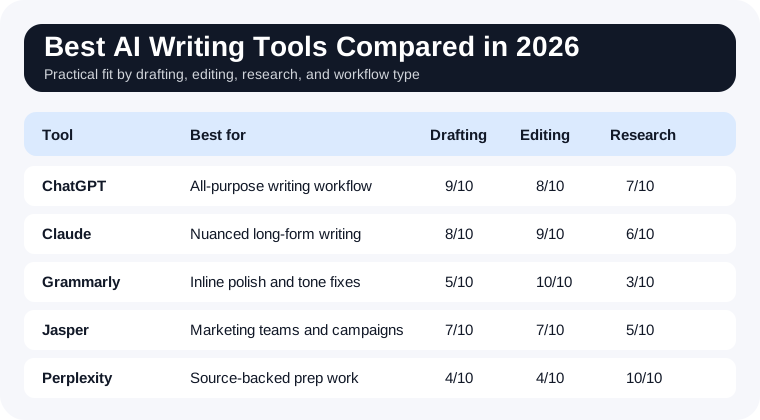
The best AI writing tools at a glance
- Best overall: ChatGPT
- Best for long-form writing and thoughtful rewrites: Claude
- Best for grammar, tone, and final polish: Grammarly
- Best for marketing teams and repeatable content workflows: Jasper
- Best for research-backed writing: Perplexity
1. ChatGPT: best overall for most people
ChatGPT is still the most complete writing tool for normal users because it handles more of the workflow in one place. OpenAI's current pricing stack pushes projects, tasks, custom GPTs, file uploads, deep research, memory, and broader agent-style features. That matters because writing work is rarely just writing. It is outlining, drafting, rewriting, summarizing notes, extracting points from documents, and turning messy context into a clean output.
Where ChatGPT is strongest:
- first drafts from rough notes
- rewriting for tone, clarity, or audience
- turning transcripts, PDFs, and source material into usable copy
- switching quickly between writing, brainstorming, and analysis
Its biggest weakness is that it can still sound generic if you prompt lazily. But as an all-purpose tool, it is the safest first subscription. If pricing is your main question, read ChatGPT Plus vs Free.
2. Claude: best for thoughtful writing
Claude has become the cleaner recommendation for people who care more about quality than speed. Anthropic's current plans emphasize bigger usage, research, memory, projects, web search, and code execution, but the practical reason writers pick Claude is simpler: it usually does better with long documents, subtle tone, and less robotic phrasing.
Claude is the tool I would reach for when the writing needs judgment, not just output volume. That includes strategy docs, sensitive emails, editorial rewrites, and long-form articles where structure and voice matter.
Claude is especially strong for:
- long-form drafts that need to stay coherent
- high-trust client writing and executive-style edits
- rewriting something without flattening the voice completely
- working through complex material before writing the final draft
If you are mainly choosing between these two platforms, the right next read is our ChatGPT vs Claude comparison.
3. Grammarly: best for polish, not blank pages
Grammarly is better than most people think in 2026, but it is still easy to mis-buy. Grammarly's plans now position the product around live grammar correction, tone help, sentence rewrites, plagiarism checks, AI-text detection, and its Authorship tracking layer. That is real value if your problem is not creating content from scratch, but cleaning up writing inside the apps where you already work.
That is why Grammarly is so good for email, docs, school submissions, and professional communication. It is not the best brainstorming tool. It is the best finishing tool in this group.
Choose Grammarly if you mostly need:
- grammar and readability fixes while typing
- tone adjustment inside your normal workflow
- final cleanup before sending, submitting, or publishing
- transparency features like Authorship in school or workplace settings
If this is the decision you are actively making, see Grammarly vs ChatGPT for Writing.
4. Jasper: best for marketing teams, not most individuals
Jasper still belongs in a best AI writing tools compared list, but it is not the universal pick it used to be. Its current positioning leans hard into marketing workflows, brand governance, content pipelines, SEO and campaign production, and team-scale repeatability. That makes sense for companies that need on-brand output across multiple people and channels.
It makes much less sense if you are a solo user who mostly writes emails, essays, or one-off blog drafts. For that job, ChatGPT or Claude usually give you more flexibility for less money and less platform overhead.
Jasper makes sense when you need:
- repeatable content operations for a team
- brand voice controls and marketing workflow structure
- campaign production across multiple channels
- more process than open-ended chat
So yes, Jasper is still a strong AI writing tool. It is just not the best default anymore unless the use case is clearly marketing-led.
5. Perplexity: best support tool for research-backed writing
Perplexity is not the best pure writing tool here, but it belongs on the shortlist because it solves a different bottleneck: finding current information with sources. That makes it extremely useful for blog posts, client work, industry research, and any writing where being current matters more than being eloquent on the first pass.
The smartest workflow is often to use Perplexity for source gathering, then move into ChatGPT or Claude for drafting. That division of labor is why it keeps showing up in our research and workflow coverage, including Perplexity vs ChatGPT for research.
Use Perplexity when you need:
- fast market or product research before drafting
- source-linked summaries you can verify
- current facts instead of pure model memory
- a research layer to pair with another writing tool
Which AI writing tool is best for your use case?
For students: ChatGPT for explanation and outlining, Grammarly for final polish, Claude if you care about better long-form quality.
For office workers: Grammarly if most of your pain is email and docs, ChatGPT if you regularly draft from scratch.
For marketers and content teams: Jasper if brand workflow and repeatability matter, ChatGPT or Claude if you want more flexible drafting and ideation.
For freelancers and consultants: ChatGPT first, Claude second, and Grammarly only if final polish is a recurring pain point. Our best AI tools for freelancers guide goes deeper on that stack.
For research-heavy writers: Perplexity plus ChatGPT or Claude is usually better than trying to make one tool do everything.
The real buying advice
Most people do not need five AI writing subscriptions. They need one main tool and maybe one specialist layer.
- Pick ChatGPT if you want the safest all-purpose answer.
- Pick Claude if writing quality and nuance matter more than ecosystem breadth.
- Pick Grammarly if your drafts already exist and you mostly need cleanup.
- Pick Jasper if you are buying for a marketing workflow, not a single person.
- Add Perplexity if research accuracy keeps slowing you down.
That is the simplest honest answer. The best AI writing tool in 2026 is not one universal winner. It is the tool that matches the stage of writing where you keep losing time.