Gemini vs ChatGPT for daily use is a better question than "which AI is smartest?" Most people are not benchmarking models all day. They want one tool that helps with email, search, writing, file uploads, random questions, and whatever annoying task showed up in the last ten minutes.
Right now, both are good enough to become a daily habit. But they feel different in actual use. Gemini feels strongest when your life already runs through Google products. ChatGPT feels stronger when you want a more polished all-purpose assistant that can write, reason, and stay with you across longer tasks.
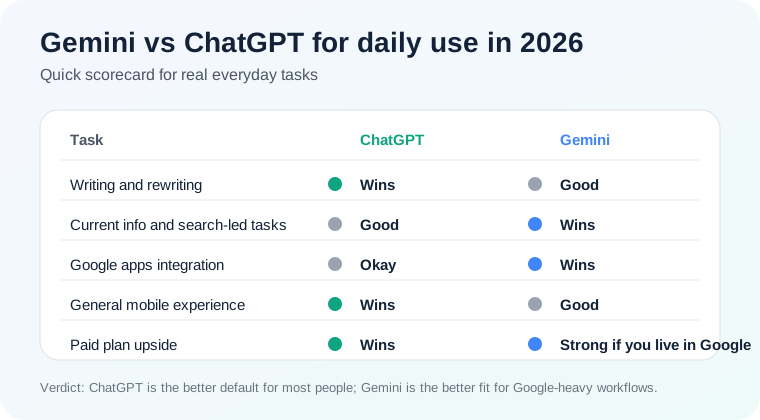
The short version: ChatGPT is the better daily default for most people. Gemini is the better daily default for people deep in Gmail, Docs, Drive, Android, and Google Search.
What "daily use" actually means
For this comparison, daily use means the stuff people do repeatedly:
- Ask quick factual questions
- Draft or rewrite emails and messages
- Summarize docs, notes, and PDFs
- Use voice on mobile
- Get help inside existing apps
- Pay for one plan and try to get real value from it
That matters because a model can be impressive in a benchmark and still be annoying to live with. Daily utility is mostly about workflow friction.
Where ChatGPT feels better day to day
ChatGPT still has the better overall product feel. The interface is cleaner, the conversations usually feel more natural, and it does a better job carrying context through longer threads. If you open one AI app 20 times a day for mixed tasks, that smoothness matters.
OpenAI's current product stack also gives ChatGPT more range for general users. Its official overview highlights web search, file analysis, image understanding, image generation, canvas editing, and agent-style web actions inside one product. On paid plans, the pricing page also leans into projects, tasks, custom GPTs, deeper memory, and broader tool access.
That turns into a practical advantage fast:
- Writing and rewriting: ChatGPT usually produces cleaner first drafts.
- Longer problem-solving: it stays coherent better once a task becomes multi-step.
- Mixed-media work: uploading files, asking questions, then turning the result into a table, summary, or plan is straightforward.
- Power-user upside: if you later want custom workflows, custom GPTs and projects give you room to grow.
If your AI usage looks like "a little bit of everything," ChatGPT is the safer pick. That's also why it still beats Gemini for many of the same people who'd otherwise consider the Google route, similar to how it beat Claude for broad consumer use in our ChatGPT vs Claude 2026 comparison.
Where Gemini feels better day to day
Gemini's core advantage is obvious and real: Google distribution. It lives closer to the products millions of people already use every day.
Google's own Gemini overview positions it as a multimodal assistant for productivity, creativity, and curiosity. The subscriptions page makes the bigger daily-use argument more directly: Gemini can sit across Gmail, Docs, Chrome, Search, NotebookLM, Android, and the wider Google account stack.
That means Gemini often wins when the job is tied to your Google environment:
- Gmail and Docs users: Gemini makes more sense when your writing starts and ends inside Google apps.
- Google Search-heavy users: it feels more native when the task is "help me find, compare, and explain this current thing."
- Android-first users: Gemini is easier to justify if your phone is already your main computer.
- NotebookLM users: if you're already using Google's research stack, Gemini sits next to a genuinely useful companion tool.
In other words, Gemini is not just competing as a chatbot. It's competing as a layer across Google's ecosystem. For some people, that's more valuable than having the slightly better standalone assistant.
Gemini vs ChatGPT for daily use: real scenarios
Scenario 1: You want help writing difficult emails.
ChatGPT wins. It tends to produce stronger tone control and cleaner drafts with less prompting. If email is a major pain point for you, start with our ChatGPT email prompts guide.
Scenario 2: You live in Gmail, Docs, and Drive all day.
Gemini wins. This is the exact use case where Google integration stops being marketing copy and becomes a workflow advantage.
Scenario 3: You want one AI assistant on your phone.
Slight edge to ChatGPT on experience, slight edge to Gemini on ecosystem fit. If you want the smoothest general mobile app, use ChatGPT. If you use Android and Google services for everything, Gemini may feel more convenient.
Scenario 4: You ask lots of current-event or current-product questions.
Gemini gets the nod. ChatGPT's search is useful, but Gemini feels more naturally connected to the live Google information layer.
Scenario 5: You want one paid subscription that does the most.
ChatGPT wins for most people. Its paid tiers open up a broader ceiling for analysis, creation, memory, projects, and advanced tooling.
Free plan vs paid plan value
This part matters because both tools are now good enough on the free tier that many people delay paying.
ChatGPT free is fine for casual use, but OpenAI's pricing page is blunt about the tradeoffs: limited messages, uploads, deep research, memory, and slower image generation. Paid ChatGPT makes sense once you rely on it for work.
Gemini free is also strong, and Google's subscriptions page makes it feel slightly more generous in everyday productivity framing: access to Gemini app features, Deep Research, Canvas, Gems, and limited higher-tier model access. Where Google's paid plans get more interesting is the bundle effect: more model access plus Search, Chrome, storage, NotebookLM, and Gemini inside Google apps.
Bottom line on value:
- If you want the highest upside from one AI subscription, ChatGPT Plus/Pro is easier to justify.
- If you already pay for and live inside Google's ecosystem, Gemini's paid plans can feel like the more natural bundle.
The biggest difference is not the model
Most comparison articles obsess over which model is slightly smarter. That's not the main thing that decides whether you'll keep using it.
The real deciding factor is where the assistant shows up when you're already doing work.
ChatGPT wins when you want an AI destination: open app, drop in problem, get useful output, keep going.
Gemini wins when you want an AI layer inside an existing Google workflow: reading Gmail, drafting in Docs, asking follow-up questions in Search, using Chrome, or moving through an Android-first day.
That's why the answer isn't universal. It's workflow-specific.
Our verdict
If you're asking which AI assistant should be your daily default in 2026, the answer for most people is still ChatGPT.
It feels more complete, more polished, and more flexible across a wider range of tasks. It is the safer recommendation for freelancers, knowledge workers, students, and anyone who wants one assistant for writing, thinking, summarizing, and everyday problem-solving.
But if your digital life is basically Google end to end — Gmail, Docs, Drive, Chrome, Search, Android — then Gemini is the smarter fit. Not because it's universally better, but because convenience compounds. A slightly worse tool that shows up exactly where you need it can beat a slightly better one you have to consciously switch into.
Simple recommendation:
- Choose ChatGPT if you want the best all-purpose AI assistant.
- Choose Gemini if Google Workspace and Android are already your home base.
- Use both if you do current-info work in Google and heavier writing/planning in ChatGPT.
For most readers, that third option is the honest power-user answer. But if you only want one, ChatGPT is still the one we'd stand behind for broad daily use.