Grammarly vs ChatGPT for writing is a real decision in 2026 because both tools now promise more than basic assistance. Grammarly is no longer just a spellchecker, and ChatGPT is no longer just a chatbot. Grammarly now pushes AI rewriting, tone adjustment, multilingual help, and Authorship tracking. ChatGPT pushes drafting, editing, canvas-based revision, file analysis, research, and broader project workflows.
But the practical answer is still pretty clean: Grammarly is better when you already have words and want them cleaner, safer, and more polished across the apps you use every day. ChatGPT is better when you need help creating, reshaping, or figuring out what to say in the first place.
If you write for work or school, the best choice depends less on model quality and more on the stage of writing where you get stuck.
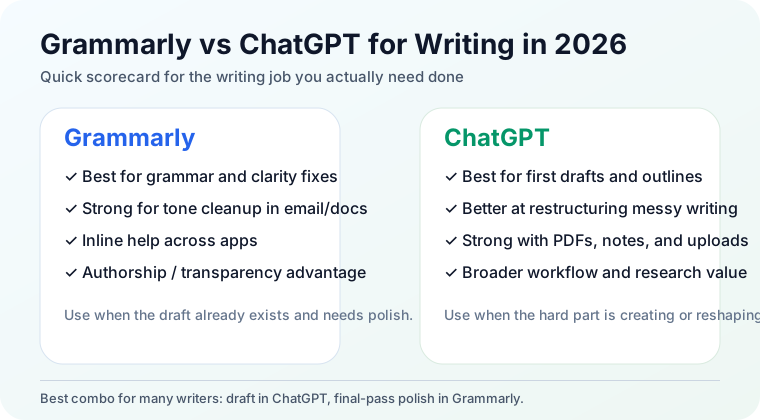
The short version
- Choose Grammarly if your main problem is grammar, clarity, tone, and polish inside email, docs, browsers, and office apps.
- Choose ChatGPT if your main problem is blank-page drafting, restructuring, brainstorming, summarizing, or turning rough notes into usable writing.
- Use both if you regularly create first drafts with AI and then need final cleanup before sending or submitting.
That combined workflow is becoming common for a reason. It maps well to how people actually write.
Where Grammarly is better
Grammarly still wins when writing is already happening and you want intelligent help inline rather than a separate conversation. Its core strength is that it sits on top of existing work: email, docs, browsers, forms, and office apps. That means less copy-paste friction.
Its current Pro plan also bundles more than grammar correction. Grammarly now pushes full-sentence rewrites, tone adjustment, plagiarism checks, AI text detection, and a larger monthly AI prompt allowance than the free plan. For a lot of professionals, that means one tool can cover proofreading, cleanup, and basic rewriting without changing the rest of their workflow.
Grammarly also has one genuinely fresh angle in 2026: Authorship. That feature tracks whether text was typed by a human, generated with AI, or pasted from elsewhere, and it can produce a shareable report. For students, instructors, and teams worried about provenance, that is a different kind of value than pure writing quality.
Grammarly is the stronger pick if you mostly need:
- live grammar and clarity fixes while typing
- tone softening for emails and client communication
- quick sentence rewrites without leaving the app
- writing transparency or originality reporting in school and professional settings
Where ChatGPT is better
ChatGPT is better when writing is still messy. OpenAI's current product messaging leans into canvas editing, uploads, web search, data analysis, projects, tasks, and agent-style help. That sounds broad because it is broad. ChatGPT is not just an editor. It is a writing partner, research layer, and restructuring engine.
That matters when the real bottleneck is not correctness but direction. If you have a fuzzy brief, rough notes, a transcript, a competitor page, or a PDF full of source material, ChatGPT is usually better at turning that mess into an outline, draft, or decision. It is also stronger when the job requires multiple passes: outline first, draft second, tighten third, convert to another tone fourth.
This is why ChatGPT keeps showing up across our broader writing and workflow coverage, including the best free AI writing tools guide, our ChatGPT email prompts article, and the save 2 hours per day workflow guide.
ChatGPT is the stronger pick if you need:
- first drafts from scratch
- outlines, rewrites, and structural edits
- summaries of notes, PDFs, or research
- back-and-forth collaboration on what the piece should even say
Grammarly vs ChatGPT for specific writing jobs
Email and everyday work writing
Slight edge to Grammarly if you already know what you want to say and just need it to sound cleaner, calmer, or more professional inside your normal workflow. Edge to ChatGPT if the hard part is drafting the message or figuring out tone for a sensitive situation. If email is your main use case, compare this with how to use ChatGPT to write better emails.
Essays, papers, and school writing
Edge depends on the rule set. ChatGPT is better for explanation, outlining, study help, and rough drafting. Grammarly becomes more attractive when the user needs citation help, polish, and transparent process tracking through Authorship. For schools that care about showing work, Grammarly has a unique advantage here.
Marketing copy and content drafts
Clear edge to ChatGPT. It is stronger for hooks, alternative angles, landing page sections, ad variations, and turning a rough offer into multiple versions. Grammarly can improve the final copy, but it is not the better ideation tool.
Final polish before sending
Clear edge to Grammarly. Once the content already exists, Grammarly is faster and lower-friction for catching awkward phrasing, grammar slips, and tone issues in the places people already write.
Long document revision
Slight edge to ChatGPT, especially when the revision is structural rather than sentence-level. If the question is “make this argument tighter” or “turn these notes into a clearer proposal,” ChatGPT is usually more helpful than Grammarly.
Pricing and value
Pricing reinforces the product split.
Grammarly's public plans page positions Free at $0 with basic writing help and 100 AI prompts per month, and Pro at about $12/month with sentence rewrites, tone adjustment, plagiarism and AI detection, and 2,000 AI prompts per month. That feels like an editor-plus-polish subscription.
ChatGPT's public pricing page positions Free as limited access and then layers in paid plans around stronger models, more uploads, more memory, projects, tasks, custom GPTs, deep research, and agent features. That feels like a broader work platform, not just a writing assistant. If you are deciding whether the upgrade is worth it, our ChatGPT Plus vs Free comparison is the cleaner next read.
So the better value depends on what you are buying:
- Buy Grammarly if you want lower-friction polish in the apps where you already write.
- Buy ChatGPT if you want a broader assistant that happens to be very strong at writing.
- Pay for both only if writing is a serious part of your work and you will use each tool for different stages.
The real difference: inline editor vs writing partner
The easiest way to think about it is this:
- Grammarly is an inline editor with expanding AI features.
- ChatGPT is a writing partner with expanding workflow features.
That is why a lot of comparison takes keep missing each other. People compare them as if they are trying to replace one another completely. Usually they are not. Grammarly helps most after words exist. ChatGPT helps most before the words are good.
Our verdict
If you want one answer: ChatGPT is the better standalone writing tool for most people because it can generate, restructure, and improve writing across a wider range of tasks.
But if your real need is tighter grammar, better tone, lower-friction polish, and help directly inside the places you already write, Grammarly is still the better specialist tool.
Simple recommendation:
- Students: ChatGPT for outlining and understanding, Grammarly for final polish and Authorship if transparency matters.
- Office workers: Grammarly if your writing is mostly email and docs, ChatGPT if you draft a lot from scratch.
- Marketers, consultants, freelancers, creators: ChatGPT first, then Grammarly if you need a cleaner finish.
The best real-world setup is often not either-or. It is ChatGPT to make the draft useful, then Grammarly to make it sendable.