The best AI expense management software in 2026 is not just a receipt scanner with a chatbot pasted on top. The useful platforms capture expenses at the moment of spend, enforce policy before finance starts chasing people, auto-code transactions, handle out-of-pocket reimbursements, and sync the whole mess back to accounting without turning month-end into a cleanup project.
This category is getting more interesting because the products are finally moving beyond basic OCR. Ramp is pushing controller-style agents and AI-led policy review across spend, AP, and procurement. Brex is packaging AI across budgets, expenses, travel, and accounting automation, including its January 2026 AI-native accounting API push. Navan launched Expense Chat in March 2026 to make out-of-pocket filing conversational instead of form-based. Mesh is now explicitly wrapping AI agents around receipt chasing and policy enforcement. Expensify still wins on simple receipt-first automation with SmartScan and Concierge-style guidance.
If your expense workflow is really part of a broader purchasing problem, read our guide to the best AI procurement software. If approvals are breaking across more than just finance, the best AI workflow automation tools guide is the better adjacent read. And if you are still standardizing which general-purpose assistant your team uses around finance writing and analysis, start with ChatGPT vs Claude in 2026.
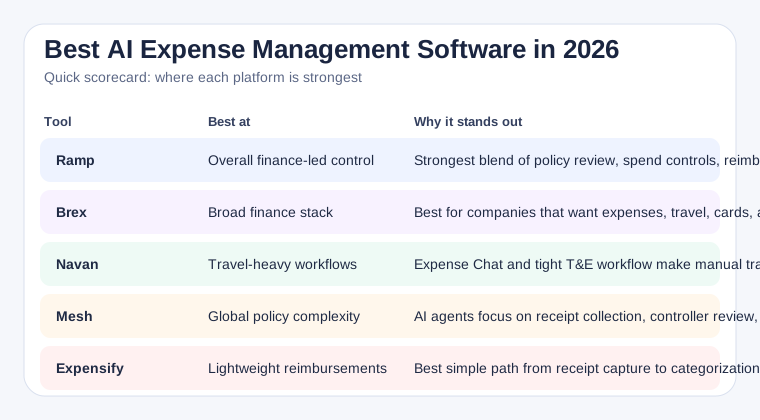
Quick answer: which AI expense management software should you use?
- Use Ramp if you want the best overall AI expense management software for policy control, card spend, reimbursements, and broader finance automation.
- Use Brex if you want a strong all-in-one finance stack for fast-growing or global companies that care about expenses, travel, cards, and accounting together.
- Use Navan if business travel is central and you want AI to make expense reports mostly disappear.
- Use Mesh if you run a more complex global, multi-entity environment and care heavily about policy enforcement and approval control.
- Use Expensify if you want the simplest AI-first receipt and reimbursement workflow without buying a heavier finance platform than you need.
For most teams, Ramp is the best AI expense management software in 2026 because it connects spend controls, auto-capture, policy review, reimbursements, and adjacent finance workflows better than the rest of this field. Navan is the sharpest travel-first choice. Brex is the best fit when expenses are just one layer of a broader finance operating stack.
Why AI expense management software suddenly matters again
Expense management used to be one of the least interesting software categories on earth. Employees saved receipts late, managers approved reports late, finance cleaned everything up even later, and everyone accepted that the process would stay annoying forever.
That is changing because AI is genuinely useful in exactly the places this workflow used to break:
- Receipt capture: extracting merchant, date, amount, and context without manual typing.
- Policy enforcement: catching out-of-policy spend while it still matters, not three weeks later.
- Approval routing: sending the right transaction to the right reviewer without finance playing dispatcher.
- Expense coding: filling GL fields, memo fields, project tags, and categories faster and more consistently.
- Exception handling: asking for missing info conversationally instead of forcing users back into clunky forms.
The current product movement makes that obvious. Ramp is leaning into autonomous controller-style review. Navan's 2026 Expense Chat launch is explicitly about eliminating manual out-of-pocket submissions. Brex keeps framing expense management as one AI-powered layer inside a larger finance system. Mesh is naming agents for employee receipt collection and controller review. Expensify is still focused on turning receipt-heavy admin into something users barely think about.
This is also why you should not evaluate these tools like generic chat assistants. The hard part is not whether the model can summarize a policy. The hard part is whether the platform actually owns the spend data, policy logic, approval paths, travel context, and accounting syncs needed to remove work safely. That same system-versus-demo distinction shows up in our AI tools for operations teams guide and our best AI tools for small business roundup too.
| Tool | Best for | What it does best | Link |
|---|---|---|---|
| Ramp | Best overall | Combines AI policy review, card spend controls, reimbursements, AP, and procurement-adjacent workflows in one finance system | → Visit Ramp |
| Brex | Fast-growing and global companies | Connects cards, expenses, travel, budgets, and accounting automation with strong global coverage and AI-assisted controls | → Visit Brex |
| Navan | Travel-heavy teams | Best for turning travel and out-of-pocket expenses into a touchless or near-touchless workflow | → Visit Navan |
| Mesh | Global multi-entity control | Strong policy enforcement, approval control, and AI agent framing for more complex enterprise spend environments | → Visit Mesh |
| Expensify | Simple expense automation | Keeps receipt capture, categorization, and reimbursements lightweight and easy for smaller teams | → Visit Expensify |
Ramp — Best overall AI expense management software for finance-led control
Website: ramp.com
Ramp gets the top spot because it has the clearest answer to the real buyer question: how do we reduce finance admin without losing control? Its current product story is strong on the parts that actually matter in production — auto-receipt capture, AI-filled categories and memos, policy review across every expense, fast reimbursements, and adjacency to AP and procurement. That broader platform shape matters. A lot of expense software still treats finance like a receipt cleanup team. Ramp is trying to make expense review one part of a larger autonomous finance workflow.
The company's finance-agent messaging also fits the category well. Ramp is explicitly pushing agents that review expenses against policy, escalate exceptions, and reduce manual reviewer time. Even if you ignore the marketing language, the direction is right: fewer humans doing repetitive policy checks, more humans spending time on true judgment calls.
Ramp is best for:
- Finance teams that want strong policy enforcement without slowing employees down
- Companies that want spend, reimbursements, AP, and procurement workflows connected
- Teams that care about auto-approval for low-risk spend and fast escalation for exceptions
- Buyers who want one finance operations system instead of several narrow point tools
Where Ramp falls short: if travel booking is the center of your expense universe, Navan is more purpose-built. And if your business already wants a broader global finance stack around cards, banking, travel, and budgets, Brex may fit more naturally.
Bottom line: Ramp is the best AI expense management software in 2026 for most finance teams because it solves both the employee experience and the controller problem at the same time.
Brex — Best for high-growth companies that want expenses inside a broader finance stack
Website: brex.com
Brex is strongest when you do not want to buy expense management in isolation. Its pitch is broader: cards, business accounts, expenses, travel, bill pay, budgets, and accounting automation, all with AI layered across the stack. That makes Brex especially attractive for fast-growing companies that want one system governing how money moves rather than separate tools stitched together later.
The January 2026 accounting API launch matters here because it pushes Brex beyond a nice employee card experience into a more serious close-and-controls story. The product is also direct about what it wants to automate: expense approvals, receipt capture, coding, and accounting sync. If your finance team cares as much about the month-end downstream work as the front-end employee workflow, Brex looks stronger than a simpler receipt app.
Brex is best for:
- Growth-stage and enterprise teams that want expenses integrated with the rest of finance
- Companies operating across many countries that need global cards and policy control
- Finance leaders who want spend visibility, budgets, travel, and accounting tied together
- Teams trying to eliminate manual accounting handoffs as much as manual expense reports
Where Brex falls short: it can be more platform than a smaller company needs if the real problem is just reimbursements and receipts. Travel-first organizations may still prefer Navan's deeper T&E experience, and some finance teams will find Ramp's expense-policy story a little more focused.
Bottom line: Brex is one of the best AI expense management software options in 2026 when you want expense automation as part of a bigger, AI-assisted finance operating system.
Navan — Best for travel and expense teams that want manual reports to disappear
Website: navan.com
Navan wins the travel-heavy lane because it understands a simple truth: a lot of expense pain is really travel pain wearing a finance badge. Flights, hotels, mileage, cash expenses, split personal charges, and last-minute changes create the ugliest edge cases in the whole category. Navan's March 2026 Expense Chat launch is one of the clearest fresh signals in this market because it targets exactly that problem — letting users drop receipts into a conversation, add context in plain language, and submit without wrestling a traditional expense form.
That matters because most vendors claim AI can "simplify expense reporting." Navan showed a more concrete product move: an agent meant to eliminate manual out-of-pocket submissions, not just summarize them after the fact. If your company spends heavily on travel, that is a real buying difference.
Navan is best for:
- Companies with meaningful business travel volume
- Finance teams tired of cleaning up travel edge cases after the trip is over
- Organizations that want travel booking, corporate card spend, and expense reconciliation in one place
- Buyers who care about reducing traveler admin, not just finance admin
Where Navan falls short: if your expense volume is not travel-driven, its travel DNA matters less. Teams focused on broader finance automation, AP, and spend controls may get more value from Ramp or Brex.
Bottom line: Navan is the best AI expense management software in 2026 for travel-heavy organizations that want AI to remove the ugliest parts of T&E administration.
Mesh — Best for global enterprises that need stronger policy and approval control
Website: meshpayments.com
Mesh earns a place here because it is unusually explicit about AI as an operational layer for finance control, not just employee convenience. Its current AI messaging revolves around named agents: one focused on collecting receipts and organizing employee-side expense details, another focused on controller-side review, policy checks, and anomaly escalation. That is a useful framing for companies where the hard part is not getting employees to upload a receipt once in a while. The hard part is keeping a global, multi-entity spend environment inside policy without creating endless finance overhead.
Mesh also looks stronger when spend management spans more than card swipes. Travel, reimbursements, accounting automation, procure-to-pay, and global control all show up in the platform story. If you have a more complex approval environment or multiple entities with different rules, that matters.
Mesh is best for:
- Global or multi-entity organizations with more complex policy structures
- Finance teams that want AI embedded directly into approval and audit workflows
- Companies that care about proactive receipt collection and anomaly escalation
- Buyers who want spend, travel, and finance controls tied together
Where Mesh falls short: smaller companies may find it heavier than they need. If your priority is the cleanest employee expense experience with fewer enterprise layers, Expensify or Navan may feel simpler. If you want the strongest all-around mainstream buyer pick, Ramp still has the sharper overall story.
Bottom line: Mesh is one of the best AI expense management software choices in 2026 for companies that care most about policy rigor, approvals, and global finance control.
Expensify — Best for simple AI expense automation without enterprise sprawl
Website: expensify.com
Expensify stays relevant because not every buyer needs a full finance operating system. Plenty of teams just want expense reporting to stop being annoying. That is still Expensify's best lane. SmartScan remains one of the clearest receipt-first workflows in the category, and the company's AI positioning around Concierge is directionally right: capture the receipt, categorize it, guide the user, and keep the reimbursement process moving with minimal friction.
That makes Expensify especially useful for smaller businesses, simpler organizations, and teams that want adoption fast. There is real value in software employees will use without training or a six-week implementation project. Buyers sometimes overcomplicate this category. If your actual pain is receipts, reimbursements, and basic approval flow, the right answer may be a lighter tool that does those things cleanly.
Expensify is best for:
- Small and midsize teams that want simple AI expense automation
- Organizations with lots of receipts and reimbursements but less platform complexity
- Finance teams optimizing for employee adoption and straightforward workflows
- Buyers who do not need heavy travel, AP, or procurement orchestration
Where Expensify falls short: it is not the deepest answer for large global policy environments, broader finance automation, or procurement-adjacent control. Teams with more complexity will usually outgrow it before they outgrow Ramp, Brex, or Mesh.
Bottom line: Expensify is the best AI expense management software here for teams that want the simplest path from receipt to reimbursement without enterprise-platform overhead.
How to choose the right AI expense management software
Do not buy this category based on who gives the slickest receipt-scanning demo. Buy it based on where your actual workflow breaks:
- If policy enforcement and finance control are the problem, start with Ramp or Mesh.
- If you want expenses inside a broader finance platform, compare Ramp and Brex first.
- If travel drives the mess, shortlist Navan immediately.
- If you mostly need a simpler reimbursement and receipt workflow, Expensify is still worth serious consideration.
- If month-end accounting cleanup is your real pain, pay extra attention to how Brex and Ramp handle coding, ERP sync, and downstream automation.
Also ask a boring but important question: what happens on exceptions? Anyone can show a clean coffee receipt in a demo. The real test is split charges, missing receipts, policy overrides, mileage, travel changes, project coding, and multi-entity approvals. If the vendor gets fuzzy there, the AI is probably more cosmetic than operational.
Bottom line
Ramp is the best AI expense management software in 2026 for most finance teams because it has the clearest blend of employee usability, policy enforcement, and broader finance automation. Brex is the strongest broad finance-stack alternative. Navan wins when travel is the center of the problem. Mesh is the better fit for global policy-heavy environments. Expensify stays useful when simple beats sprawling.
If I were buying in this category today, I would not start by asking which tool has the smartest AI branding. I would start by deciding whether the real bottleneck is policy, travel, accounting cleanup, or employee friction. That one answer usually narrows the field fast.